
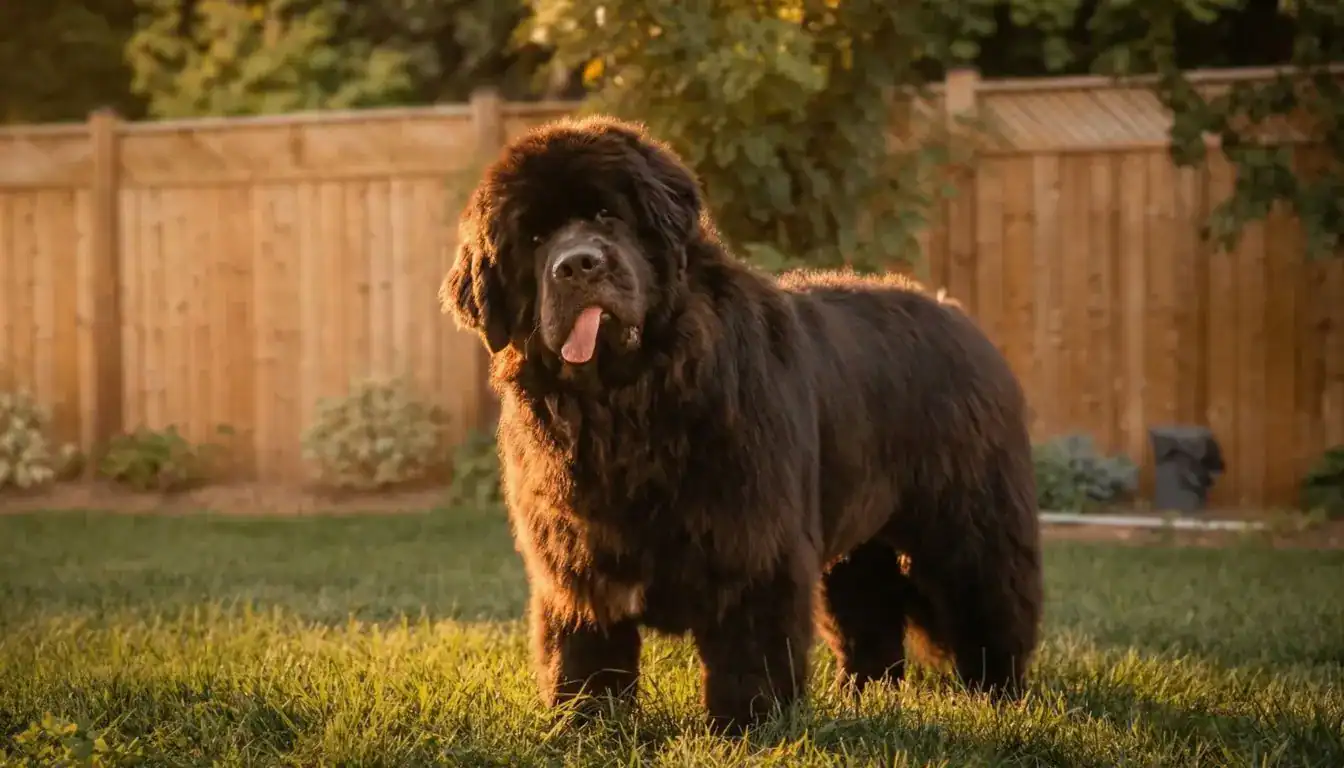
Picture a canine lifeguard with the sheer mass of a black bear and the disposition of a patient kindergarten teacher. The Newfoundland dog is widely regarded as one of the sweetest large breeds on earth, but their monumental build brings equally monumental care requirements.
If you are not prepared for constant saliva and heavy grooming, their loyalty alone will not make ownership easy. For the right household, however, these quirky traits are part of the charm rather than a drawback, revealing one of the most dependable companions you can share a home with.
These water-loving Canadian helpers were developed to haul heavy fishing nets in freezing Atlantic waves. The Newfoundland dog’s origin means they possess immense strength wrapped in a thick, water-resistant double coat designed for cold maritime conditions.
This guide combines practical ownership experience with AKC standards, OFA CHIC screening protocols, and Newfoundland Club of America guidelines.
Affiliate Disclosure: K9Sphere is a participant in the Amazon Services LLC Associates Program. As an Amazon Associate, K9Sphere earns from qualifying purchases made through links in this article at no extra cost to you.
Breed Snapshot
📊 Vitals and Lifespan
Height
Males: 27-29 in (69-74 cm)
Females: 25-27 in (63-69 cm)
Weight
Males: 130-150 lb (59-68 kg)
Females: 100-120 lb (45-54 kg)
Lifespan
9-11 years
AKC Group
Working Group
Origin
Canada
🇨🇦
⭐ Personality Traits
Ratings (1 to 5). A massive retriever that combines profound patience with an undeniable mess factor. Their suitability is highest for spacious homes in moderate to cold climates.
History and Origin
The Newfoundland dog traces its origin to the rugged island of Newfoundland off Canada’s Atlantic coast, where European fishermen and indigenous peoples shaped a powerful working animal over several centuries. Unlike most modern companion dogs, the Newfoundland was never a luxury. It was a blue-collar draft animal that earned its keep hauling nets, pulling carts of fish to market, and rescuing drowning sailors from freezing North Atlantic swells.
📌 1600s-1700s: Working the Atlantic Coast
European settlers arriving on the island of Newfoundland found large, powerful dogs already living alongside indigenous communities. These dogs interbred with mastiff-type and retrieving breeds brought by Portuguese, English, and Irish fishermen. The result was a massive, web-footed animal with a dense, oily double coat that could withstand hours in freezing seawater while hauling heavy nets and pulling loaded carts to coastal market towns.
📌 1800s: The Lifesaving Reputation
The Newfoundland’s instinct to swim toward struggling humans became legendary. Documented rescues include a Newfoundland saving survivors from the shipwreck of the SS Ethie in 1919 by swimming a towline through crashing surf to shore. This lifesaving drive is not trained behavior. It is a deeply embedded genetic instinct that remains fully intact in modern dogs, which is why water rescue organizations across Europe still deploy them today.
📌 1886: AKC Recognition
The American Kennel Club officially recognized the Newfoundland and placed it in the Working Group. By this point, the dog had already established a loyal following among English aristocracy. Lord Byron famously owned a Newfoundland named Boatswain and composed a well-known epitaph upon the dog’s death.
📌 1920s-Present: Near Extinction and Revival
Population numbers plummeted in their native Canada during the 1920s due to strict dog ownership restrictions and economic depression. Dedicated enthusiasts rebuilt the population using stock that had been exported to England decades earlier. Today the Newfoundland Club of America maintains strict cardiac and orthopedic screening standards for all registered dogs used in reproduction.
Today, they are primarily kept as devoted household companions. However, their physical adaptations for sub-freezing conditions remain fully intact in every litter. A closely related dog in terms of build and disposition is the Saint Bernard, another massive working animal that shares the Newfoundland’s gentle nature but was developed for alpine rather than maritime rescue.
Physical Characteristics
This is a dog built for power and buoyancy. A mature male typically peaks at 150 pounds, with massive, heavy bone structure supporting a broad, deep chest. Their body language is calm and deliberate, giving them an almost stately presence.
🐾 Webbed Feet
Their toes are heavily webbed, functioning like biological flippers. Combined with their distinctive, powerful “breaststroke” swimming style rather than a standard dog paddle, this allows them to move quickly and efficiently through turbulent conditions while towing immense weight. Each foot is designed for propulsion rather than speed on land.
💧 The Saliva Factor
They possess prominent, loose jowls (flews) designed to allow them to breathe easily while carrying objects in open water. The reality is that these jowls trap and release a lot of saliva. Expect to find it on walls, ceilings, and furniture. This is a moderate requirement for ownership that cannot be trained away.
Temperament
Sweetness does not negate the need for boundaries. A 150-pound dog that playfully jumps on a guest can cause unintentional harm, making early socialization and basic obedience essential from the start. In body language terms, the Newfoundland communicates through positioning rather than vocalization.
👨👩👧 The Gentle Heavyweight
They are famous for a sweet, patient disposition. They bond deeply with their households and often display remarkable tolerance with children. However, their sheer mass can accidentally knock over a toddler simply by turning around in a hallway. Supervision remains important regardless of the dog’s intent.
🛡️ Passive Deterrent
They are not confrontational guard dogs. Instead, they operate as physical deterrents. If a Newfoundland senses a threat, they typically position their massive body directly between their people and the danger. This body language is subtle but unmistakable to anyone on the receiving end.
🛋️ Calm Indoors
Once they pass the chaotic adolescent phase, adults are notably settled indoors. They prefer to find a cool spot on a hard floor and observe the household. They have moderate to low indoor output, provided their physical needs are met outside. For beginner-friendly households, this makes them surprisingly manageable compared to high-drive sporting breeds.
🌊 Drawn to Water
A Newfie will find every puddle, pool, and hose on your property. They will lie in their bowls, climb into small puddles, and attempt to “rescue” you from your own swimming pool. You cannot condition this genetic drive out of them. It is part of what makes them so distinctive and endearing.
Screening and Conditions
Veterinary Disclaimer: The information provided in this article is for educational purposes only and is not intended as a substitute for professional veterinary advice, diagnosis, or treatment. Always consult a licensed veterinarian for any concerns about your dog.
Sources: Data compiled from:
- CHIC: Required testing protocols for the Newfoundland
- Newfoundland Club of America: Cardiac and orthopedic guidelines
Always consult your licensed DVM for personalized medical advice.
Like many massive dogs, their lifespan is tragically short, typically averaging 9 to 10 years. Their substantial build places enormous strain on their cardiovascular and skeletal systems. The greatest disease risk in the Newfoundland is cardiac, not orthopedic.
🔴 Subvalvular Aortic Stenosis (SAS)
What to watch for: This genetic heart defect narrows the blood flow from the left ventricle to the aorta, forcing the heart to work much harder. Severe cases can lead to sudden cardiac death at a young age.
Screening: Both parents must have an OFA Advanced Cardiac clearance performed by a board-certified veterinary cardiologist (not a general vet) before being used for reproduction.
🔴 Gastric Dilatation-Volvulus (Bloat)
What to watch for: Their deep chest cavity makes them highly susceptible. The stomach fills with gas and flips, rapidly cutting off blood circulation to vital organs.
This is a medical emergency. Do not attempt home treatment. Seek immediate veterinary care.
🟡 Hip and Elbow Dysplasia
What to watch for: Rapid growth patterns and massive adult weight place heavy stress on their frame. Dysplasia causes the socket to fit improperly, leading to painful arthritis.
Screening: Strict OFA or PennHIP evaluation on parent dogs is required. Starting a proven hip and joint supplement supports cartilage as the dog ages.
Consult your veterinarian before starting any supplement regimen for your dog.

Nutramax Cosequin for Dogs Cartilage Support Supplement
Use for: Supporting cartilage in massive breeds prone to dysplasia. Helps maintain mobility as their heavy frame ages and absorbs daily structural load.
View on AmazonTo further protect their heavy frame, an orthopedic dog bed is strongly recommended. Hard floors create painful pressure sores and worsen arthritis over time in dogs carrying 130+ pounds of body mass.
Grooming
The Newfoundland possesses a flat, weather-resistant double coat that requires intense maintenance. They shed heavily year-round and “blow” their dense inner layer completely twice a year. A practical tip: schedule your heaviest brushing sessions right before bath time, when the loosened undercoat pulls out most efficiently.
Brushing several times per week is a requirement to prevent mats from forming behind the ears and under the legs. If mats solidify close to the skin, they pull painfully and often trap moisture, leading to bacterial hot spots.
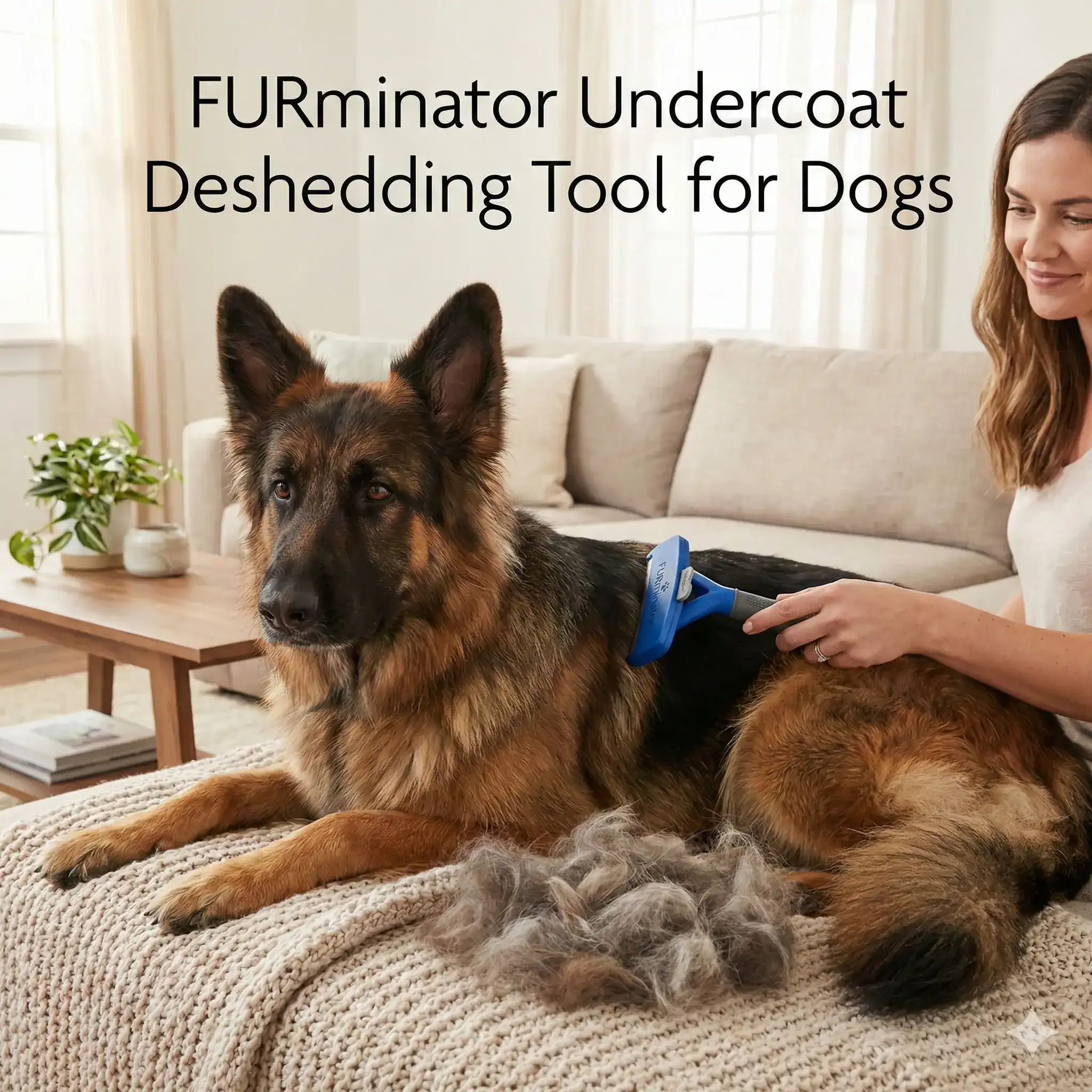
FURminator Undercoat Deshedding Tool for Dogs
Use for: Removing loose inner-layer hair before it covers your furniture. Designed for thick double-coated breeds, reaching the dense underlayer that standard brushes cannot access.
View on AmazonRegular brushing with an appropriate grooming tool helps remove dead hair and reduces the volume of loose fur inside the home. Heavy double-coated breeds benefit from tools designed specifically for thick underlayers rather than standard surface brushes.
Activity
They are moderate indoors but require at least 45 to 60 minutes of structured movement to prevent destructive chewing and obesity. They excel at swimming and cart-pulling (drafting), which provide excellent low-impact muscle building. A regular schedule of outdoor sessions keeps them physically and mentally satisfied.
How do they handle heat? Extremely poorly. A Newfoundland should never be worked in the heat of the day. If you live in a warm region, air-conditioning is essential. Their dark coats absorb solar heat rapidly, and their sheer mass makes them highly susceptible to overheating. In cold weather, however, they are in their element and will happily spend hours outside in snow and freezing rain.
Nutrition
Feeding a massive dog correctly during the growth phase dictates their skeletal soundness for life. Their metabolism and nutritional demands shift significantly across their stages of development.
🐶 Puppy Stage
A Newfoundland must eat a high-quality, specifically formulated large-breed formula. These formulas tightly control calcium and phosphorus ratios to slow bone development. Rapid growth causes the bones to outpace the supporting ligaments, resulting in permanent orthopedic issues. Feed measured meals three to four times and adopt a strict schedule rather than free-feeding.
🐕 Adult Stage
Adults require a protein-rich formula that supports their muscle mass without encouraging excess weight. To mitigate the risk of bloat, feed two to three smaller meals per day rather than one massive bowl. Prevent vigorous movement for at least an hour before and after feeding. Body condition monitoring is critical at this stage since even a moderate weight gain places disproportionate strain on their frame.
🐕🦺 Senior Stage
Reduce calories as their pace naturally slows. Supplements with glucosamine and omega fatty acids become increasingly important for maintaining mobility. Transition to senior-appropriate formulas around age 6 to 7 and increase veterinary checkups to twice yearly.
Conditioning
Despite their massive build, they are sensitive dogs that respond poorly to harsh methods. Positive reinforcement, patience, and consistency yield the best results.
🎓 Early Leash Manners
Controlling them becomes difficult once fully grown. If a 150-pound dog decides to chase a squirrel across the street, you will struggle to anchor them. Leash conditioning must be perfected while they still weigh 40 pounds. This is one of the most common mistakes new owners say they wish they had addressed sooner.
🎓 Socialization
Expose your Newfoundland to different people, animals, environments, and sounds before 16 weeks. While they are naturally gentle, under-socialized dogs of this size can become fearful, and a fearful 150-pound dog is a liability. Early, positive exposure builds the confident disposition they are known for.
Breed Comparison
| Attribute | Newfoundland | Labrador Retriever | Great Pyrenees |
|---|---|---|---|
| Weight | 100-150 lb (45-68 kg) | 55-80 lb (25-36 kg) | 85-160 lb (39-73 kg) |
| Disposition | Calm, devoted, sweet | High-output, eager to please | Independent, protective |
| Grooming | Extremely high + saliva | Moderate, minimal saliva | High shedding, minimal saliva |
| Primary Drive | Rescue / drafting | Retrieving / field work | Flock guarding / perimeter |
| Lifespan | 9-11 years | 10-12 years | 10-12 years |
If you love the retrieving nature but cannot accommodate the size, the Labrador Retriever offers a highly trainable alternative at roughly half the weight. The Newfoundland vs the Lab is a common comparison for water-loving households. The Great Pyrenees provides a similarly massive, thick-coated presence but with a much stronger protective drive and greater independence. The Golden Retriever is another popular alternative for those who want a loyal, water-loving sporting dog without the logistical demands of a true giant. The biggest pro of the Newfoundland specifically is their exceptional gentleness at extreme size. The biggest con is the expensive veterinary profile, and the price of ongoing care is substantially higher than average due to their short lifespan and massive frame.
FAQ
Do Newfoundlands really produce that much saliva?
Direct Answer: Yes. The saliva is a constant reality of ownership.
Context: Their loose jowls are structurally designed to allow them to breathe while swimming with objects in their mouths. When they drink, shake their heads, or anticipate meals, it goes everywhere.
Management: Keep towels strategically placed in every room. You will wipe down walls and ceilings regularly. This is manageable with the right routine.
Can a Newfoundland live in an apartment?
Direct Answer: Technically yes, but it is challenging and usually not ideal.
Context: They are settled indoors, but their sheer footprint requires space. A wet, muddy 150-pound dog shaking off in a small space creates a significant mess.
Management: You must commit to multiple walks and frequent trips to safe swimming areas if a fenced yard is unavailable.
Are they good with cats and other pets?
Direct Answer: Yes, they are generally excellent with other animals when socialized early.
Context: They have minimal prey drive and a naturally nurturing instinct. However, their size means they can accidentally step on a small animal during movement.
Management: Always supervise interactions with smaller animals, focusing on teaching the dog spatial awareness from a young age.
Are they expensive to maintain?
Direct Answer: Yes, substantially more than average breeds.
Context: Massive breeds eat large volumes, require weight-based doses of all veterinary medications, and face substantial emergency bills for issues like bloat or orthopedic intervention. Pet insurance is strongly recommended.
Management: Budget for ongoing veterinary monitoring and consider an organization like a breed club for referrals to sources who prioritize cardiac clearances.
Do they make effective guard dogs?
Direct Answer: No. They are visual deterrents, not confrontational protectors.
Context: Most people will not approach a house containing a 150-pound bear-like dog. If a threat materializes, a Newfie will usually stand between the people and the intruder, but they rarely confront directly.
Management: Rely on their intimidating presence for security, but do not expect the protection drive of a dedicated guardian like the Great Pyrenees or a Bernese Mountain Dog.
Are they straightforward to condition?
Direct Answer: Yes, they are eager to please and highly intelligent.
Context: They respond beautifully to positive reinforcement. However, they mature slowly both physically and mentally, often acting like oversized adolescents for the first two years of life.
Management: Begin basic obedience and leash work at 8 weeks before their size becomes unmanageable.
How long can they be left alone?
Direct Answer: They should not be left alone for long workdays.
Context: This is a deeply social dog that bonds intensely with their humans. Long periods of isolation lead to separation anxiety, depression, and destructive behavior.
Management: Ensure someone is home for part of the day, or get a trusted dog walker to break up the isolation.
Do they need a swimming pool?
Direct Answer: No, but they genuinely thrive when given access to safe open water.
Context: Swimming is part of their DNA. It provides the best low-impact movement available for their massive, stress-prone frame.
Management: Find local dog-friendly lakes or beaches near you. Always rinse their thick coat thoroughly after swimming to prevent bacterial hot spots.
Finding a Newfoundland Dog
Sourcing this dog from the wrong breeder or operation funds animal suffering. A poorly produced massive dog will face a short, agonizing life of heart failure and crippled structure. Finding a responsible source requires patience and thorough research, and any listing offering puppies for sale without documented cardiac clearances should be avoided entirely.
🏠 Responsible Source
A responsible source will provide verified OFA Advanced Cardiac and orthopedic clearances for both parent dogs. They will interview you about your home environment, air-conditioning capabilities, and financial readiness. Expect to wait 6 to 12 months for a well-screened puppy. The Newfoundland Club of America maintains referral lists for those beginning their search.
🐾 Rescue and Adoption
Newfoundlands are commonly found through breed-specific organizations. Handlers routinely surrender them around 18 months of age when the dog reaches 120 pounds and the reality of the saliva, shedding, and massive feeding bills sets in. Adopting an adult allows you to assess their true disposition and bypass the chaotic adolescent phase entirely.
🚩 Red Flags
- No OFA Advanced Cardiac clearance for both parents (this is the single most important test)
- No hip or elbow screening documentation available
- Multiple litters available immediately with no waitlist
- No questions asked about your lifestyle, home setup, or air-conditioning
- Parent dogs appear overweight, lethargic, or show signs of breathing difficulty
Personal Observation
💭 Personal Observation
When Bruno, my Labrador who lived with me from 2012 until his passing in 2021, reached his senior years, carrying his roughly 45 kg (99 lb) frame became a genuine struggle. I had to monitor his structure and heavily manage his environment during the hottest summer months because the heat exhausted him rapidly. A Newfoundland weighs more than double what Bruno did, wrapped in a dense, weather-resistant double coat designed for freezing Atlantic waves. If a 99-pound Labrador struggled with wear and thermal regulation in a warm climate, a 150-pound heavyweight is fighting its own biology every single day. My advice: if you live in an area that regularly sees high temperatures, or if your home involves multiple flights of stairs, this giant will face orthopedic and thermal stress that demands significant accommodation. Commit to air-conditioning and ground-floor access before you ever bring one home.
Conclusion
The Newfoundland dog is a magnificent, devoted companion capable of profound gentleness. They excel as household dogs, offering unwavering loyalty and a settled indoor presence that belies their enormous size.
The biggest pro is an exceptionally gentle temperament wrapped in a powerful, capable body built for real work. The biggest con is the short lifespan, expensive veterinary profile, and relentless grooming demands that come with maintaining a dog of this magnitude. For the household willing to invest in space, temperature management, and proactive veterinary care, the Newfoundland returns the effort with quiet, steady devotion that few breeds can match.
Disclaimer: This article is for informational purposes only and does not constitute veterinary or professional breeding advice. All information is based on publicly available breed data and should not replace a physical examination or treatment plan from a licensed veterinarian. Product recommendations contain affiliate links. K9Sphere earns from qualifying purchases at no additional cost to you.


