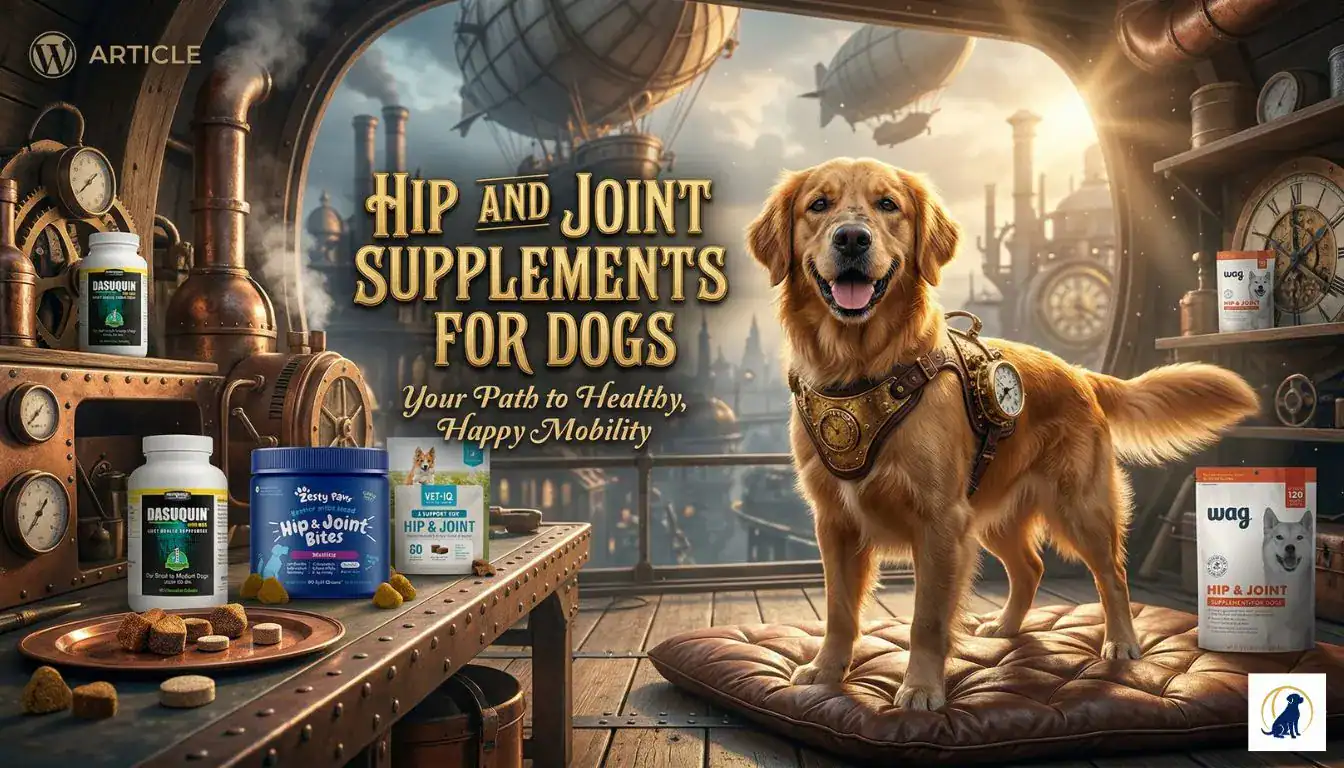
Reduced flexibility, pain, and limited movement affect millions of pets, especially larger animals and seniors. Hip and joint supplements for dogs are commonly used to support cartilage health, help modulate inflammation, and may improve comfort in those with arthritis, hip dysplasia, or age-related wear.
We researched and compared the most well-reviewed formulas based on ingredients, clinical backing, form factor, and customer feedback. This guide covers seven established options that address different stages of care, from early prevention to advanced issues.
Breeds like German Shorthaired Pointers, Australian Shepherds, and Siberian Huskies are genetically predisposed to skeletal conditions. But these formulas are not limited to high-energy or large animals. Any pet showing reluctance to climb stairs or difficulty getting up after rest can potentially benefit. Consistent canine joint support is most effective when started before symptoms become severe. Maintaining joint function over the long-term is far easier than reversing damage that has already occurred.
Choosing the right formula comes down to ingredient quality, serving amounts, and your pet’s specific condition. This comparison breaks down what each option contains, who it suits, and where it falls short.
Choosing an ill-matched formula can waste money and delay more meaningful support. The difference between options often comes down to ingredient quality, concentration levels, and whether the formula targets prevention, daily maintenance, or advanced deterioration. Always consult your vet before starting any new regimen, especially for pets with existing health conditions or those on medication.
⚕️ Important Note: These formulas are not a substitute for professional diagnosis or treatment. If your pet shows sudden lameness, refuses to bear weight, or has significant changes in movement, seek clinical evaluation first. The options in this guide are intended to support skeletal health, not treat or cure disease. When used as directed, they are generally considered safe for most healthy adult animals and are commonly used to help prevent further deterioration alongside professional care.
Affiliate Disclosure: As an Amazon Associate I earn from qualifying purchases. K9Sphere is a participant in the Amazon Services LLC Associates Program. Links in this article may earn a commission at no extra cost to you.
Quick Picks and Comparison Table
| Product | Recommended For | Key Ingredients | Form | Rating (as of Apr 2026) |
|---|---|---|---|---|
| Nutramax Dasuquin with MSM | Top Overall | Glucosamine, CS, MSM, ASU | Chewable tablet | 4.7 / 5 |
| VetriScience GlycoFlex Plus | Top for Athletic Dogs | Glucosamine, CS, MSM, Green Lipped Mussel, DMG | Soft chew | 4.5 / 5 |
| Zesty Paws Mobility Bites | Top for Picky Eaters | Glucosamine, CS, OptiMSM, Green Lipped Mussel, Curcumin | Soft chew | 4.4 / 5 |
| PetHonesty Hip & Joint Turmeric | Top Natural Option | Curcumin, Omega-3s (Fish Oil & Flaxseed Oil), Spirulina | Soft chew | 4.2 / 5 |
| VETIQ Hip and Joint | Top Budget | Glucosamine, CS, MSM, Krill, EPA/DHA | Tablet (Advanced) / Chew (Standard) | 4.4 / 5 |
| Amazon Wag Hip & Joint | Top Store-Brand Value | Glucosamine, CS, MSM, EPA/DHA | Soft chew | 4.3 / 5 |
| Glucosamine Chondroitin Chews | Top Generic All-Size | Glucosamine, CS, MSM | Soft chew | 4.6 / 5 |
If your pet has diagnosed joint disease or developmental skeletal conditions, start with Nutramax Dasuquin. It is the #1 vet-recommended joint health brand according to the manufacturer and includes ASU, which most competitors lack. For athletic sport animals, choose VetriScience GlycoFlex Plus. For pets that refuse chews, Zesty Paws Mobility Bites have strong palatability ratings across multiple flavor options.
Top Hip and Joint Supplements for Dogs Reviewed
Nutramax Dasuquin with MSM
🏆 Top Overall
Nutramax Dasuquin is the #1 vet-recommended joint health brand in the United States, according to a survey conducted among small animal practitioners who recommended oral joint health supplements (source: manufacturer). It combines glucosamine hydrochloride, low molecular weight chondroitin sulfate, MSM, ASU (avocado/soybean unsaponifiables), Boswellia serrata extract, and EGCG from decaffeinated tea extract. ASU is the key differentiator. It is commonly used to support cartilage health and is believed to help maintain cartilage integrity, which most competing formulas do not include.
The chewable format makes routine administration straightforward. Dasuquin is manufactured by Nutramax Laboratories, a company that publishes research on its formulations and follows National Animal Supplement Council (NASC) quality standards. That level of transparency is uncommon in the pet market, where many brands rely on proprietary blends without disclosing exact ingredient amounts.
The main downside is cost. Dasuquin is one of the more expensive options on this list, and the recommended loading phase during the first 4 to 6 weeks means you go through the initial supply faster. Some pets also take time to accept the chew, though palatability feedback is generally positive across tens of thousands of reviews. Results are not instant. Most owners report visible improvement in movement after 4 to 8 weeks of consistent use. Dasuquin is one of the most frequently recommended osteoarthritis support options and is widely used as a senior dogs joint health supplement by veterinary practitioners across the United States. Building it into a routine and keeping a consistent schedule helps maximize the relief owners report over time.
Dasuquin is available in two formulations based on size. The version for larger animals contains higher active ingredient levels to match the greater skeletal load on heavier frames. Both use the same ingredient profile including ASU. Select the size that matches your pet’s weight.
Ideal for: Pets with diagnosed joint disease, developmental skeletal conditions, or progressive deterioration. Especially suited for German Shorthaired Pointers, Australian Shepherds, Border Collies, Golden Retrievers, Labradors, and German Shepherds. Also appropriate for any senior showing reduced flexibility or limited movement.
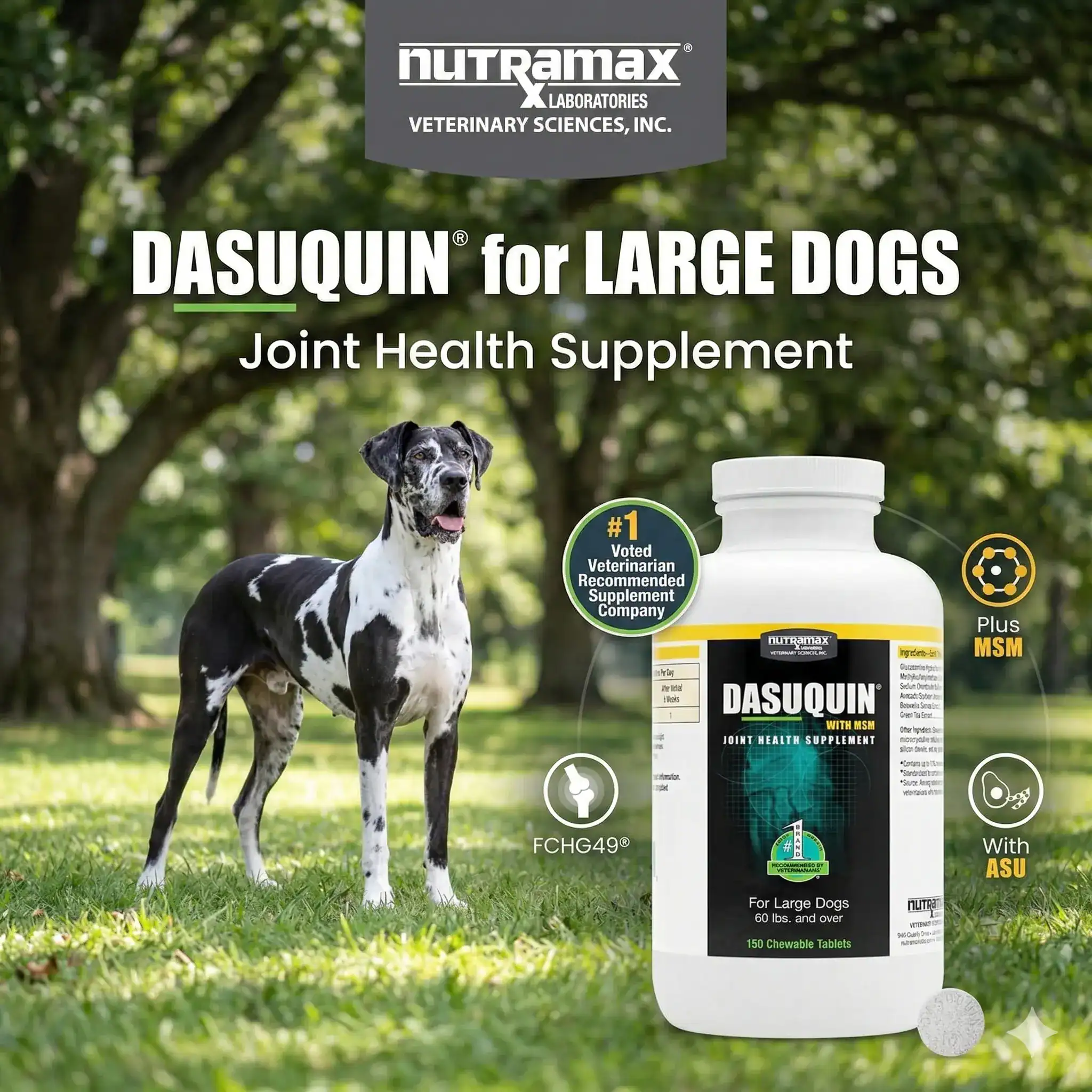
Dasuquin with MSM
Large Dogs (60+ lbs)
Higher glucosamine & CS levels
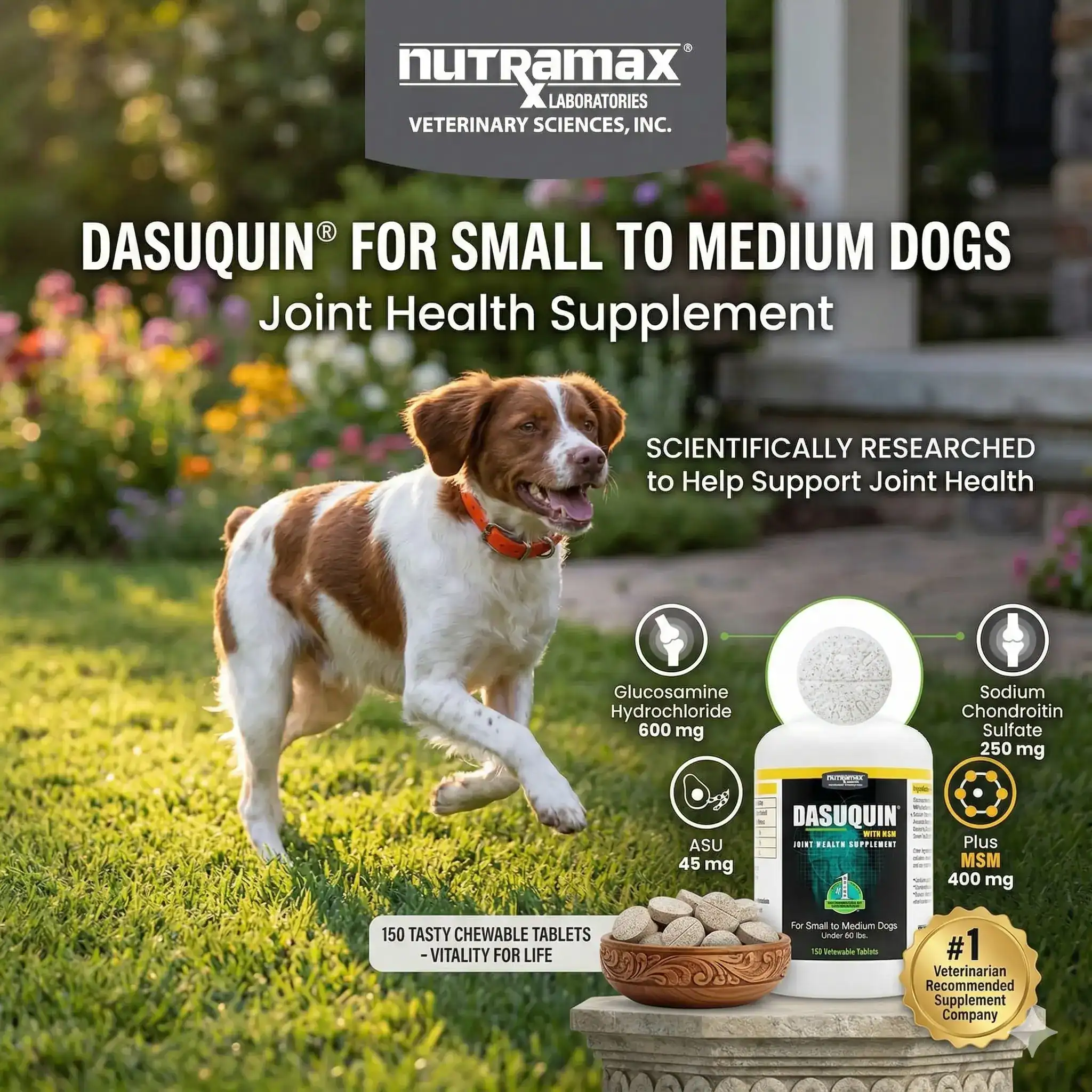
Dasuquin with MSM
Small to Medium Dogs (under 60 lbs)
Lower dosage for lighter frames
Select the size that matches your dog’s weight. Both formulas contain the same active ingredients. Ratings reflect Amazon.com as of April 2026.
VetriScience Ultimate Strength Healthy Hip & Joint
🐕 Top Pick for Athletic Dogs
VetriScience Ultimate Strength Healthy Hip and Joint (previously sold as GlycoFlex Plus) is the top-tier formula in VetriScience’s support lineup. It combines glucosamine, CS (chondroitin sulfate), MSM, Perna canaliculus (New Zealand mussel), DMG (dimethylglycine), Vitamin E, and Vitamin C. The NZ mussel extract is a natural source of marine-derived fatty acids and glycosaminoglycans that support lubrication and a healthy inflammatory response.
This formula has been evaluated in manufacturer-sponsored clinical testing and is specifically designed for pets with higher physical demands: high-drive and sporting animals, seniors, and those recovering from surgery or injury. It is particularly popular among owners of dogs that work in demanding field or service roles. According to the manufacturer, the formula was shown to increase hind-leg strength by up to 41% in just 4 weeks. The soft chew format uses a chicken flavor that has good acceptance rates. VetriScience offerings are certified by the National Animal Supplement Council (NASC) and routinely undergo third-party testing. The formula is particularly well suited to athletic animals that need help with post-exercise recovery. By supporting connective tissue and cartilage, it helps maintain performance across training seasons.
The cost sits at the higher end of the market, which is expected for a research-backed, multi-ingredient formula. Some pets do not respond as visibly as others, and the chew texture may not suit extremely picky eaters. For energetic animals that need skeletal support without reducing their physical demands, this is one of the more robust formulas available in terms of ingredient concentration and supporting research.
Ideal for: High-demand and sporting animals, agility competitors, and physically intense lifestyles. Well suited for Border Collies, Australian Shepherds, German Shorthaired Pointers, and any animal with sustained skeletal stress.
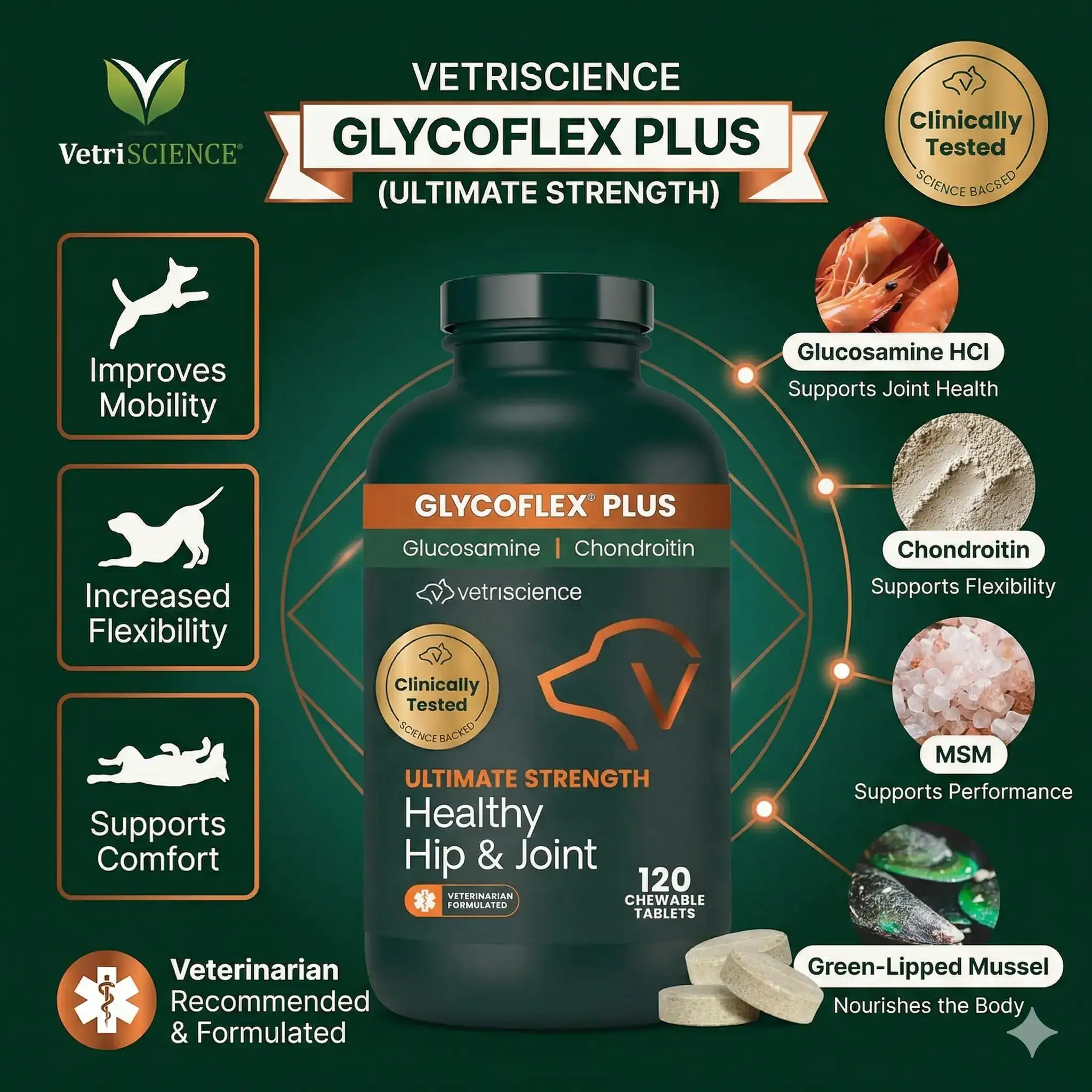
VetriScience Ultimate Strength Healthy Hip & Joint
Previously sold as GlycoFlex Plus. Glucosamine, CS, Perna canaliculus (NZ mussel), MSM, DMG, Vitamin E, and Vitamin C. NASC certified with third-party testing. Chicken flavor soft chew, 120 count.
Check Price on AmazonZesty Paws Mobility Bites
🍖 Top Pick for Picky Eaters
Zesty Paws Mobility Bites solve the most common compliance problem: pets refusing to eat their chews. The soft chew format and multiple flavor options (Senior Advanced, Hemp, and NZ Mussel) give owners flexibility when one variety gets rejected. The Senior Advanced and Hemp variants share a glucosamine and OptiMSM base with additional specialty ingredients varying by variant. The Mussel variant uses a simpler, limited-ingredient formula focused solely on New Zealand mussel extract.
The Senior Advanced version includes OptiMSM, Qmin+ curcumin with BioPerine for enhanced absorption, NZ mussel, CS (chondroitin sulfate), hyaluronic acid, and Vitamins C and E. The Hemp variant adds hemp seed powder and hemp seed oil alongside Organic Boswellia and curcumin. The Mussel version is a limited-ingredient formula built entirely around cold-processed New Zealand Perna canaliculus. All three use a treat-like texture and chicken flavor that pets tend to accept more readily than hard chewables or unflavored options.
The trade-off is ingredient concentration. Zesty Paws prioritizes palatability, which means the amounts per chew are typically lower than what you get from Dasuquin or GlycoFlex Plus. For mild to moderate discomfort and pets that need compliance above all else, these are a practical choice. For advanced deterioration, a stronger formula may be more appropriate.
Ideal for: Pets that refuse other formulas, picky eaters, and owners who want multiple flavor options. Good for mild to moderate discomfort in any size.
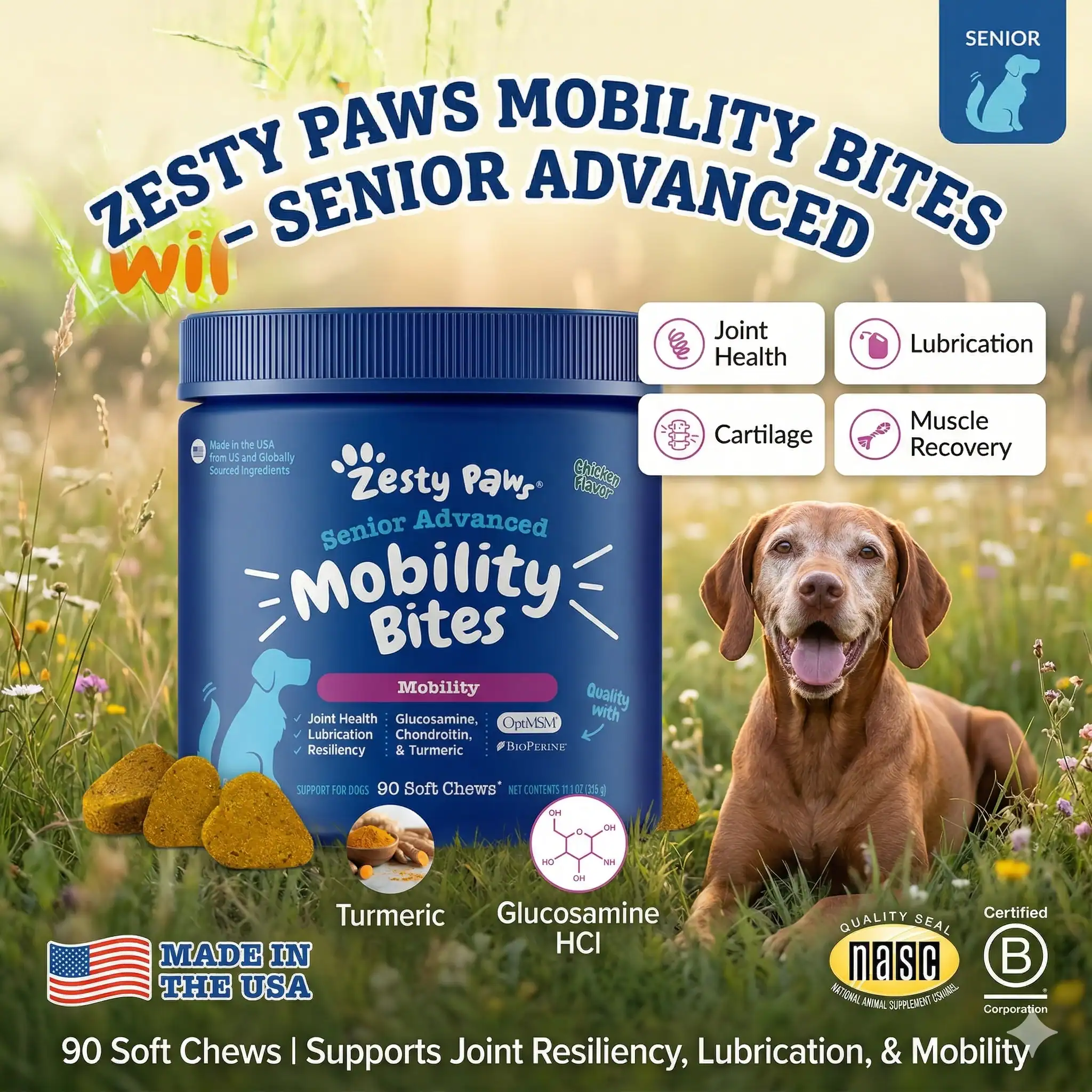
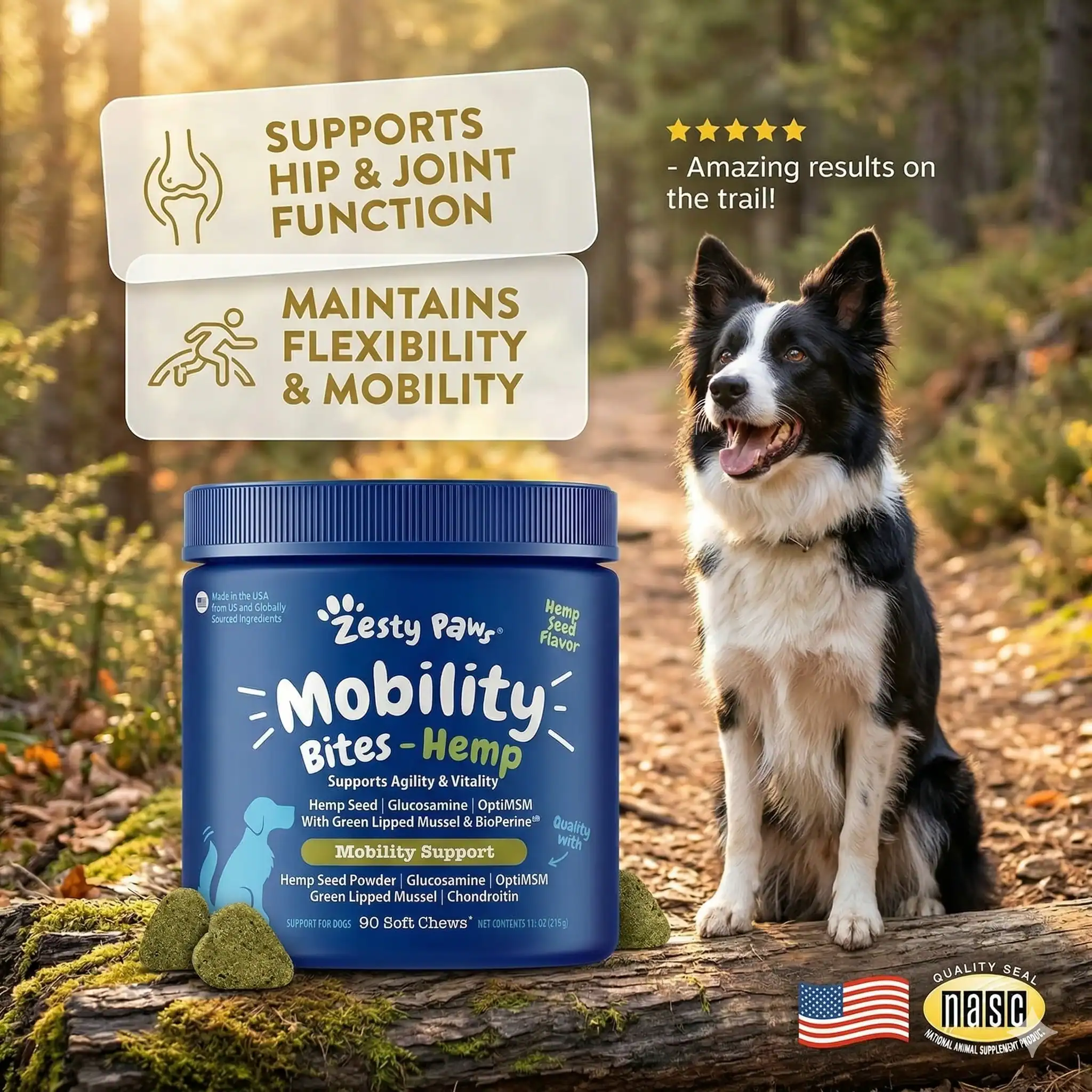
Hemp Formula
Hemp seed + Boswellia + Curcumin
Multi-ingredient support
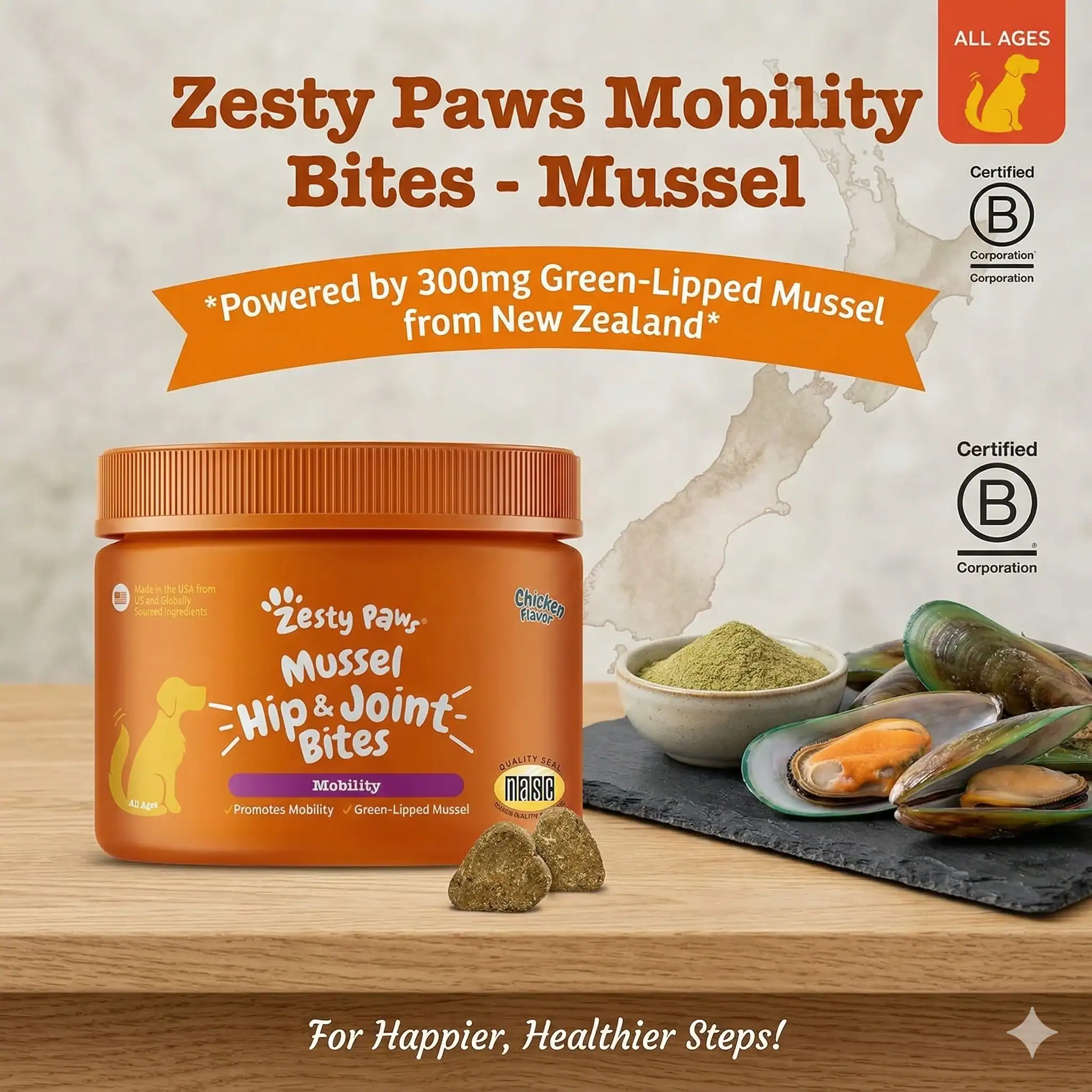
Senior Advanced and Hemp share a glucosamine/CS/OptiMSM base. The Mussel version is a limited-ingredient formula. Ratings reflect Amazon.com as of April 2026.
PetHonesty Hip and Joint Turmeric Health
🌿 Top Natural Pick
PetHonesty Hip and Joint Turmeric Health takes a holistic, herbal approach compared to the traditional formulas on this list. The primary ingredients are the root extract, curcumin (its bioactive compound), omega-3s (from fish oil and flaxseed oil), spirulina, and black pepper extract. Piperine from the black pepper dramatically improves curcumin absorption, making the formula more effective per serving.
The soft chew uses a pumpkin coconut flavor that most pets accept without resistance. The formula is free from corn, soy, and GMOs, which matters for owners who are selective about diet quality. PetHonesty is a NASC member company, meaning it meets established quality and compliance standards for pet supplements. The formula also avoids extreme concentrations, which reduces the risk of digestive upset that can occur with high-strength curcumin options.
This formula is suited for routine maintenance rather than treatment for advanced disease. It does not contain the traditional foundational compounds, so it is not a direct replacement for Dasuquin or GlycoFlex Plus. Instead, it complements them or serves as a standalone choice for owners who prefer plant-based, inflammation-modulating support over traditional ingredients.
Ideal for: Owners who prefer natural, plant-based ingredients. Pets with mild discomfort or as a complementary formula alongside a traditional option. Suits all sizes. Adjust serving based on your dog’s weight.
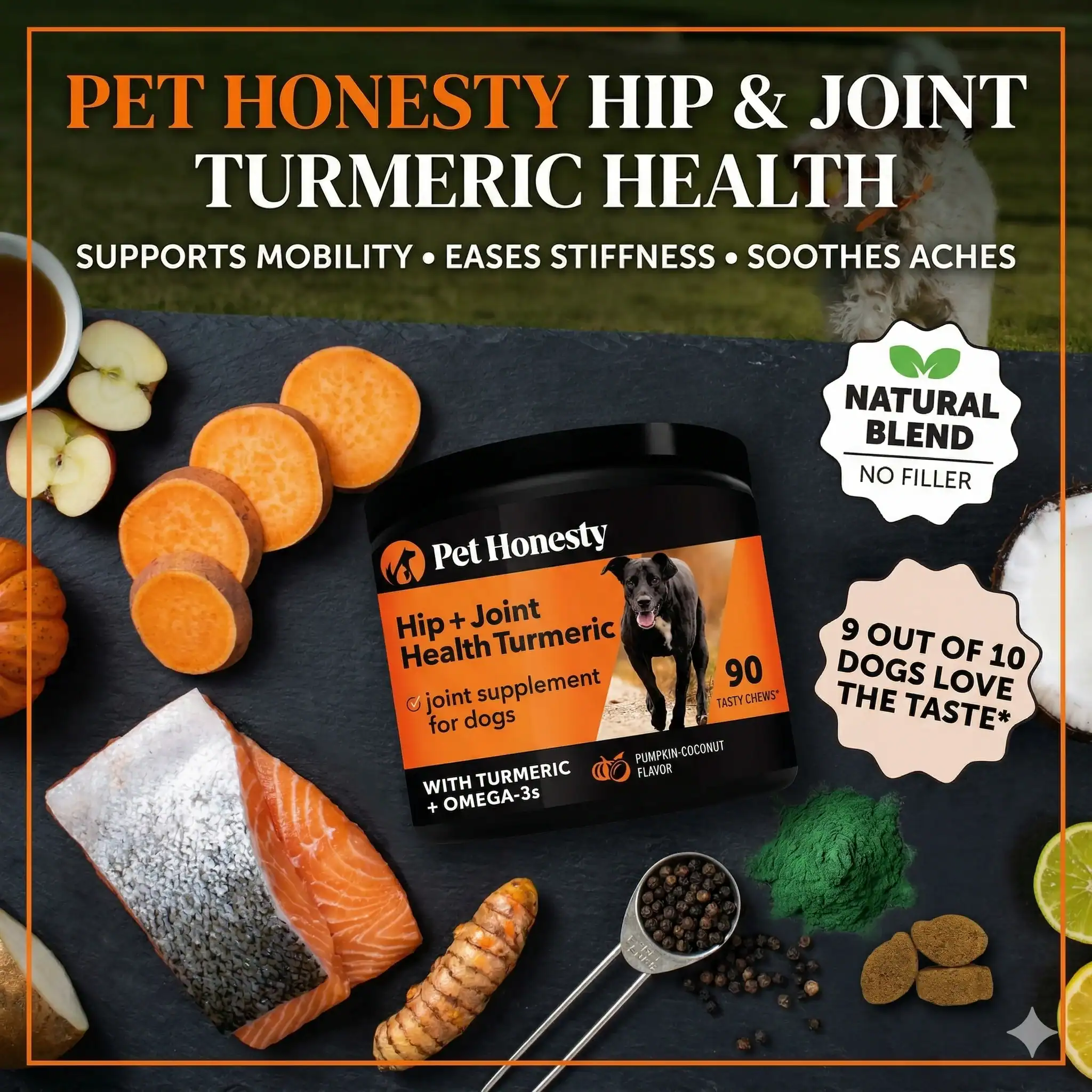
PetHonesty Hip & Joint Turmeric Health
Curcumin extract with omega-3s (from fish oil and flaxseed oil), spirulina, and black pepper extract for enhanced absorption. No corn, soy, or GMOs. NASC member company. Pumpkin coconut flavor, 90 count.
Check Price on AmazonVETIQ Hip and Joint Supplement
💰 Top Budget Pick
VETIQ offers an affordable, widely available formula that covers the core ingredients without a high price tag. It serves as a practical aid for owners who want a multi-ingredient option at a budget price. The Advanced Strength version includes glucosamine HCL, CS (chondroitin sulfate), MSM, krill meal (Qrill Pet), and collagen, along with EPA and DHA from marine sources that support lubrication and a healthy inflammatory response. The Standard Strength version uses a simpler formula built around glucosamine, krill, and MSM.
The chicken flavor makes routine administration simple. The Advanced Strength comes in a chewable format, while the Standard Strength uses a softer chew. Both come in 60-count bags. The lower price point compared to Dasuquin or VetriScience makes VETIQ practical for multi-pet households or owners on a tight budget who still want a multi-ingredient formula.
The trade-offs are expected at this price point. The ingredient concentrations per serving are lower than leading brands, which means the formula may take longer to show visible results or may suit mild support and prevention rather than managing advanced conditions. Both versions contain added flavoring and inactive fillers that higher-tier brands avoid. VETIQ offerings are NASC-certified, which provides a baseline of quality assurance. For basic routine maintenance at a fraction of the cost, VETIQ delivers reasonable value.
Ideal for: Budget-conscious owners, multi-pet households, and animals that need basic support for prevention or mild discomfort. Available in multiple sizes. Select the appropriate one based on your pet’s weight on the listing page.
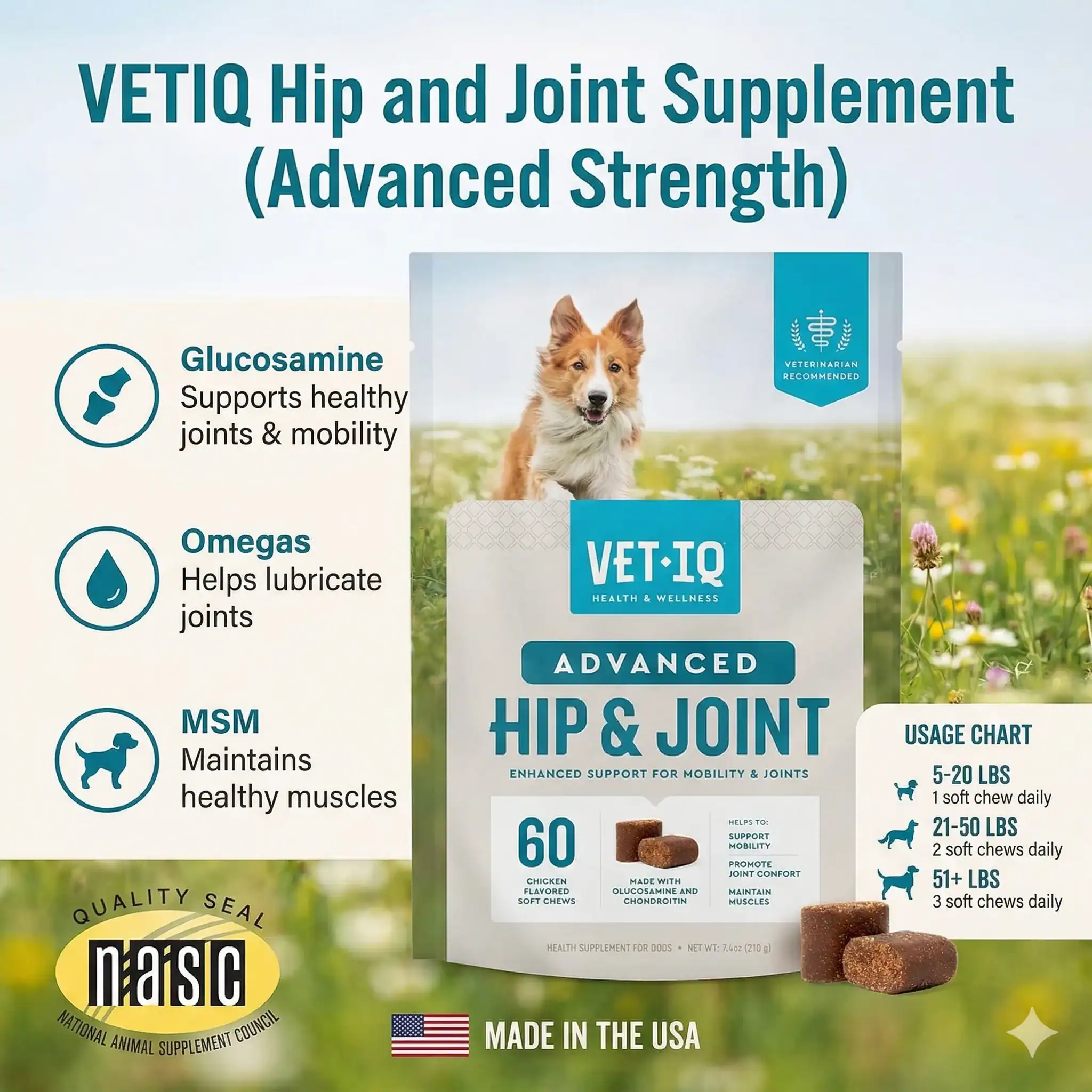
VETIQ Advanced Strength
Glucosamine + CS + krill + collagen
Chewable format, 60 count
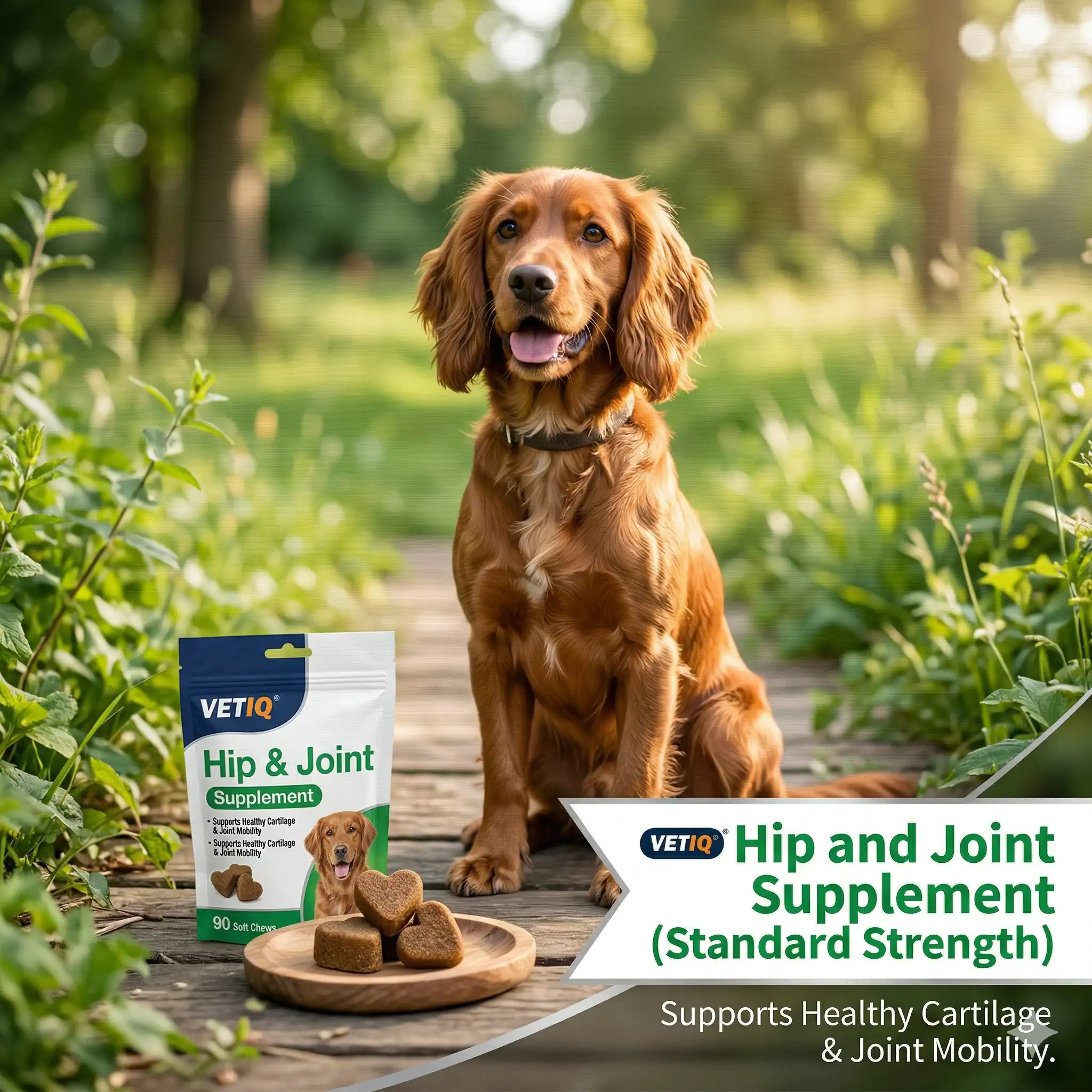
VETIQ Standard Strength
Glucosamine + krill + MSM
Soft chew, 60 count
Advanced Strength includes CS and collagen in a chewable format. Standard Strength is a simpler soft chew formula. Both are NASC-certified. Ratings reflect Amazon.com as of April 2026.
Amazon Wag Hip and Joint Supplement
🏷️ Top Store-Brand Value
Amazon Wag is Amazon’s own pet wellness brand. The formula contains the same foundational ingredients found in mid-range competitors: glucosamine, CS (chondroitin sulfate), MSM, EPA, and DHA. The ingredient list reads like a mid-range option, but the store-brand pricing makes it accessible for owners who want core ingredients without the brand markup.
The soft chew format is marketed as free from added wheat and corn, which matters for dogs with food sensitivities. Directions are weight-based, so you adjust the serving to match your dog’s size. The formula suits all life stages with weight-based administration.
The main limitation is that Amazon Wag is a store brand without the clinical research or professional backing that companies like Nutramax and VetriScience invest in. You are getting solid ingredients at a good price, but not the published studies or NASC certification that leading brands provide. For owners who prioritize ingredient value over brand pedigree, Wag is a sensible choice.
Ideal for: Owners who want a no-frills formula with established core ingredients at a store-brand price. Suitable for dogs at any life stage. Adjust serving based on weight.
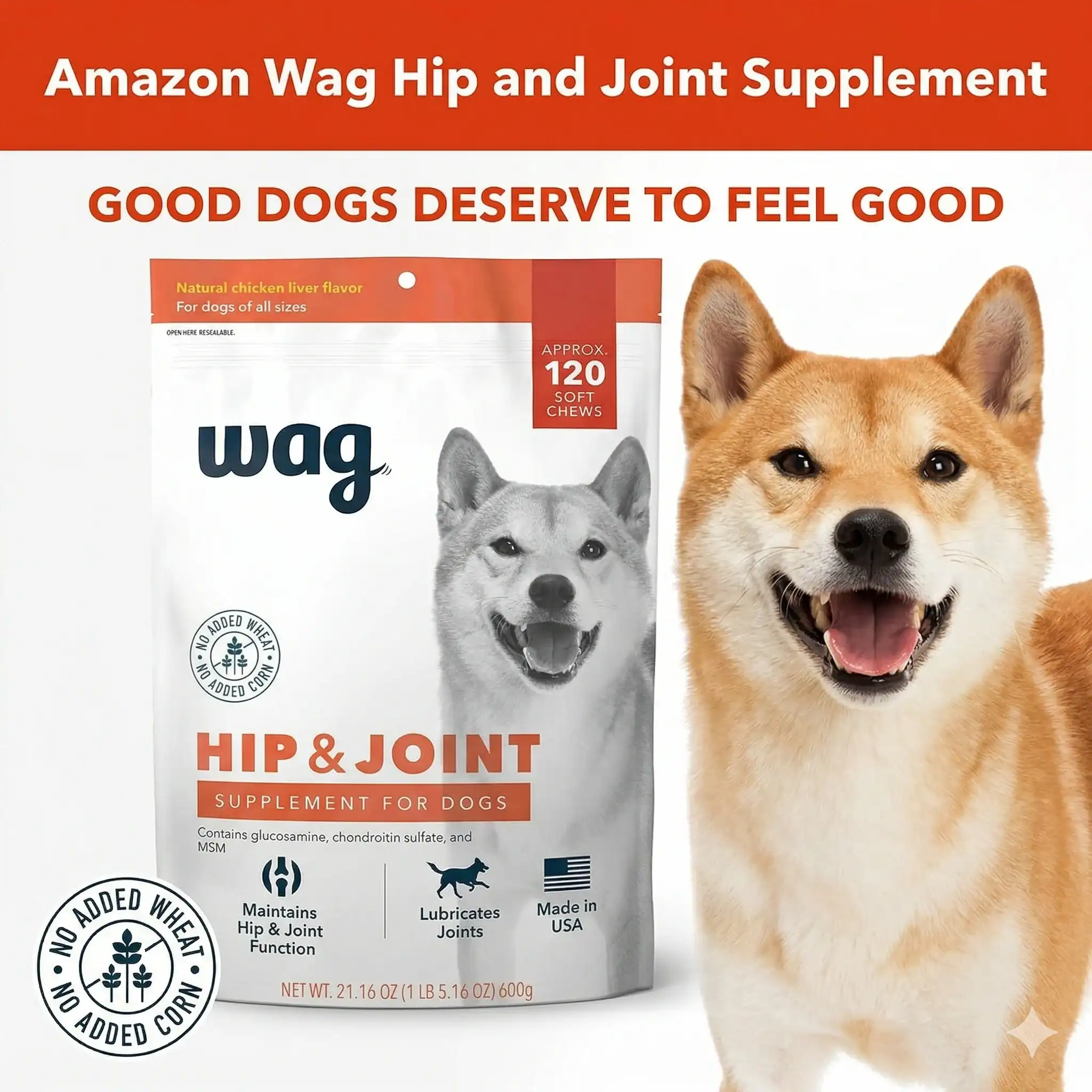
Amazon Wag Hip & Joint Supplement
Glucosamine, CS, MSM, and EPA/DHA in a soft chew. No added wheat or corn. Store-brand pricing with mid-range ingredients.
Check Price on AmazonGlucosamine Chondroitin Chews
🐾 Top Generic All-Size Option
This generic glucosamine chew offers a 200-count bottle with the three key ingredients. The chicken flavor helps with acceptance, and the formula avoids sugar, wheat, corn, and soy. At 200 pieces per bottle, the cost per serving is among the lowest on this list.
The formula covers small, medium, and large dogs with weight-based adjustments. It targets the same fundamentals as the branded options but at a fraction of the price. For owners who want to try a joint formula before committing to a higher-tier brand, or who have multiple pets that all need support, the high count and low price make this a practical starting point.
The limitation is brand transparency. Unlike Nutramax or VetriScience, there are no published studies, no NASC certification, and less detailed ingredient sourcing information. The formula covers the basics but does not include specialty ingredients like ASU, Perna canaliculus, or curcumin. For mild support and prevention, it does the job. For advanced conditions, a more established formula is the better investment.
Ideal for: First-time buyers, multi-pet households, and owners who want basic joint support at the lowest cost per serving. Adjust serving size based on your dog’s weight.
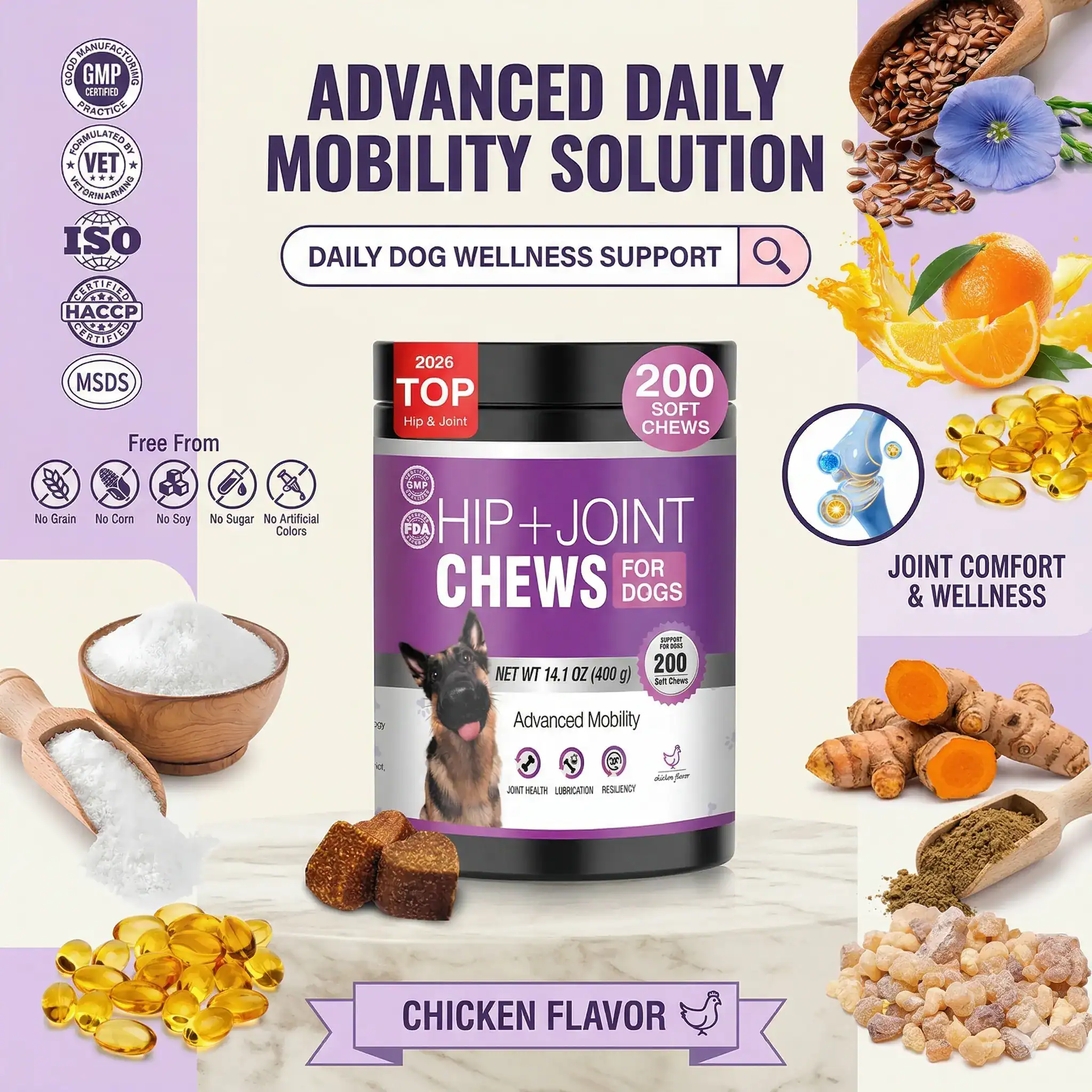
Glucosamine Chondroitin Joint Chews (200 count)
Core joint ingredients in a chicken-flavored soft chew. 200-count bottle for extended use. No sugar, wheat, corn, or soy. All sizes.
Check Price on AmazonKey Ingredients and What They Do
Joint formulas use a small group of key ingredients that support cartilage, synovial fluid, and normal inflammation levels. Each plays a different role, so understanding what they do helps you choose the right option.
💊 Glucosamine
Glucosamine is the most common ingredient in this category. It is a natural compound found in healthy cartilage that helps maintain the tissue cushioning the ends of bones. When that cushioning wears down, movement becomes limited and less flexible. Supplemental glucosamine provides building blocks the body uses to maintain and support cartilage structure over time. It comes in two main forms: glucosamine sulfate and glucosamine hydrochloride (HCL). Both aim to provide the same basic support. It is also available in powder and liquid formats, though chews remain the most convenient option for routine use. Results are gradual, with most pets needing several weeks of consistent use before owners notice changes in comfort.
🦴 Chondroitin (CS)
CS (chondroitin sulfate) is a natural component of cartilage that helps it retain water, keeping the tissue firm and flexible under pressure. It often appears alongside glucosamine because they function through complementary pathways. It may also help slow cartilage breakdown over time. Like the previous ingredient, it is gradual and requires consistent use to be effective. Low molecular weight forms, which Nutramax uses in Dasuquin, are designed for absorption compared to standard versions.
⚡ MSM
MSM (methylsulfonylmethane) is a sulfur-containing compound that supports the formation of connective tissues including cartilage, tendons, and ligaments. Most commercial formulas use a purified synthetic form of MSM for consistency and purity. It frequently appears in formulas that already contain the two ingredients above, adding a third layer of support focused on connective tissue integrity and comfort. It is well tolerated by most pets, with mild digestive upset being the most commonly reported side effect at higher amounts.
🐟 Omega-3 Fatty Acids
Omega-3 fatty acids, specifically EPA and DHA from marine or algae sources, support a normal inflammatory response in the body. They do not rebuild cartilage, but they help manage everyday inflammation that contributes to discomfort, especially in older animals. Quality matters. Look for options that list specific EPA and DHA amounts per serving rather than just total oil content. Several entries on this list, including Amazon Wag and VETIQ, include marine-derived fatty acids as part of their multi-ingredient formulas.
💊 Glucosamine + CS
The foundation of most joint formulas. Glucosamine supports cartilage maintenance. CS helps cartilage retain water and flexibility. Found in Dasuquin, VetriScience, VETIQ, Amazon Wag, and the generic chews.
⚡ MSM + Marine Fatty Acids
Supplementary ingredients that add connective tissue support and inflammation-modulating benefits. MSM targets tendons and ligaments. EPA/DHA from marine sources help manage everyday discomfort. Found in most multi-ingredient formulas on this list.
Which Level of Support Does Your Dog Need?
Not all formulas serve the same purpose. The right choice depends on where your pet is in terms of skeletal health. Early prevention in young or at-risk animals typically calls for a basic formula like Amazon Wag or the generic chews. Pets showing mild tightness or early signs of discomfort benefit from adding MSM or marine fatty acid support through options like VETIQ or Zesty Paws. Moderate issues in aging animals call for multi-ingredient formulas like Dasuquin (with ASU) or VetriScience GlycoFlex Plus (with Perna canaliculus). Those with advanced orthopedic conditions need the highest-concentration formulas available, and no over-the-counter remedy replaces proper clinical assessment, so consult your vet to determine whether oral support alone is sufficient or if prescription medication is also needed.
Breeds Most Prone to Joint Problems
Larger and giant animals face the highest risk of skeletal problems because they carry more weight and often experience rapid growth during the puppy stage that can stress developing hips and elbows. Those with deep chests and long bodies are also at elevated risk for spinal issues.
The animals most commonly affected by elbow joint disease and related orthopedic conditions include Labrador Retrievers, German Shepherds, Golden Retrievers, Rottweilers, Great Danes, Saint Bernards, Newfoundlands, and Bernese Mountain Dogs. Sporting and herding types like Australian Shepherds, Border Collies, and German Shorthaired Pointers also face skeletal stress from sustained high-impact movement.
Smaller animals are not immune. Dachshunds and French Bulldogs deal with spine and pelvic stress due to their body proportions. Miniature American Shepherds can inherit predispositions from their Australian Shepherd lineage. Any individual can develop orthopedic issues with age, obesity, or injury.
Giant and heavy-boned animals carry the greatest skeletal load. Cane Corsos, English Mastiffs, Great Pyrenees, and Doberman Pinschers are frequently evaluated for developmental hip and elbow conditions due to the sheer mechanical stress their frames endure during growth and routine movement. These animals often benefit from early supplementation, sometimes as young as 12 to 18 months, especially if parents had documented orthopedic conditions. Bullmastiffs and Anatolian Shepherds fall into the same high-load category and are commonly screened through OFA evaluations.
Athletic and high-drive animals face a different pattern of wear. Belgian Malinois, Vizslas, and Weimaraners sustain repetitive impact on their hips, elbows, and stifles through intense physical routines, whether in professional roles or demanding household environments. Border Collies and other herding types that make sharp directional changes at speed are especially prone to cruciate ligament stress and early cartilage deterioration. Owners of these animals often start preventive supplementation well before visible symptoms appear.
Several of the most popular medium-sized animals are commonly affected but often overlooked in joint health discussions. Boxers are genetically prone to developmental hip conditions and degenerative myelopathy. Pit Bull Terriers (American Staffordshire Terriers and related types) carry heavy muscle mass on a compact frame, which accelerates wear on the hip and knee structures. Standard Poodles, despite their athletic build, have documented rates of patellar luxation and hip conditions that warrant attention.
Small and toy animals are the most underestimated group when it comes to skeletal support. Pugs face a combination of patellar luxation, hip conditions, and spinal compression from their compact structure. Shih Tzus and Cavalier King Charles Spaniels are commonly affected by patellar luxation and early-onset joint disease. Chihuahuas and Yorkshire Terriers, despite their size, frequently develop luxating patellas that can progress to chronic discomfort without intervention. Pomeranians and Cocker Spaniels also appear regularly in orthopedic records. Owners of these smaller animals are among the most frequent buyers of joint support formulas, often starting supplementation after the first episode of limping or reluctance to jump.
If your pet belongs to any of these categories, many vets recommend starting supplementation as a preventive measure before symptoms appear, typically from age 2 to 3 for larger animals and age 5 to 7 for smaller ones.
📋 Breed-Specific Joint Health Data
The Orthopedic Foundation for Animals (OFA) maintains breed-specific health data and screening recommendations for orthopedic conditions. Check your dog’s OFA statistics to assess risk level and discuss preventive options with your vet.
How We Selected These Supplements
We focused on ingredient quality, brand transparency, customer review volume, and cost per serving. Each formula had to contain at least one widely used, research-supported ingredient and have a substantial number of verified buyer reviews. We favored brands that disclose full ingredient amounts, follow NASC standards, or publish supporting research. We excluded entries with unclear labeling, unverifiable claims, or very low review counts.
How to Choose the Right Joint Supplement for Your Dog
Start with your pet’s current condition. Those with diagnosed joint disease or developmental skeletal conditions need a comprehensive formula like Dasuquin (with ASU for cartilage protection) or VetriScience GlycoFlex Plus (with Perna canaliculus for lubrication). Pets showing early stiffness or at-risk animals used preventively can start with a simpler formula like Amazon Wag or the generic chews.
Format matters more than most buyers realize. If your pet refuses a chew, it does not function regardless of how good the ingredients are. Soft chews with strong flavors (Zesty Paws, PetHonesty) solve compliance issues. Hard chewables may cost less per serving but can create administration battles with picky eaters.
💡 Quick Selection Guide
Diagnosed joint disease or skeletal deterioration: Dasuquin with MSM. High-demand or sport animal: VetriScience GlycoFlex Plus. Picky eater that refuses other chews: Zesty Paws Mobility Bites. Prefer natural, plant-based support: PetHonesty. Budget or multi-pet household: VETIQ or Amazon Wag. First time trying joint support: Generic Glucosamine Chews.
Check the ingredient label for specific amounts, not just ingredient names. A formula that lists an ingredient without specifying milligrams per chew is really hiding something. Compare cost per serving, not package price. A cheaper bottle with fewer chews or lower concentrations may actually cost more per day than a premium option. When comparing formulas head-to-head, for example Dasuquin vs GlycoFlex Plus, the deciding factor is usually the per-serving nutrition profile, not the brand name. Check the per-chew milligram amounts to evaluate each option against your pet’s weight and condition. Choosing a formula that genuinely supports joint health from day one avoids the common mistake of switching every few weeks.
Amount per serving often matters more than just reading the ingredient list. Budget entries often include the standard compounds on the label but at levels well below what clinical research suggests is effective. Leading brands like Nutramax and VetriScience publish their exact milligram amounts per chew and use therapeutic ranges. If a formula does not disclose specific amounts for each ingredient, treat that as a red flag.
Finally, give any formula at least 4 to 8 weeks of consistent use before evaluating results. These formulas act gradually. Skipping servings or stopping after two weeks does not give the ingredients enough time to support cartilage and movement. If your pet shows no improvement after 8 weeks of proper use, consult your vet about adjusting the formula or concentration.
📅 What to Expect: Typical Supplement Timeline
Weeks 1 to 2: No visible change. Ingredients are building up in the system.
Weeks 3 to 4: Some dogs begin showing subtle improvements in willingness to move or climb stairs.
Weeks 4 to 6: Most owners report noticeable changes in morning tightness and general comfort.
Weeks 6 to 8: Full evaluation point. If no improvement is visible by week 8, consult your vet about formula or concentration adjustments.
It is also important to recognize when oral support is not enough. These formulas help maintain skeletal health, but they do not reverse severe damage. Pets with advanced movement loss may require prescription anti-inflammatory medication, structured weight management, physical therapy, or hydrotherapy in addition to supplementation. Providing an orthopedic dog bed that supports the spine and hips during rest can also reduce overnight tightness and improve morning comfort at home. Weight management and controlled exercise are effective non-pharmaceutical alternatives that provide genuine relief alongside any routine. Always consult your vet if symptoms worsen or do not improve with consistent use.
Conclusion: Which Supplement Should You Choose?
If you only buy one formula, get Nutramax Dasuquin with MSM. It is the #1 vet-recommended joint health brand according to the manufacturer, and the inclusion of ASU gives it a meaningful advantage over simpler options. It suits many pets with degenerative joint conditions or progressive skeletal wear.
For high-demand and sporting animals, VetriScience GlycoFlex Plus provides research-backed support with Perna canaliculus and DMG that targets sustained skeletal stress.
If your pet refuses other chews, Zesty Paws Mobility Bites in one of three flavor options gives you the strongest chance at compliance. For owners who prefer plant-based ingredients, PetHonesty Chews offer inflammation-modulating support without the traditional foundational ingredients.
On a budget, VETIQ Advanced Strength and Amazon Wag both cover the core ingredients at a fraction of higher-tier pricing. For first-time buyers or multi-pet households, the 200-count generic chews offer the lowest entry cost with solid basic ingredients.
FAQ
Do vets recommend joint supplements for dogs?
Many practitioners recommend these formulas for pets with degenerative joint conditions or age-related tightness. Formulas combining the primary joint nutrients with marine-derived fatty acids are most commonly suggested. Vets often pair supplementation with weight management and appropriate exercise. Nutramax Dasuquin and VetriScience GlycoFlex Plus are among the most frequently recommended brands.
How long do these formulas take to show results?
Most pets need 4 to 8 weeks of consistent use before owners notice visible changes in comfort or movement. Some respond sooner, while others take the full 8 weeks. Many formulas recommend a higher loading phase for the first 4 to 6 weeks, then a lower maintenance amount afterward. Skipping servings or inconsistent use significantly delays results.
Can I use these formulas preventively?
Yes. Many owners and vets use joint formulas preventively for high-risk animals, energetic pets, and those approaching their senior years. Starting before symptoms appear may help maintain cartilage health and function over time. For prevention, a simpler formula like Amazon Wag or a basic chew is typically sufficient. Consult your vet for guidance specific to your pet’s size and age.
What is the difference between glucosamine and CS?
Glucosamine supports cartilage maintenance by providing building blocks the body uses to repair and maintain the tissue cushioning skeletal connections. CS (chondroitin sulfate) helps cartilage retain water, keeping it firm and flexible under pressure. They function through complementary pathways, which is why most formulas include both together. Neither produces immediate results. Both require consistent use over several weeks.
Are there any risks or reactions to watch for?
Most pets tolerate these formulas well. The most commonly reported reactions are mild digestive upset, including soft stool, gas, or decreased appetite during the first few days. These typically resolve as the animal adjusts. Starting with a lower amount and gradually increasing to the recommended serving can help minimize digestive issues. An accidental overdose is unlikely with standard chews, but giving significantly more than the recommended amount can cause vomiting or diarrhea. If your pet experiences persistent symptoms or behavioral changes, stop the formula and consult your vet.
Can my dog take a human joint supplement instead?
No. Human formulas are concentrated for adult body weight and metabolism, which differs significantly from canine physiology. Some of these also contain xylitol or other ingredients that are toxic to animals. Always use a formula made specifically for dogs. Canine formulas account for species-specific absorption rates and weight-based serving sizes to support joint function naturally and help prevent further wear without the risks associated with off-label use.
This article is for informational purposes only and does not constitute medical advice. Always consult a qualified vet before starting any supplement regimen, especially for dogs with existing health conditions or those on medication.
Descriptions, ingredient lists, and formulation details are based on manufacturer-published information available on Amazon.com at the time of research. Ratings shown in the comparison table reflect Amazon.com customer ratings as of April 2026. Formulations, ratings, pricing, and availability are subject to change without notice. Always verify current details on the Amazon listing before purchasing.
K9Sphere is not responsible for changes made by manufacturers to formulations, packaging, or ingredient sourcing after the publication date of this article.