The story of the Hachiko dog begins in Odate, Japan. Hachiko was an Akita, a large Japanese dog breed, born there in 1923. His owner, Professor Hidesaburō Ueno, died in 1925. Hachiko kept going back to Shibuya Station in Tokyo for nearly 10 years, until he died in 1935.
Today the Hachiko dog is often called the world’s most loyal dog. In Japan he is known as Chūken Hachikō, which means “faithful dog Hachikō.” But over the last 100 years, people have added details to his story that the old records do not back up. Here is the true story of Hachiko, myths and all.
The dog who kept coming back
From Odate
to Shibuya Station
16
Months with his owner
10
Years of waiting, about
1932
The news story that made him famous
Apr 8
The day he is honored each year
Is His Story True? The Short Answer
Yes, mostly. Hachiko really did keep going back to Shibuya Station for years after Prof. Ueno died. Records from that time show it. But one popular part may not be true. Many people say he met Prof. Ueno at the station every day while his owner was alive. A historian now doubts that.
Breed
Akita
Born
November 1923, Odate, Japan
Owner
Professor Hidesaburō Ueno, Tokyo Imperial University
Arrived
January 1924, about 50 days old
Waited
About 10 years at Shibuya Station
Died
March 8, 1935, near Shibuya Station
Statue
Hachiko Exit, Shibuya Station, Tokyo
Today
His body is kept at the National Museum of Nature and Science
Affiliate Disclosure. K9Sphere is a participant in the Amazon Services LLC Associates Program. As an Amazon Associate I earn from qualifying purchases. Links marked (paid link) may earn K9Sphere a commission on qualifying purchases, at no additional cost to you.
Chapter I
Who Was Hachiko?
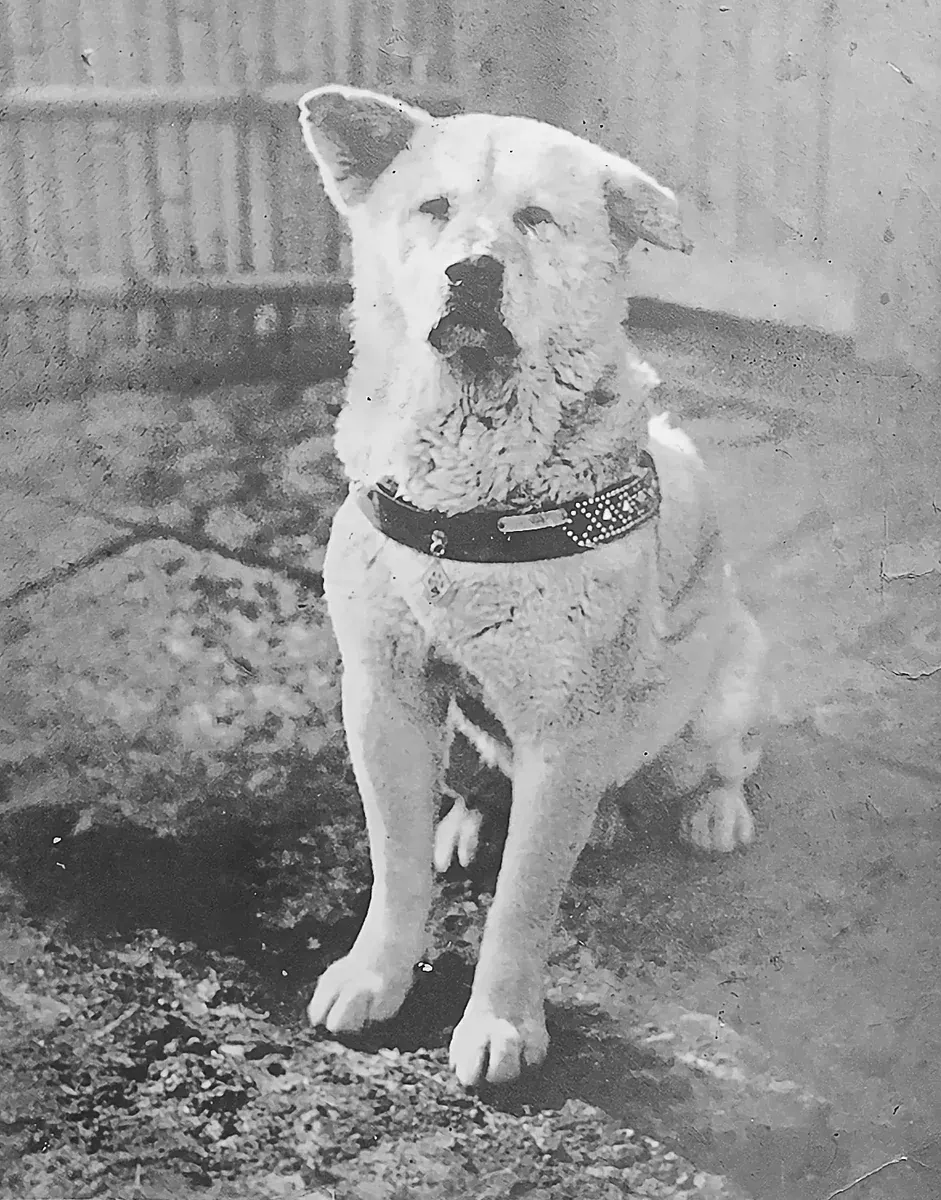
Hachiko was an Akita dog born in November 1923 on the Saito family farm in Odate, Japan. His owner, Prof. Ueno, taught agricultural engineering, the science of improving farmland, at Tokyo Imperial University. That school is now the University of Tokyo.
A University of Tokyo document gives Hachiko’s birthday as November 10, 1923. Other records give only the month. Hachiko was born in a litter of Akita puppies, Nippon.com reports. A litter is a group of puppies born together.
A new home
How Did Hachiko Come to Prof. Ueno?
Hachiko came to Prof. Ueno in January 1924. He was sent by train from Odate to Tokyo when he was about 50 days old.
Prof. Ueno lived in the Shibuya area of Tokyo. He named the puppy Hachi and kept him at his home there. That was the start of the story of Prof. Ueno and Hachiko.
A daily routine
What Hachiko’s Days With Prof. Ueno Were Really Like
Hachiko most likely walked with Prof. Ueno to the gate of the Komaba campus, where the professor worked, and not to Shibuya Station. That is the view of Takashi Tamura, a historian at the University of Tokyo.
Many stories say Hachiko would go with Prof. Ueno to Shibuya Station each morning and meet his train each evening. Tamura says this probably did not happen. Prof. Ueno took the train mainly for trips, such as visits to a government farm research center.
The walk to work
Prof. Ueno’s Daily Walk, Mapped
Prof. Ueno’s home sat between the Komaba campus and Shibuya Station. The campus was about a 10-minute walk one way. The station was the other way. The train line that now links Shibuya and Komaba, called the Inokashira Line, had not opened yet in 1924.
Komaba campus
Where Prof. Ueno worked
Daily walk, about 10 minutes
Prof. Ueno’s home
Shibuya area, between the two
Used mainly for train trips
Shibuya Station
The other way from work
A simple drawing, not exact distances, based on Tamura’s description.
A timeline
Hachiko’s Life in 6 Milestones
Nov 1923
Odate, Akita
Born on the Saito family farm.
Jan 1924
Shibuya, Tokyo
Arrived at Prof. Ueno’s home.
1924
Komaba campus
Likely met Prof. Ueno at the university gate.
1925 to 1935
Shibuya Station
Kept returning after Prof. Ueno died.
Apr 21, 1934
First statue
Hachiko was at the ceremony.
1935
Ueno Park, Tokyo
His body was saved for a museum.
Chapter II
Why Did Hachiko Keep Returning to Shibuya Train Station?
Nobody can know for sure. One idea is that Hachiko linked Shibuya train station with Prof. Ueno, who left from there on his train trips. Prof. Ueno died suddenly on May 21, 1925, from bleeding in the brain, a type of stroke. He was 53. Hachiko kept going back to the station for years afterward.
Prof. Ueno’s partner was Yaeko Sakano, the University of Tokyo’s Tansei magazine notes. After he died, she had to move out of their house. Hachiko stayed with someone the family knew, then with relatives, and then with Yaeko. He kept trying to go back to Shibuya.
In the end, a gardener named Kikuzaburō Kobayashi took him in. Kobayashi lived near Prof. Ueno’s old home, and he cared for Hachiko.
Counting the years
How Many Years Did Hachiko Wait?
Life with Prof. Ueno
Waiting after Prof. Ueno died
From Prof. Ueno’s death in May 1925 to Hachiko’s death in March 1935 is 9 years, 9 months and 15 days. That number covers all the time after Prof. Ueno died. It includes his early moves between homes, so he was not at the station that whole time.
So the popular story that the dog waited for his owner for ten years is close to the truth. That is why he is remembered as the dog who waited.
Chapter III
How Did Hachiko Become a National Sensation?
Hachiko became famous through a newspaper story in 1932. A man named Hirokichi Saito knew Hachiko’s story. Saito had started a group to protect Japan’s own dog breeds. He wrote about the dog for the Tokyo Asahi Shimbun newspaper, which printed his article on October 4, 1932.
Tokyo Asahi Shimbun, October 4, 1932
“He keeps waiting at this station for a master who will not return.”
This sentence is from inside Saito’s newspaper article about Hachiko. Translated from Japanese by K9Sphere.
Readers were touched by the old dog at the station, who seemed to wait for his master every day. Before long, Hachiko became a national sensation, famous all over Japan. People began calling him Hachikō, adding a word of respect to his name.
Two versions
How a School Textbook Helped Shape His Story
A 1934 school textbook told Hachiko’s story to children all over Japan. A historian thinks this book is where the famous daily station story took shape.
The Japanese elementary school textbook came out on November 22, 1934, while Hachiko was still alive. It taught children about right and wrong. The lesson was titled “On o Wasureru na,” roughly “Never Forget a Kindness.” It used the story of a loyal dog to teach children to be thankful.
The 1934 textbook
What children were taught
Every morning, the dog walked his owner to the train station. Every evening, he went back to meet him.
Historian Takashi Tamura
What he thinks happened
Prof. Ueno walked to work. The daily station story was probably built from Hachiko’s visits after Prof. Ueno died, and it took shape around this textbook.
Later books and films told the story the same way as the textbook. That is why it is the version most people know today.
Chapter IV
What Breed Was Hachiko?
Hachiko was an Akita, and one of the most famous Akita dogs in history. His birthplace, Odate, is still closely linked to the breed in Japan. You can learn more about the breed in our Akita guide.
Hachiko lived at an important time for the breed. In the early 1900s, some Akitas had been bred with bigger dogs, such as the Tosa and mastiffs. Japanese breeders then worked to bring back the original Akita. On July 31, 1931, Japan named the Akita a Natural Monument, according to a list from Akita Prefecture, a region of Japan. That title gave the breed official protection.
One ear down
Did Hachiko Have a Floppy Ear?
Yes. His left ear drooped late in his life, and photos from that time show it. The “Hachiko Looking Homeward” statue in Odate also shows him as an old dog with that drooping ear, Tohoku Tourism notes.
Akita in the USA
How Hachiko Helped Bring the Akita to America
The story of Hachikō reached Helen Keller, the famous American author who was deaf and blind. She visited Japan in 1937 and asked for an Akita of her own. She was given a puppy named Kamikaze-go. The American Kennel Club gives her credit for bringing the first Akita to the United States.
After World War II, American soldiers brought more Akitas home.
Two modern types
Japanese Akita or American Akita?
Today the Akita has split into two types, the Japanese Akita and the heavier American Akita. Many dog clubs outside North America treat them as two separate breeds.
Modern Japanese type
Japanese Akita
The breed as kept in Japan today. It has a lighter body and a fox-like face. Coat colors are red fawn, sesame (red with black tips), brindle (striped) or white.
Modern American type
American Akita
Developed in the United States after 1945 from Akitas brought from Japan. It is usually bigger and heavier, with a broad, bear-like head. It comes in more colors, and a black face mask is common.
Hachiko lived before the American type was developed. In his time there was only one Akita, so he was simply an Akita from Odate. If you are choosing between two Japanese breeds, our Shiba Inu vs Akita comparison can help. Akitas are strong dogs with minds of their own. Talk to a trusted breeder or an expert on the Akita breed before bringing one home.
Chapter V
How Did Hachiko Die?
Hachiko died of heartworm disease, according to the University of Tokyo veterinary pathology lab, a lab that studies animal diseases. He likely had lung cancer too. He died at about 2 AM on March 8, 1935. His body was found near Shibuya Station before sunrise and taken to Tokyo Imperial University for an autopsy. An autopsy is an exam of a body to learn the cause of death.
Medical record
What the Autopsy Found
Heartworm disease
Found in 1935. Heartworms are worms that live in a dog’s heart. Mosquito bites spread them. Many were found in the right side of his heart.
Likely cancer
Found in 2011 in his saved lungs and heart. It was likely a lung cancer that had spread.
Four skewers
Four bamboo skewers were in his stomach, but the record shows no damage from them.
One popular story says yakitori skewers, the sticks used for grilled chicken, poked holes in his stomach and killed him. But the 1935 autopsy record notes no damage from them. Researchers did not count them as a direct cause of his death.
In 2011 the same lab looked again at his saved organs, such as his lungs and heart. It found lumps called tumors in both. The researchers said these were most likely a lung cancer, called carcinosarcoma, that had spread to his heart.
They saw the cancer as another important cause of his death, along with heartworm disease. Some lab tests could not be finished on the old tissue, so the finding is called likely, not certain.
Two age systems
How Old Was Hachiko When He Died?
Hachiko was 11 years old by the way we count age today. Some Japanese sources say 13. That number comes from the old Japanese way of counting age. It counts a newborn as one year old and adds a year every New Year.
Hachiko was born in November 1923, so he was already counted as 2 on New Year’s Day 1924. By 1935 that count had reached 13. So both numbers are right.
Chapter VI
Where Is the Hachiko Statue?
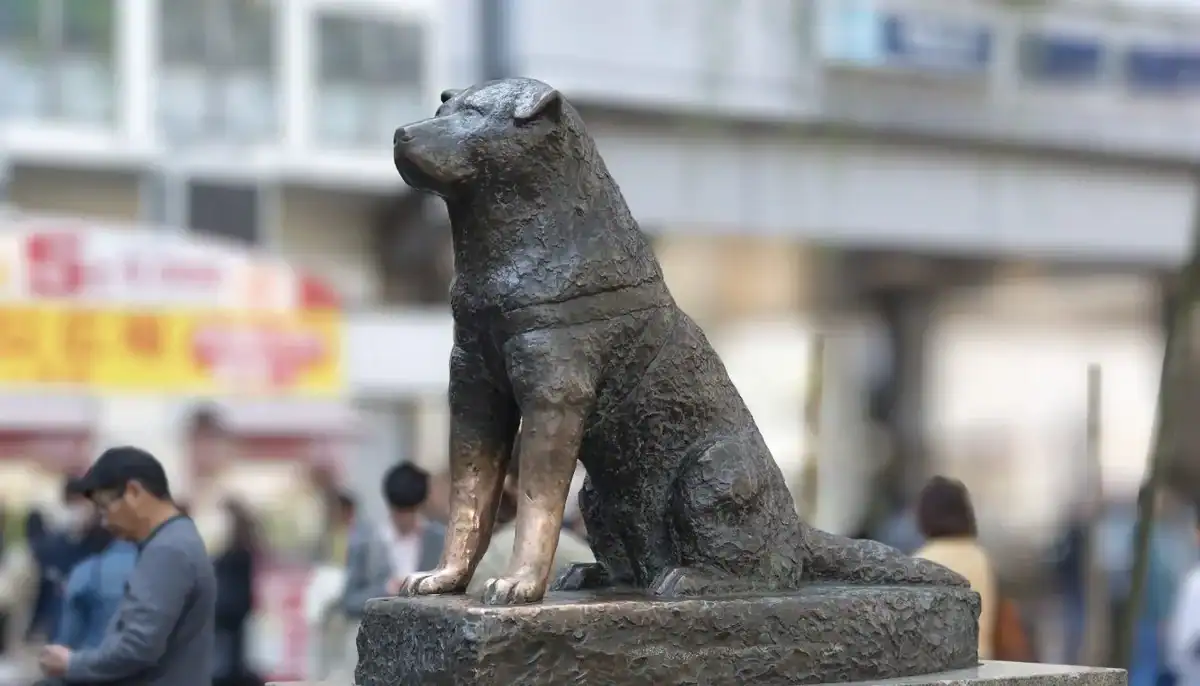
The bronze statue of Hachiko stands outside Shibuya Station in Tokyo, by the exit named after him. It is one of Tokyo’s best-known meeting spots. But it is not the first statue there.
The first statue was shown to the public on April 21, 1934, and Hachiko himself was at the ceremony. During World War II, the statue was melted down under a wartime order. That order collected metal to use in the war. A new statue took its place in 1948, Time Out Tokyo reports, and it still stands today.
A visitor guide
How to Visit the Hachiko Statue in Shibuya and More
A Hachiko visit in Tokyo can cover four places. They are the Shibuya statue, the museum in Ueno Park, the University of Tokyo and Aoyama Cemetery. You can see them all in a day. Most visitors start with the Hachiko statue in Shibuya.
Shibuya Station
The Hachiko statue
If you visit the Hachiko statue, expect crowds and a line for photos. Early morning is usually quieter.
Ueno Park
His preserved body
After he died, his body was preserved through taxidermy, a way of keeping an animal’s body so it still looks lifelike. It is kept at the National Museum of Nature and Science, sometimes called the National Science Museum of Japan. Displays sometimes change, so check the museum’s website first.
University of Tokyo
Statue and organs
A statue of Hachiko and Professor Ueno was first shown on campus on March 8, 2015. Some of his saved organs are on display at the Agricultural Museum, next to a bust of Prof. Ueno. A bust is a statue of a head and shoulders.
Aoyama Cemetery
His memorial stone
Some of his remains were buried beside Prof. Ueno’s grave, under a memorial stone for Hachiko.
The cemetery details come from Minato City, the part of Tokyo where the cemetery is. The campus statue shows an imagined reunion between dog and master, not a real event.
Further north in Odate, the “Hachiko Looking Homeward” statue stands outside the Akita Inu Kaikan. The name means “Akita Dog Hall.” This building is the main office of the Akita Dog Preservation Society, a group that protects the breed. It also holds the Akita Dog Museum in Odate, which shows items about the breed.
Every spring
Hachiko Day and the Yearly Memorial
A ceremony to honor Hachiko is held each year on April 8 in front of the Shibuya statue. It is held one month after the date of his death so that it falls in cherry blossom season.
Films and a book
How Does Hachiko’s Story in Pop Culture Compare With History?
The dog’s story in pop culture is told as drama, so it does not follow the historical records in every detail. Films have been made in Japan, the United States and China. The Japanese film Hachikō Monogatari came out in 1987. The 2009 American remake, known as Hachi, starred Richard Gere and moved the story to Rhode Island. A Chinese version, also called Hachiko, came out in 2023.
These films are touching dramas inspired by his story. There is also a novel called Hachiko Waits (paid link) by Lesléa Newman, with pictures by Machiyo Kodaira.
Chapter VII
How True Is the Story of Hachiko?
The heart of the story is true, but the records do not back up some popular details about the dog named Hachiko. Here is what holds up and what does not.
Documented means the records show it. Disputed means sources tell it differently. Myth means the records show it is not true.
Returned to Shibuya Station for nearly 10 years
Prof. Ueno died in May 1925 and Hachiko died in March 1935, still visiting the station.
DocumentedMet Prof. Ueno at the station every day
Historian Takashi Tamura says Prof. Ueno walked to Komaba. The 1934 textbook tells the daily station story.
DisputedLived alone as a homeless stray
After a few short stays in other homes, a gardener, Kikuzaburō Kobayashi, took him in and cared for him.
MythWas there when his own statue was first shown
He was there on April 21, 1934, almost a year before he died.
DocumentedYakitori skewers killed him
Four bamboo skewers were found, but the record notes no damage from them.
MythHeartworm disease was the recorded cause of death
The 1935 autopsy found many heartworms. A 2011 study also found likely cancer that played a part.
DocumentedToday’s statue is the 1934 original
The first statue was melted down in World War II. Today’s statue dates from 1948.
MythBorn in November 1923
Records give November 1923. A University of Tokyo document gives the day as November 10.
DocumentedHachiko Dog FAQ
Where is Hachiko buried?
Some of his remains were buried beside Prof. Ueno’s grave at Aoyama Cemetery in Tokyo, under a memorial stone for Hachiko.
Can you see Hachiko’s body today?
His preserved body is kept at the National Museum of Nature and Science in Ueno Park, Tokyo. Check the museum’s website before you visit, since displays change.
What does the name Hachiko mean?
Hachi means “eight” in Japanese, a lucky number in Japan. The ending “kō” is a polite title, added as a sign of respect.
Why is Hachiko called the most loyal dog in the world?
Because of his years of visits to Shibuya Station after Prof. Ueno passed away. Newspapers, statues and films later carried his story far beyond Japan.
How long did Hachiko live with Prof. Ueno?
About 16 months, from January 1924 to May 1925. He then waited nearly 10 years for his owner.
Was Hachiko a male or female dog?
Hachiko was a male dog.
How is Hachiko written in Japanese?
His name is written ハチ公 in Japanese. His full nickname, Chūken Hachikō, is written 忠犬ハチ公.
Where is Odate, the town where Hachiko was born?
Odate is a city in Akita Prefecture, in the north of Japan’s main island. The Akita breed is named after this region.
Final Thoughts
The story of Hachiko the dog is not exactly the story most people know. Some parts were added later. But the true parts are still touching.
He kept going back to Shibuya Station for years, and people still remember him for it. Today the bronze statue, the yearly ceremony and the films keep his story alive.
If his story has made you curious about the breed, read our Akita guide or browse more working dog breeds.
Sources
- University of Tokyo, Komaba Hachiko story (commute, textbook, autopsy record)
- University of Tokyo Veterinary Pathology, Hachiko findings
- University of Tokyo, Tansei magazine
- University of Tokyo, Hachiko centennial symposium abstracts
- Nippon.com, Hachiko
- Time Out Tokyo, Hachiko statue history
- Akita Sakigake Shimpo, April 8 memorial
- Akita Prefecture, list of natural monuments
- Tohoku Tourism, Akita Inu Kaikan and the Odate statue
- Minato City, Aoyama Cemetery history
- American Kennel Club, Helen Keller was a true dog lover
Editorial Note. This article is for informational and educational purposes. It draws on historical records and on sources from universities, museums and government bodies. It also uses published accounts available at the time of writing. Brief quotations are included for historical context and are credited to their sources. Translations from Japanese are K9Sphere’s own.
Accuracy Notice. Historical accounts sometimes differ, and new records can come to light. Where sources disagree, this article says so. If you spot an error, please contact us so we can review and correct it.
Image Notice. Images are used under the license or public domain status shown in each caption. The historical photo of Hachiko in this article is in the public domain in Japan and the United States. Microsoft Fluent Emoji assets are used under the MIT License. Copyright © Microsoft Corporation. The full license text is on our image credits page.
Product Disclosure. Product recommendations are based on independent research and editorial judgment. As an Amazon Associate, K9Sphere earns from qualifying purchases at no additional cost.
Independence. K9Sphere is an independent website. It is not affiliated with, sponsored by, or endorsed by any museum, university, organization, film studio or brand mentioned in this article, apart from taking part in the Amazon Associates program. Names of organizations, books and films are used for identification only. All trademarks belong to their respective owners.
Last reviewed November 5, 2026.