
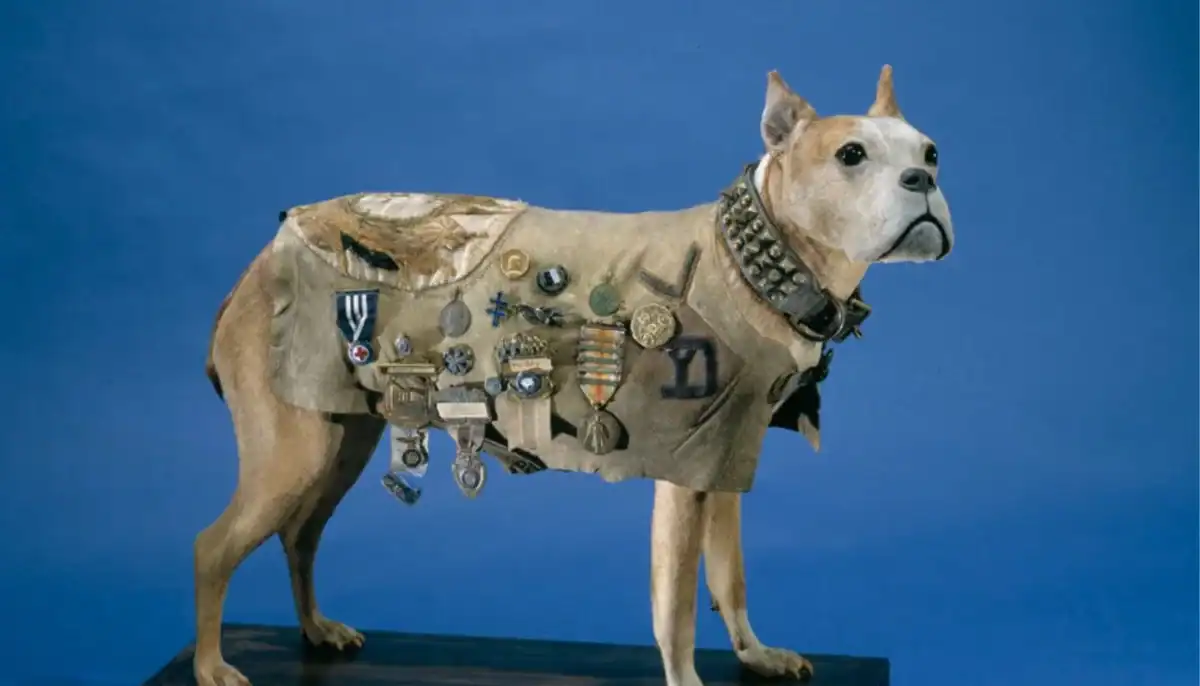
Sergeant Stubby was a stray brindle dog who became the mascot of the 102nd Infantry Regiment, part of the 26th “Yankee” Division, in World War I (WW1). He served on the front lines in France, survived poison gas and a shrapnel wound, and met three US presidents. His preserved body is now at the Smithsonian Institution, the national museum group of the United States, in Washington, D.C.
His exact breed is unknown, though records point to a Boston Terrier-type mix. People still argue about his breed, his rank and his medals. Here is his true story, myths and all.
The stray who went to war
From Yale Field
to the Front Lines
17
Battles
4
Major offensives
1
Gold medal from Pershing
3
Presidents met
The Short Answer on His Breed
Stubby was a stray, so nobody can name his breed with certainty. His 1926 obituary called him a brindle and white “bull terrier,” and Georgetown said he represented the “Boston bull terrier” in a general way. The Boston Terrier itself was once called the American Bull Terrier and the Boston Bull Terrier, so a Boston Terrier-type mix is the strongest possibility. Today the Bull Terrier is a separate breed.
Breed
Unknown, most likely a Boston Terrier-type mix
Found
Yale Field, New Haven, Connecticut, 1917
Unit
102nd Infantry, 26th “Yankee” Division
Trick
A salute, right paw to right eyebrow
Georgetown
“Boston bull terrier,” in a general way
Honor
Humane Education Society gold medal from Gen. John J. Pershing
Died
March 16, 1926, Washington, D.C.
Today
Smithsonian National Museum of American History
Affiliate Disclosure. K9Sphere is a participant in the Amazon Services LLC Associates Program. As an Amazon Associate I earn from qualifying purchases. Links marked (paid link) may earn K9Sphere a commission on qualifying purchases, at no additional cost to you.
Chapter I
Who Was Stubby?
Stubby was a stray puppy who became the mascot of the 102nd Infantry Regiment in 1917. He served with the unit in France but was never formally enlisted, and his 1926 obituary notes that he “had no enlistment card.”
The USA entered World War I in April 1917, and later that year the regiment was training on Yale Field in New Haven, Connecticut, when he wandered into camp and decided to stay. The Smithsonian National Museum of American History, which holds Stubby today, describes him as a brindle puppy with a short tail. Brindle describes a coat with darker and lighter streaks.
Private J. Robert Conroy took a liking to the puppy and later became his owner. The soldiers named the dog Stubby after his short tail. Animals were not allowed in camp, but Stubby had such a positive impact on morale that he was allowed to stay. He learned the bugle calls and drills, and he even picked up a salute, raising his right paw to his right eyebrow.
How Stubby Got to France
When the 26th Division shipped out for France, Conroy smuggled Stubby aboard the SS Minnesota and hid him in the coal bin until the ship was far out at sea. In France, Conroy’s commanding officer discovered the stowaway. Stubby saluted the officer, who let the dog stay. Soon Stubby received orders to travel with the division as its mascot, an animal a unit adopts for company and morale.
Map of a life
Stubby’s Journey in 6 Stops
1917
New Haven, Connecticut
Found as a stray on Yale Field.
1917
SS Minnesota
Smuggled across the Atlantic in a coal bin.
Feb 5, 1918
Chemin des Dames, France
A ridge where he first faced the front lines.
Apr 20, 1918
Seicheprey, France
A French village where he was wounded by grenade shrapnel.
Apr 20, 1919
Camp Devens, Massachusetts
Released from service with the 102nd Infantry.
1920s
Washington, D.C.
Georgetown football games and his final home.
Chapter II
What Breed Was Sergeant Stubby?
Stubby’s exact breed is unknown, but the records point to a Boston Terrier-type mix.
No record names his parents, and he had no pedigree or registration papers. His New York Times obituary of April 4, 1926, called him “the brindle and white ‘bull terrier.'” The writer put “bull terrier” in quotation marks, which suggests a rough description rather than an exact breed. The obituary also said plainly that he had no pedigree, as this line shows.
From his obituary, April 4, 1926
“He was only a dog and unpedigreed at that, but he was the most famous mascot in the A.E.F.”
The New York Times. A.E.F. stands for American Expeditionary Forces, the US forces sent to Europe in World War I.
You can read the full obituary on the Connecticut Military Department web page. Later sources point in a similar direction. Georgetown University, where Stubby entertained football crowds in the 1920s, describes him as representing the Boston bull terrier breed “in a general way.” The American Kennel Club calls him a stray brindle dog of Boston Terrier or Bull Terrier type.
Evidence check
How Strong Is the Case for Each Breed?
Boston Terrier-type mix
Georgetown linked him to the Boston bull terrier. His brindle and white coat fits too. The AKC also names this type.
“Bull terrier” type mix
This is the word his 1926 obituary used. Early Boston Terriers were also called American Bull Terriers. So the word may mean a Boston type.
Pit bull type
This is mostly a modern idea. His 1926 obituary does not call him a pit bull.
Boxer
This is based on looks only. People often see their favorite breed in him.
These ratings are K9Sphere’s judgment of the available records, not statistical probabilities.
Here is a detail that is easy to miss. The Boston Terrier went by several names in its early years, including Round Heads, American Bull Terrier and Boston Bull Terrier. Its founding dog was Hooper’s Judge, a cross between an English Bulldog and the White English Terrier, a breed that no longer exists. Knowing these old names helps explain why descriptions of Stubby can be confusing.
Name decoder
The Boston Terrier’s Many Names
About 1870
Hooper’s Judge
Robert C. Hooper of Boston bought this dog. Judge was an English Bulldog and White English Terrier cross. He became the breed’s founding dog.
Late 1800s
Early names
Breeders showed the early dogs as Round Heads or American Bull Terriers. Boston Bull Terrier was another early name.
1893
Boston Terrier
The Boston Terrier Club of America formed in 1891. Two years later, the AKC registered its first Boston Terrier.
1926 and later
Old names stick
His 1926 obituary called Stubby a “bull terrier.” Georgetown later linked him to the Boston bull terrier.
So when his 1926 obituary called him a “bull terrier,” the writer could have meant a Boston Terrier-type dog, but the wording alone does not prove it. By then the Boston Terrier was a well-established breed. Today it belongs to the AKC’s Non-Sporting Group, which includes many popular non-sporting dog breeds.
Size clue
How Heavy Was a Boston Terrier-Type Dog?
Hooper’s Judge, the founding dog
Boston Terrier standard, top limit
Stubby
The breed’s founding dog was heavier than today’s standard allows. No reliable measured weight for Stubby has been recorded, so this comparison cannot tell us how big he was.
Chapter III
Was Stubby a Pit Bull or a Boston Terrier?
The historical descriptions make a Boston Terrier-type mix the strongest possibility, not a pit bull. This is one of the most debated questions about Stubby. The table below shows how six sources describe him, from his 1926 obituary to modern museum, breed history and news accounts.
| How He Was Described | Who Said It | Date or Context |
|---|---|---|
| Brindle puppy with a short tail | Smithsonian museum record | 1917 (period described) |
| Brindle and white “bull terrier,” unpedigreed | The New York Times obituary | 1926 |
| Said to represent the Boston bull terrier breed “in a general way” | Georgetown University Library | Modern look back at his Georgetown years |
| Boston Terrier or Bull Terrier type | American Kennel Club breed history | Current web page |
| Bull terrier mix | AKC Museum of the Dog statue announcement | 2019 |
| A mutt from Connecticut | Connecticut Public news report | April 20, 2026 |
By the numbers
What Those 6 Sources Have in Common
use the words “bull terrier”
say no pedigree or call him a mutt
mention Boston
call him a pit bull
These counts cover only the six sources above, and some sources fit more than one ring.
None of the six sources call him a pit bull. So why do some people think he was one? In museum pictures, his compact build and short coat can look like the American Pit Bull Terrier or the Staffordshire Bull Terrier.
The American Pit Bull Terrier and the Staffordshire Bull Terrier come from bulldog and terrier crosses, just like the Boston Terrier. Each later became its own breed. That shared history may explain why people see a resemblance.
Historian Ann Bausum, who wrote two books about Stubby, explained this in a Military Times article. She said people tend to see their favorite breed in him. “If you love boxers, he’s a boxer,” she said. But she also noted that “he did look like what was then a Boston terrier.”
Keep in mind that Boston Terriers in Stubby’s day did not look exactly like today’s. Early Bostons could be bigger, like the founding dog Hooper’s Judge. Today’s smaller Boston is often mixed up with the French Bulldog. Our French Bulldog vs Boston Terrier guide shows how to tell the two apart.
Chapter IV
What Did Stubby Do During the War?
During World War I, Stubby served on the front lines in France as the 102nd Infantry’s mascot, keeping the men company and lifting morale. After being gassed himself, he reportedly smelled gas early and warned the men. He also helped find wounded soldiers and, by several accounts, held a German soldier until American troops arrived. He was injured by gas and later wounded by shrapnel.
The regiment reached the front on February 5, 1918, in the Chemin des Dames sector, a ridge in northern France whose French name means “the Ladies’ Way,” north of the town of Soissons.
His 1926 obituary says he was under fire night and day for more than a month in that sector. The noise and strain shook many of the men, and Stubby helped keep their spirits up. These four episodes are among the best-known parts of his war story.
Field report
Four Episodes That Made Him Famous
Early 1918
The gas alarm
He was exposed to poison gas and treated at a field hospital. Afterward he reportedly picked up the smell of gas before the soldiers did. Dogs have a far stronger sense of smell than people. In one early morning attack, he ran through the trench barking and nipping at sleeping men. That woke them in time to raise the gas alarm.
April 20, 1918
Wounded at Seicheprey
During the German raid on the French village of Seicheprey, grenade shrapnel struck his chest and leg, according to the Smithsonian. The Connecticut Military Department describes a wound to his foreleg. Once he was well enough to move around the hospital, he visited other wounded soldiers to lift their spirits.
No-man’s-land
Finding the wounded
He searched the battlefield for wounded men, including no-man’s-land, the open ground between enemy trenches. When he found someone, he barked until medics arrived. Other times he guided lost soldiers back to the trenches.
Details differ
Catching a German soldier
In his most famous act, he reportedly held a German soldier until American troops arrived. The 1926 obituary places it at Chemin des Dames, the Smithsonian late in the war and the Connecticut Military Department in the Argonne.
The Smithsonian museum credits Stubby’s gas warning with saving many soldiers from injury. It also says Stubby took part in 17 battles. His 1926 obituary counts four major offensives. These numbers measure different things, because an offensive is a large campaign that can include several battles. In 1921, General John J. Pershing presented him with the Humane Education Society’s gold medal, as the National Park Service notes.
Famous meetings
The Three Presidents Who Met Stubby
Woodrow Wilson
Christmas Day 1918, in France, after the fighting ended.
Warren G. Harding
A visit to the White House after the war.
Calvin Coolidge
Met Stubby more than once, while serving as governor, vice president and president.
Chapter V
Was Stubby Really a Sergeant?
Sources disagree. The AKC and the National Park Service both say he was promoted for his heroic work in the trenches. Historian Ann Bausum read hundreds of newspaper articles from his lifetime and found no report calling him “Sgt. Stubby.” She said she is “quite convinced that he was promoted by the internet.” One possible source of the confusion is his blanket.
3 chevrons = time overseas, not rank
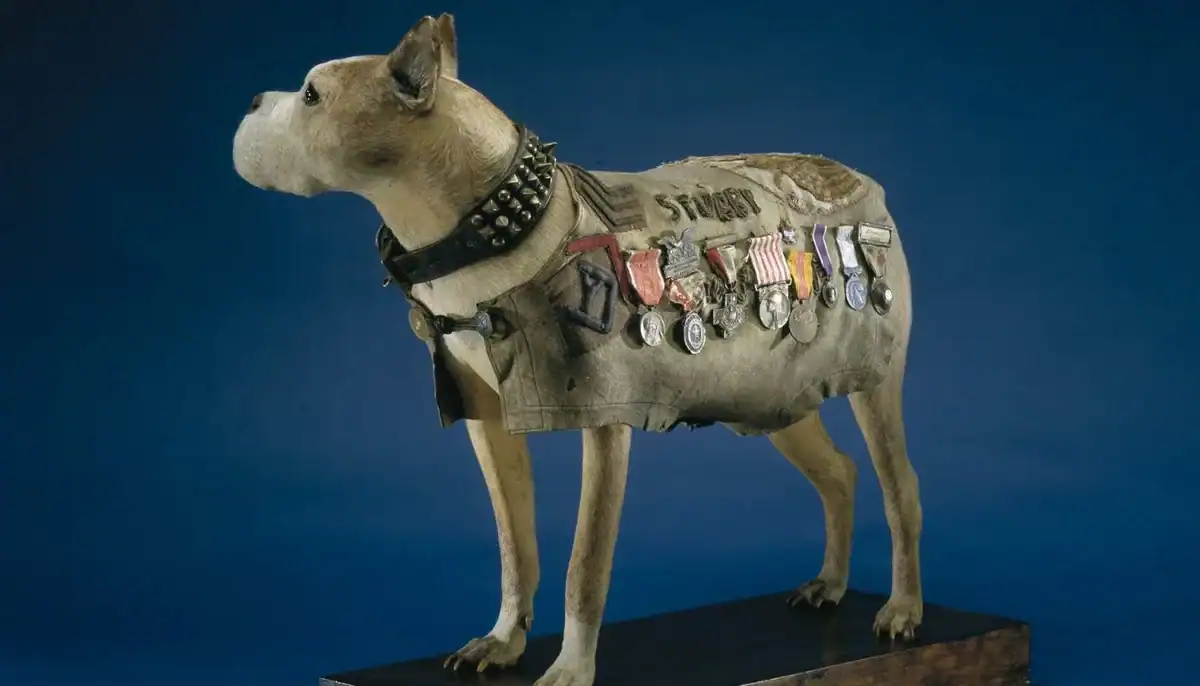
Stubby’s blanket carries three chevrons. In World War I, each overseas service chevron stood for six months of service abroad. They look a lot like sergeant stripes, but they marked time overseas, not rank.
What About His Purple Hearts?
Claims that he received Purple Hearts run into a problem of dates. The modern Purple Heart was revived on February 22, 1932, as the National Archives explains.
1926
Stubby dies on March 16
6 years later
1932
Purple Heart revived on February 22
Accounts of a later award disagree. The AKC says he received two Purple Hearts, while a 2026 Connecticut Public report says he received one after his death. Neither account cites an official award record. His wounds were real, but no official US military Purple Heart award has been documented.
None of this takes anything away from his war service. He is widely remembered as a sergeant today, even though the record does not settle whether he was ever formally promoted.
Chapter VI
Is Stubby’s Story Fact or Legend?
Famous stories often pick up details over a century that the records do not support. Here is how the best-known claims about Stubby stand up against the records. The list below also makes a good classroom activity on checking sources.
Found as a stray at Yale in 1917
The Smithsonian, the 1926 obituary and Georgetown all link him to the regiment’s training at Yale.
DocumentedServed in 17 battles
The Smithsonian gives 17. His obituary mentions four major offensives.
DocumentedDied on March 16, 1926
The Smithsonian gives this date. His New York Times obituary ran on April 4, 1926, which is why that later date sometimes appears.
DocumentedCaptured a German soldier, reportedly a spy
The capture appears in early records, but the place and details differ.
DisputedReceived Purple Hearts
The modern medal came in 1932, after his death. Later accounts claim one or two awards, but no official award has been documented.
DisputedPromoted to Sergeant
The AKC and National Park Service say yes. Ann Bausum found no newspaper of his lifetime calling him Sgt.
DisputedHe was a purebred dog
He was a stray with no known pedigree. Old descriptions hint at breed links but do not prove any pure breed.
LegendDNA has proven his breed
No DNA study of Stubby has been published, so his exact ancestry is unknown.
LegendChapter VII
How Was Stubby Honored and Remembered?
Stubby was honored while he was still alive. In 1921, General Pershing gave him a gold medal from the Humane Education Society. He was also made a member of the American Legion and the Y.M.C.A.
He died in 1926, and The Washington Post and The New York Times both ran obituaries. Conroy never adopted another dog after him. Today his preserved body is on display at the Smithsonian. Three sculptures honor him in Connecticut and New York. Books tell his story to both adults and children.
Humane Education Society gold medal from Gen. Pershing
Member of the American Legion and the Y.M.C.A.
Georgetown football mascot
A long New York Times obituary
Preserved at the Smithsonian
Tributes in three places
Where to See Stubby Today
In 1956, Conroy gave Stubby to the Smithsonian. His body had been preserved through taxidermy, and the museum lists the materials as fur and plaster. Today he is part of the Price of Freedom exhibition at the National Museum of American History in Washington, D.C. Museum displays sometimes change, so check the museum’s website before you go to make sure he is on view.
In New York, the AKC Museum of the Dog unveiled a bronze statue called Stubby Salutes on May 23, 2019, as the AKC announced. Sculptor Susan Bahary made it. The original statue stands at Veterans Memorial Park in Middletown, Connecticut.
On April 20, 2026, a life-size reproduction of Stubby was unveiled in Hartford, Connecticut. It is in the Museum of Connecticut History, inside the Connecticut State Library. David Hayes Studio made it, as the Connecticut National Guard reported. The unveiling came 100 years after his death.
Inside the library, visitors can touch a copy of the medal-covered blanket he wore, Connecticut Public reported.
His Story in Books and Film
Stubby’s story also lives on in books, including Ann Bausum’s 2014 biography for adults (paid link) and her children’s book, Stubby the War Dog (paid link). A 2018 animated movie retold his life for family audiences. If you watch it with kids, remember it is a dramatized story, not a documentary or a history lesson.
Sergeant Stubby FAQ
What breed was Sergeant Stubby?
His exact breed is unknown. His 1926 obituary calls him a “bull terrier,” and Georgetown links him to the “Boston bull terrier,” which makes a Boston Terrier-type mix the most likely answer.
Was Stubby a pit bull?
None of the historical sources in this article call him a pit bull. His 1926 obituary called him an unpedigreed “bull terrier,” and Georgetown said he represented the “Boston bull terrier” in a general way.
What did “bull terrier” mean in Stubby’s obituary?
Nobody can say for sure. Early Boston Terriers were once called American Bull Terriers or Boston Bull Terriers, so the writer may have meant a Boston Terrier-type dog. The word alone does not prove it.
Was Stubby really a sergeant?
Sources disagree. The AKC and the National Park Service say he was promoted, but historian Ann Bausum found no newspaper from his lifetime that called him Sgt. The three service chevrons on his blanket marked time overseas, not rank, and they may explain some of the confusion.
When was Stubby born?
Nobody knows his exact birth date. The Smithsonian museum describes him as a puppy when he was found in 1917, which suggests he was born around 1916 or 1917.
His 1926 obituary speaks of “five peregrinating years,” meaning years of wandering, before he reached Yale. But parts of the obituary tell his story with gentle humor. For example, it says he chose Yale as his “alma mater,” the school a student attends, as if a stray dog had enrolled in college. So the “five years” may not be an exact number.
How did Stubby join the army?
He wandered onto Yale Field in New Haven, Connecticut, in 1917 while the 102nd Infantry was training there. Private J. Robert Conroy adopted him and smuggled him to France, where he received orders to serve as the division’s mascot. He was never formally enlisted in the Army.
Did Stubby really salute?
Yes. The Smithsonian museum says he learned to raise his right paw to his right eyebrow when soldiers saluted. A salute is also what reportedly won over Conroy’s commanding officer in France.
What happened to Stubby after the war?
He came home in 1919, met Presidents Harding and Coolidge, received a medal from General Pershing in 1921 and became a football mascot at Georgetown University while Conroy studied law there. He died in 1926.
How many battles did Stubby fight in?
The Smithsonian museum credits him with 17 battles. His 1926 obituary says he took part in four major offensives, which are larger campaigns that can each include several battles.
Did Stubby get a Purple Heart?
Not during his lifetime. The modern Purple Heart was revived in 1932, six years after he died. Later accounts claim one or two awards, but no official US military award has been documented.
How did Sergeant Stubby die?
The Smithsonian museum record does not give a cause of death. He died in Washington, D.C., on March 16, 1926, years after the war. The New York Times published a long obituary for him on April 4, 1926.
Where is Stubby today?
His body, preserved through taxidermy, is at the Smithsonian National Museum of American History in Washington, D.C. Conroy presented him to the museum in 1956.
Where is Stubby buried?
He has no grave in the usual sense. His body was preserved through taxidermy. It is kept at the Smithsonian Institution, the national museum group of the United States, in Washington, D.C. His 1926 obituary even said “His Arlington is to be the Smithsonian Institution,” comparing the museum to Arlington National Cemetery, the resting place of American war heroes.
Has Stubby ever been DNA tested?
No DNA study of Stubby has been published. Without genetic evidence or a documented pedigree, any single breed label remains an educated guess.
Where can I see a Stubby statue?
Three well-known figures of Stubby are on public view. The original bronze, Stubby Salutes, is at Veterans Memorial Park in Middletown, Connecticut. A second bronze casting is at the AKC Museum of the Dog in New York, and a life-size reproduction is at the Museum of Connecticut History in Hartford.
Who are some other famous military dogs?
Chips, a mixed breed dog, charged an enemy machine gun position in Sicily in 1943. He received the Silver Star, which was later rescinded after the War Department decided animals should not receive official military awards, as Military.com recounts. Smoky, a tiny Yorkshire Terrier, pulled a telegraph cable through a narrow pipe under a Philippine airfield in World War II, says the Australian War Memorial.
Final Thoughts
Stubby had no known pedigree, and whether he was formally promoted to sergeant is still disputed. What is clear is that a stray from Yale Field went to France with the 102nd Infantry, warned men about gas, helped find the wounded and came home famous. A century later, people still call him a hero.
He also mattered because of what he meant to the men around him. Perhaps his greatest gift was simple. He kept tired, frightened soldiers company in the trenches.
In the end, his breed matters less than who he was. He was a good dog who showed up for his people.
If his story has you curious about the breeds people compare him with, start with our terrier dog breeds guide or meet the Boxer, a breed some people see in his face.
Sources
- Smithsonian National Museum of American History, Stubby object record
- Smithsonian Institution Archives, Presentation of World War I Mascot Stubby, 1956
- Connecticut Military Department, Stubby’s obituary from The New York Times, April 4, 1926
- Georgetown University Library, Did a decorated war hero once serve as our mascot?
- American Kennel Club, Boston Terrier History
- American Kennel Club, Stubby Salutes statue announcement, 2019
- Military Times, Stubby’s story, 2017
- National Archives, The History of the Purple Heart Medal
- National Park Service, Military Dogs
- Connecticut Military Department, Stubby at the front
- Military.com, the story of Chips
- Australian War Memorial, Smoky the Brave War Dog
- Finding Connecticut, Museum of Connecticut History to honor Sgt. Stubby, 2026
- Connecticut National Guard, Connecticut State Library Unveils New Sgt. Stubby Statue, 2026
- Connecticut Public, Sgt. Stubby statue report, 2026
Editorial Note. This article is for informational and educational purposes. It is based on historical records, museum and archive sources, and published accounts available at the time of writing. Short quotations are used for commentary and are credited to their sources. The 1926 New York Times obituary quoted here is in the US public domain.
Accuracy Notice. Historical accounts sometimes differ, and new records can come to light. Where sources disagree, this article says so. If you spot an error, please contact us so we can review and correct it.
Image Notice. Images are used under the license or public domain status shown in each caption. The photo of Stubby shows his preserved body at the Smithsonian, not a photo taken during his lifetime. Microsoft Fluent Emoji assets are used under the MIT License. Copyright © Microsoft Corporation. The full license text is on our image credits page.
Product Disclosure. Product recommendations are based on independent research and editorial judgment. As an Amazon Associate, K9Sphere earns from qualifying purchases at no additional cost.
Independence. K9Sphere is an independent site and is not affiliated with, sponsored by, or endorsed by any museum, organization, film studio or brand mentioned, apart from taking part in the Amazon Associates program. Names of organizations, books and films are used only to identify them, and all trademarks belong to their owners.
Last reviewed November 2026.

