

If you are comparing a German Shepherd vs Australian Shepherd, the first thing worth knowing is that both sit in the same AKC Herding Group. What surprises most buyers is how differently they were built to work.
The German Shepherd was created in Germany to tend flocks and patrol boundaries, then deliberately steered toward police, military, and protection work within two decades of its founding. The Australian Shepherd was refined on American ranches to gather and drive cattle across rough country, and it was never developed as a dedicated human-protection breed. Beyond the obvious difference in size and appearance, each makes a very different household companion.
They overlap more than the labels suggest. Each is highly intelligent, reserved with strangers, heavy shedding, prone to herding children, and genuinely demanding of daily physical and mental work. The key differences come down to size, protective instinct, lifespan, and two completely separate genetic risk profiles.
This guide compares them across the areas that decide the match, from herding style and temperament to health screening, grooming, and cost. Each section ends with a clear round verdict so you can see which breed fits your stated use case.
Read it as a decision tool for weighing the real-life trade-offs between these two herding breeds. By the final verdict you should know whether you want a protector or a ranch athlete.
Affiliate Disclosure: K9Sphere is a participant in the Amazon Services LLC Associates Program. As an Amazon Associate, K9Sphere earns from qualifying purchases made through links in this article at no additional cost to you. Product recommendations are based on independent research and editorial judgment, not paid placement.
Quick Answer and Who Each Round Favors
⚡ The 30-Second Answer
Choose the German Shepherd if you want a large, protective working partner with a genuine guarding instinct and you can handle the size, the workload, and the orthopedic risk. Choose the Australian Shepherd if you want a medium, longer-lived ranch athlete with elite trainability and no protection baggage.
Each is a demanding herding breed that needs substantial daily physical and mental work, and neither is an ideal choice for a sedentary home. The real decision is whether you need a protector or a sport and work partner.
| Category | Favors |
|---|---|
| Herding style and role | Depends on the job |
| Temperament | Roughly even |
| Protective instinct | German Shepherd |
| Trainability | Roughly even |
| Exercise and energy | Roughly even |
| Family fit | Roughly even |
| Grooming and shedding | Australian Shepherd (slightly) |
| Health and longevity | Australian Shepherd |
| Cost of ownership | Australian Shepherd |
| First-time owners | Neither, Aussie slightly ahead |
German Shepherd vs Australian Shepherd at a Glance
Whether you search for German Shepherd vs Australian Shepherd or Australian Shepherd vs German Shepherd, this comparison table lays out the core differences in size, role, health, and lifestyle fit. Scan the rows that matter most to you for a quick view of the similarities and differences, then read the detailed sections below.
| Attribute | German Shepherd | Australian Shepherd |
|---|---|---|
| Height (male) | 24–26 in (61–66 cm) | 20–23 in (51–58 cm) |
| Weight (male) | 65–90 lb (29–41 kg) | 50–65 lb (23–29 kg) |
| Lifespan | 9–13 years | 12–15 years |
| Origin | Germany | United States |
| Breed group | Herding (AKC 1908) | Herding (AKC 1993) |
| Original purpose | Tending flocks and patrol | Driving cattle and sheep |
| Herding style | Boundary tending | Gathering and driving |
| Protective instinct | Strong | Alert but minimal |
| Coat | Dense double coat | Dense weather-resistant coat |
| Colors | Black and tan, sable, black | Black tri, red tri, blue or red merle |
| Signature health risks | Hip dysplasia, bloat, DM | MDR1 sensitivity, eye conditions |
| Exercise | Up to two hours daily | 90 minutes to two hours daily |
| Puppy price range | 1,500 to 3,500 USD | 800 to 2,000 USD |
| First-time owner? | Not recommended | Challenging |
📜 A Quick Origin Story
The German Shepherd traces to a single vision. In 1899, cavalry officer Captain Max von Stephanitz bought a dog named Horand von Grafrath and founded the breed society that same year, making Horand the genetic template for everything that followed. The AKC recognized the breed in 1908.
The pivot came fast. As industrial farming reduced the need for flock tending, von Stephanitz deliberately redirected the breed toward police and military service. It served in World War I as a messenger, sentry, and casualty locator, and Rin Tin Tin turned it into a global star in the 1920s.
The Australian Shepherd is an American breed despite the name. Its exact ancestry is debated, with British, Spanish, Basque, Australian, and American working dogs all proposed as influences.
The popular account of Basque shepherds bringing dogs by way of Australia is one theory rather than established fact, and ranchers in the west refined the breed through the late 1800s for cattle and sheep across rugged country. The Australian Shepherd Club of America formed in 1957, and AKC recognition followed in 1993.
Who Should Choose the German Shepherd
🐕 The German Shepherd is the right pick if:
- You want a genuine protective instinct alongside working intelligence.
- You can physically manage and train a dog of 65 to 90 pounds.
- You have experience with high-arousal breeds or will hire professional help.
- You want a deeply bonded dog that often attaches most to one handler.
- You can budget for the orthopedic and emergency risks the breed carries.
Who Should Choose the Australian Shepherd
🐕 The Australian Shepherd is the right pick if:
- You want elite trainability for agility, rally, disc, or stock work.
- You prefer a medium dog that is easier to lift, transport, and manage.
- You value a notably longer lifespan of 12 to 15 years.
- You want a watchful dog without protection-breed responsibility.
- You will test for MDR1 and avoid any merle-to-merle breeding.
Herding Style and Working Role
Both sit in the Herding Group, but they were developed for somewhat different approaches to livestock work. The German Shepherd is a tending breed, developed to walk boundaries and act as a living fence that keeps a flock inside unfenced grazing land. That role rewards patience, endurance, and a willingness to confront intruders across rural farmland.
The Australian Shepherd is a gathering and driving breed, refined on western ranches to collect scattered cattle and push them across open country. That work rewards speed, direction changes, and close pressure on stock through heel nipping and the intense stare handlers call giving eye. Herding ability remains the metric ranch breeders selected for above all else.
Those origins still show up in the living room. An Aussie is more likely to circle running children, nip at heels, and try to control movement, while a Shepherd is more likely to position itself between the household and a visitor. Neither instinct can be trained away, so both need a constructive outlet instead.
🎯 Verdict: This depends entirely on the job you have in mind. The German Shepherd suits patrol, protection, and structured service work, while the Australian Shepherd suits stock work and competitive dog sport.
Temperament and Personality
These two are more alike than buyers expect. Each is highly intelligent, deeply bonded to its household, reserved rather than effusive with strangers, and prone to neurotic behaviour when its mind goes unused. Boredom is the root of most problems in both breeds.
The German Shepherd is often described as a one-person dog, frequently selecting a single primary handler and shadowing that person through the house. It carries high arousal by design, reacting fast to sudden movement, and its independence shows in how readily it acts without waiting for a command.
The Australian Shepherd is more openly people-oriented and wants to participate in everything rather than stand guard. It shows open affection with family once properly exercised, though a bored one will bark and pace instead, and its relentless intensity overwhelms households expecting a low-effort pet, and each is prone to distress when left alone for full work days.
🎯 Verdict: Roughly even, since each is intelligent, reserved, and bonded to its people. The Shepherd leans toward watchful attachment to one handler, while the Aussie leans toward participatory involvement with everyone.
Protective Instinct
This is the clearest split between them. The German Shepherd carries a genuine guardian instinct and remains one of the most widely deployed police, military, and personal protection breeds in the world. A stable example observes quietly, takes cues from its handler, and acts as a real deterrent.
The Australian Shepherd is watchful and naturally reserved around strangers, and it will alert to activity around its property. Neither breed scores high on friendliness toward unfamiliar people, so stranger tolerance has to be built rather than assumed. That is where it stops. It was not developed as a dedicated human-protection breed, though ranch dogs were expected to be watchful over livestock and property.
Its wariness is better understood as caution that needs socializing than as a security asset.
Neither instinct should be pushed toward aggression. A Shepherd’s guarding drive demands intense socialization between 8 and 16 weeks so it assesses accurately rather than reacting fearfully, and an Aussie needs the same window so its natural reserve does not harden into fear-based reactivity.
🎯 Verdict: The German Shepherd wins this round decisively if protection matters to you. The Australian Shepherd is an alert watchdog, not a deterrent, which many families consider an advantage rather than a shortfall.
Trainability
Both rank near the top of any trainability list, and this round is close to a dead heat. Each learns commands at remarkable speed, which cuts both ways, because both pick up bad habits just as quickly when a handler is inconsistent.
The German Shepherd combines that speed with an intense desire to please and enough physical power that structure becomes a safety issue rather than a convenience. It responds badly to heavy-handed correction, which fractures trust and can provoke defensive snapping, so firm boundaries through positive reinforcement work best.
The Australian Shepherd is often described as desperate to learn, and it dominates agility, rally, disc, and stock trials for exactly that reason. It also shuts down under harsh handling, and rally obedience is one of the venues where it consistently excels. The practical difference is consequence rather than aptitude, since mistakes with a 90-pound protective dog carry higher stakes.
🎯 Verdict: Call it even on raw aptitude. Each is an exceptional learner that needs positive reinforcement and clear rules. The Aussie edges ahead in competitive sport, while the Shepherd’s size raises the cost of training errors.
Exercise and Energy Needs
Neither breed is satisfied by a walk around the block, and both land in rescue when owners underestimate this. The German Shepherd typically needs up to two hours of vigorous daily work, while the Australian Shepherd is usually quoted at 90 minutes to two hours plus significant mental stimulation. Treat those as practical guidelines rather than fixed minimums, since individual drive varies.
Physical exhaustion alone fails with both. Each needs problem-solving work through scent games, structured training drills, puzzle feeders, or sport, and both will invent their own entertainment when bored. A long hike on leash satisfies the body but not the athletic mind behind it. For the Aussie that usually means destroying belongings, and for the Shepherd it often means pacing and vocal frustration.
For each breed, growth-plate protection matters during the first year, so forced running and repetitive jumping should wait until the joints mature. A securely fenced yard suits both, and the Aussie in particular is strongly recommended a yard rather than apartment life.
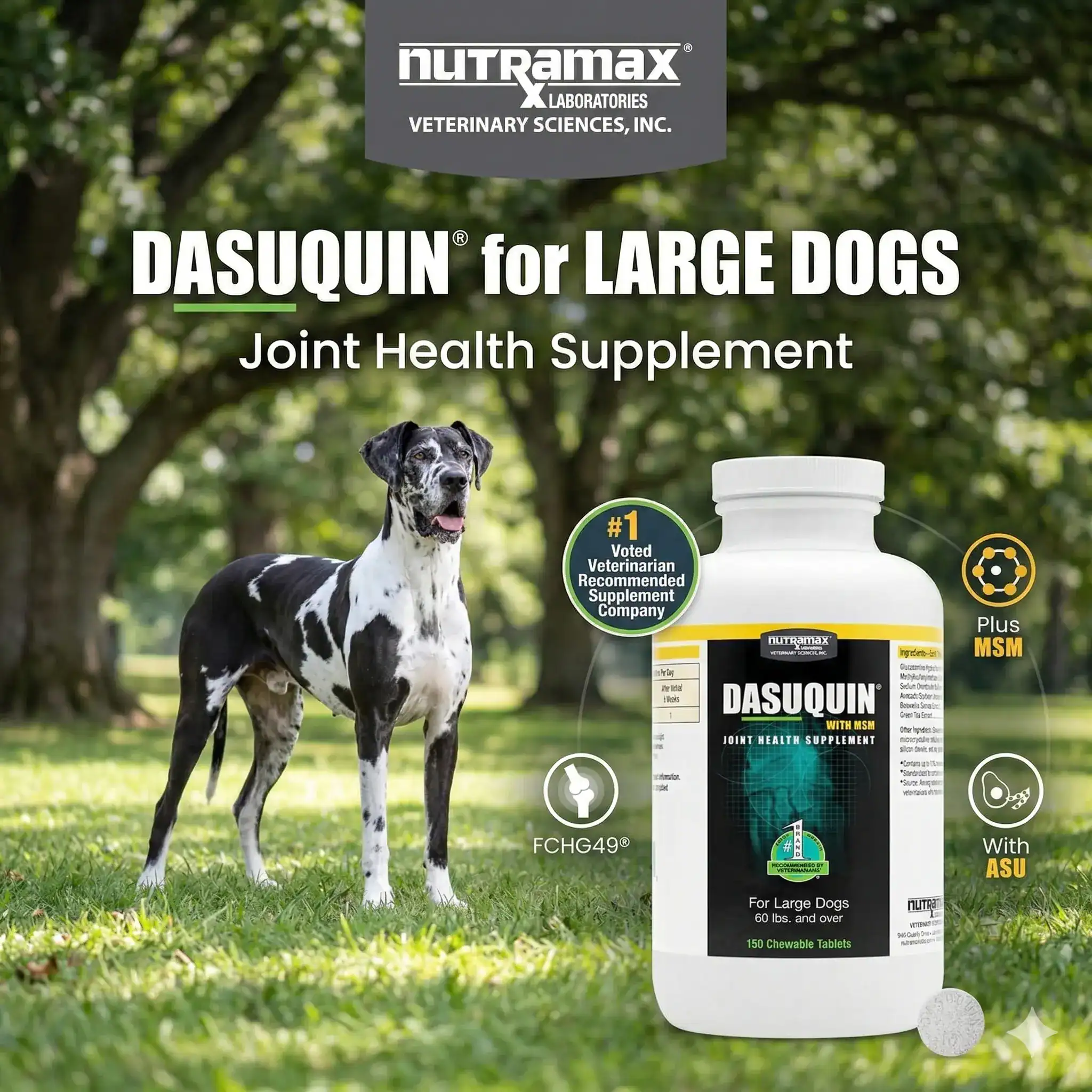
Nutramax Dasuquin with MSM Soft Chews for Dogs
Use for: Hip and elbow dysplasia affect both herding breeds, and years of sport work load the same joints. Glucosamine, chondroitin, and MSM help support cartilage in hard-working dogs.
Check price on Amazon🎯 Verdict: Roughly even, and each is genuinely demanding. Both need substantial daily physical and mental work, often around one to two hours depending on age, health, and individual drive, and neither is an ideal choice for a sedentary household.
Family Fit
Each can be a devoted family dog in an active household, and both bond closely with their own children. The German Shepherd often acts as a gentle supervisor for the kids it lives with, while a well-exercised Aussie is surprisingly affectionate and wants to join every activity.
The shared caution is herding behaviour aimed at children. Some individuals may stare, circle, or nip at the heels of running toddlers to control movement, which is instinct rather than aggression but still needs immediate redirection. Teaching children to avoid chase games helps considerably with either breed.
With other pets, a resident cat needs careful introduction to either breed, and the Shepherd’s higher prey drive makes that groundwork more important. Visitors are where they diverge. The Shepherd’s guard drive means introductions need structure and calm handling, since an under-socialized dog may treat a delivery person as a threat. The Aussie’s reserve is milder, though it still benefits from broad early exposure to unfamiliar people.
🎯 Verdict: Roughly even for active families. Each is devoted to its own children, and both herd them. The Aussie is simpler around visitors, while the Shepherd asks for more deliberate management of introductions.
Grooming and Shedding
These two are double-coated shedders, and neither is a low-maintenance choice. The German Shepherd is nicknamed the German Shedder, dropping fur moderately year-round with a massive blowout twice a year. The volume it produces is the single most common complaint from owners.
The Australian Shepherd sheds moderately year-round with the same twice-yearly blowouts, but produces less by sheer volume given its smaller frame. Its weather-resistant coat does mat behind the ears and under the legs without regular attention, which the Shepherd’s harsher coat does less often.
Coat care is similar for both, with brushing at least twice weekly and daily during seasonal blowouts, using an undercoat tool rather than a surface brush.
Routine shaving is not recommended for either coat, since the double layer regulates temperature in both directions and protects skin from sunburn, though veterinary clipping may be necessary for medical reasons. Bathe both sparingly to preserve the protective oils, and choose a gentle formula for an Aussie prone to skin allergy or seasonal hot spots.
Both also cope poorly with a hot, humid climate despite the insulation working well in cold weather, so shift exercise to early morning and late evening in warm regions. Daily toothbrushing should be part of the routine for either breed, alongside regular veterinary dental checks.
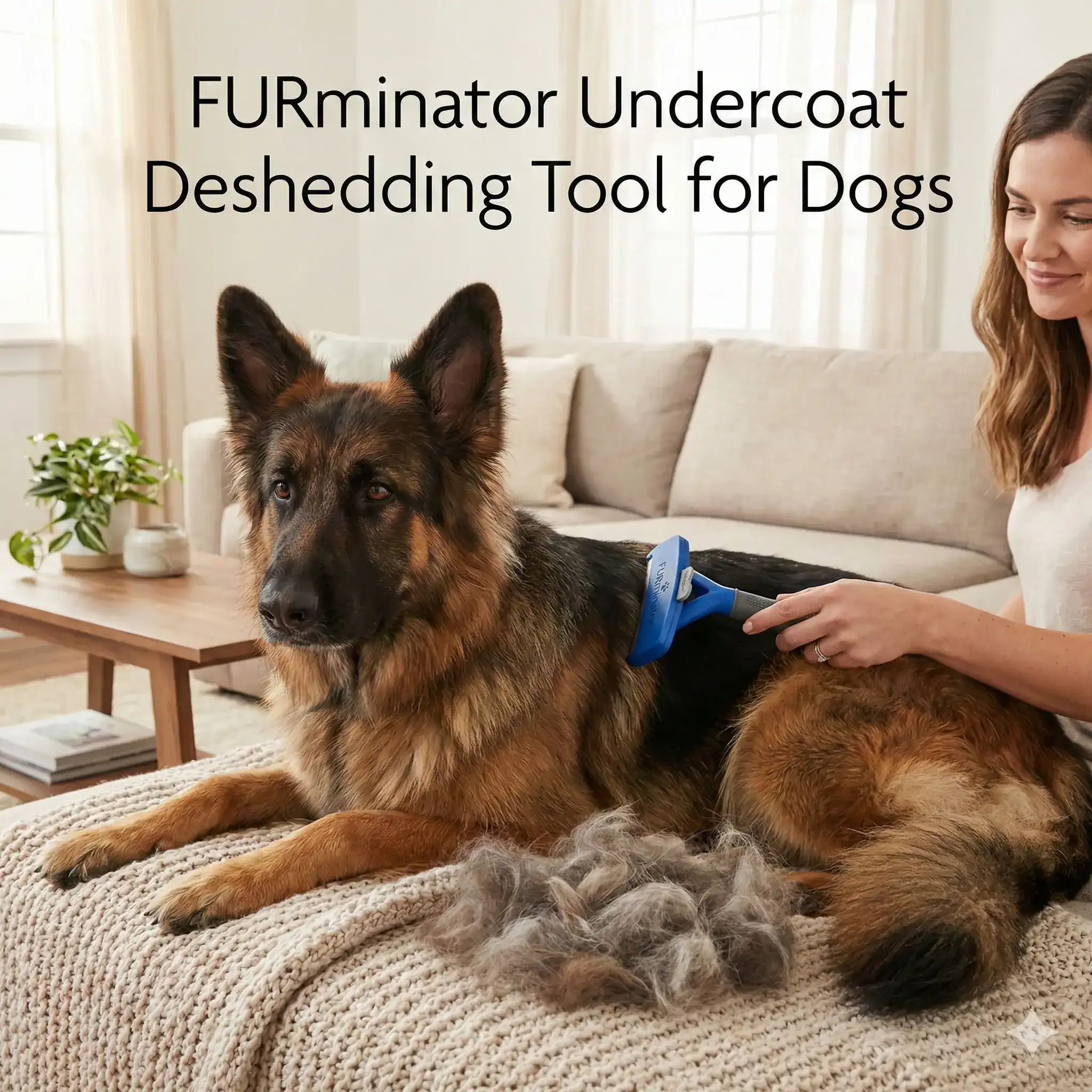
FURminator Undercoat Deshedding Tool for Dogs
Use for: Pulling loose undercoat from either herding coat before it covers the house, especially during the heavy twice-yearly blowouts both breeds go through.
Check price on Amazon🎯 Verdict: A slight edge to the Australian Shepherd, which generally produces less total loose hair than the larger German Shepherd, though both are substantial shedders. The routine is nearly identical for both, and the Aussie trades lower volume for more mat-prone feathering.
Health and Genetic Testing
The lifespan gap is real and worth weighing. The Australian Shepherd typically lives 12 to 15 years while the German Shepherd averages 9 to 13, a difference of roughly three years.
UK VetCompass data from the Royal Veterinary College puts median German Shepherd longevity at 10.3 years, with musculoskeletal disorders and an inability to stand recorded as the two leading causes of death. Both share hip and elbow dysplasia, so prioritize breeders who document hip and elbow screening of both parents through a recognized scheme such as OFA, PennHIP, or the relevant national programme.
Hip and elbow dysplasia are important health concerns in German Shepherds, and musculoskeletal disease is a major contributor to illness and death in the breed. Conformation differences between working and show lines remain widely debated among breeders and veterinarians. It also carries bloat risk from its deep chest and degenerative myelopathy, a progressive spinal disease that causes rear-leg paralysis in older dogs and is identifiable by DNA test.
German Shepherds are among the breeds most strongly predisposed to exocrine pancreatic insufficiency, particularly the form caused by pancreatic acinar atrophy, where the pancreas stops producing digestive enzymes and the dog loses weight despite eating ravenously.
The Australian Shepherd’s signature risk is completely different. The MDR1 mutation causes life-threatening sensitivity to common drugs including ivermectin, loperamide, and several anesthesia and chemotherapy agents, and a simple DNA test through a laboratory such as UC Davis confirms status.
Roughly half of all Australian Shepherds carry at least one copy, so this is a breed-wide concern rather than a rare edge case. Dogs with two copies are likely to show severe signs, while dogs with one copy can also react, usually more mildly. Hereditary cataracts, Collie Eye Anomaly, and progressive retinal atrophy also appear in some lines.
Merle genetics deserve separate attention. Merle-to-merle breeding can produce homozygous-merle puppies with greatly increased risk of congenital deafness and eye abnormalities. Responsible programs always pair a merle dog with a solid-coloured partner, so never buy from a litter where both parents carry merle.
Cryptic merle is the trap here, since some dogs carry the gene with little or no visible mottling, which is exactly why DNA testing rather than eyesight should decide a pairing.
Veterinary Disclaimer: This article is for educational purposes only and is not a substitute for professional veterinary advice, diagnosis, or treatment. K9Sphere’s authors are experienced dog owners, not licensed veterinarians. Always consult a qualified DVM regarding any health concerns about your dog.
Always consult your licensed DVM for personalized medical advice.
Because both breeds carry documented joint vulnerability, a supportive sleeping surface helps through their working years and into old age. See our guide to the FurHaven orthopedic dog bed for a frame that distributes weight evenly.
Health Information Sources. Data compiled from the following references.
- American Kennel Club German Shepherd Dog reference
- Australian Shepherd Club of America breed genetics policies
- UC Davis Veterinary Genetics Laboratory MDR1 mutation testing
- OFA CHIC Program recommended screening protocols
- RVC VetCompass German Shepherd longevity and mortality data
Always consult your licensed DVM for personalized medical advice.
🎯 Verdict: The Australian Shepherd takes this round on longevity and orthopedic odds. Its MDR1 risk is serious but fully identifiable through one DNA test, while the Shepherd’s dysplasia, bloat, and degenerative myelopathy profile is harder to manage.
Cost and Ownership
Purchase prices differ meaningfully, though any figure is a snapshot that shifts with pedigree, location, and demand. A well-bred German Shepherd from a health-testing breeder is commonly quoted around 1,500 to 3,500 US dollars, with titled European working imports higher still, while a well-screened Australian Shepherd is typically quoted lower. Verify current pricing with breeders in your own country.
Running costs follow size. The Shepherd has a higher daily calorie requirement, needs weight-based medication in larger doses, and carries the higher emergency risk, since bloat surgery ranks among the most expensive canine operations. That size disadvantage compounds across a lifetime. Prices vary by country across the US, UK, Canada, and Australia.
Both demand budget beyond a good diet. Sport class fees, training, joint supplements, and genetic screening all add up, and pet insurance is worth serious consideration for either breed given their documented orthopedic risks.
🎯 Verdict: The Australian Shepherd is the cheaper dog to buy and to run, thanks to a lower purchase range, smaller portions, and reduced emergency exposure. Neither is a low-cost breed to own responsibly.
First-Time Owners
Neither is among the easiest choices for a first-time owner, and both fill rescue kennels with adolescents whose owners misjudged the workload. Each needs substantial structured daily work, secure fencing, crate training from the first week, early socialization through the critical window, and an owner who enforces rules long after the puppy phase ends.
The German Shepherd is the harder of the two and is widely listed as not recommended for newcomers. Its combination of size, guard drive, and high arousal means handling errors carry real consequences, and professional training should be arranged before the puppy arrives rather than after problems appear.
Both breeds fill rescue kennels, so adoption of an adolescent or adult is a sensible route that lets you assess real energy levels first. The Australian Shepherd is challenging rather than discouraged. A dedicated first-timer can succeed with one, provided they understand that an unemployed Aussie becomes destructive and neurotic within months. The smaller size also keeps mistakes recoverable in a way a 90-pound protective dog does not.
🎯 Verdict: The Australian Shepherd is the more realistic first breed of the two, though neither is easy. The German Shepherd rewards experience or committed professional support from day one.
Head-to-Head Scorecard
Ratings are from 1 to 5 stars and reflect suitability for a typical active home. A high Protective Instinct score is an asset if you want a guardian and a non-issue if you do not, while a high Exercise Demand score means the dog needs more daily work.
German Shepherd
Australian Shepherd
Reading the scores: Both max out on Trainability and Exercise Demand, which is why neither suits a quiet household. The German Shepherd leads on Protective Instinct, while the Australian Shepherd leads on Longevity and Grooming Ease. Low First-Timer scores on both sides reflect workload rather than any flaw in the dogs.
Common Questions about German Shepherd vs Australian Shepherd
These are the frequently asked questions buyers raise when comparing the two herding breeds.
What is the main difference between a German Shepherd and an Australian Shepherd?
Direct Answer: Size and purpose. The German Shepherd is a larger protection-capable breed, while the Australian Shepherd is a medium ranch and sport dog with no guarding mandate.
Context: Both sit in the AKC Herding Group, but the Shepherd was bred to tend boundaries and later redirected to police and military work, while the Aussie was refined to gather and drive cattle across western ranches.
Management: Choose based on whether you need protection alongside intelligence, and on whether you can manage a 65 to 90 pound dog rather than a 50 to 65 pound one.
Which breed is better for protection?
Direct Answer: The German Shepherd, by a wide margin.
Context: It carries a genuine guardian instinct and remains one of the most deployed police and personal protection breeds worldwide. The Australian Shepherd is watchful around its property but was never selected for protection work.
Management: If security matters, choose the Shepherd and shape its instincts through professional training and intense early socialization, never by encouraging aggression.
Which one lives longer?
Direct Answer: The Australian Shepherd, typically by about three years.
Context: Aussies average 12 to 15 years while German Shepherds average 9 to 13. Larger body size and the breed’s orthopedic and neurological risk profile both contribute to the shorter span.
Management: Keep either dog in lean body condition, buy from breeders who screen the parents, and budget for senior veterinary monitoring, since cancer and organ disease become more likely in any breed with age.
What is MDR1 and why does it matter?
Direct Answer: MDR1 is a genetic mutation common in herding breeds that causes life-threatening sensitivity to several common medications.
Context: Affected dogs cannot clear drugs such as ivermectin, loperamide, and certain anesthesia and chemotherapy agents from the brain, which leads to severe neurological reactions. Roughly half of all Australian Shepherds carry at least one copy, and it is documented in German Shepherds at a much lower rate of around 10 percent.
Management: Test any Aussie through your veterinarian or a laboratory such as UC Davis, and disclose the result to every vet who treats the dog.
Which breed is easier to train?
Direct Answer: Neither has a clear advantage, since both rank among the most trainable dogs in existence.
Context: Each learns commands at remarkable speed and each picks up bad habits equally fast. Both shut down under harsh handling and both need clear, consistent boundaries built on positive reinforcement.
Management: Use reward-based methods with either breed, and arrange professional training early for a Shepherd if you have not handled a high-arousal dog before.
Do both breeds herd children?
Direct Answer: Some individuals in both breeds circle running children and nip at heels, and it tends to show more openly in the Australian Shepherd.
Context: This is herding instinct rather than aggression, expressed as an attempt to control movement. It cannot be trained out of either breed, though it can be redirected into an acceptable job.
Management: Teach children to avoid chase games, interrupt and redirect the behaviour immediately, and give the dog a structured task several times a day.
Which breed sheds more?
Direct Answer: The German Shepherd, mainly because it is a larger dog producing more coat.
Context: Both carry dense double coats that shed moderately year-round with heavy blowouts twice a year. The Shepherd’s nickname of German Shedder reflects the sheer volume rather than a different shedding pattern.
Management: Brush both at least twice weekly and daily during blowouts using an undercoat tool, and never shave either coat.
Can either breed live in an apartment?
Direct Answer: Either can with a sufficiently active owner, but neither is an easy apartment dog.
Context: Each needs around two hours of daily work plus mental stimulation, and each is vocal enough to trouble neighbours. The Australian Shepherd is specifically better served by a securely fenced yard given its reactivity to environmental stimuli.
Management: If you attempt apartment living, commit to structured daily outings and enrichment, and be honest about whether your schedule realistically supports it.
Which is better with strangers?
Direct Answer: The Australian Shepherd, though both are naturally reserved rather than outgoing.
Context: The Shepherd is genuinely suspicious of unfamiliar people and may act preemptively if under-socialized. The Aussie’s reserve is milder and rarely escalates beyond watchfulness.
Management: Socialize each intensively through the early weeks, roughly 8 to 16, and keep exposing the dog to new people and places well beyond that as it matures.
How much does each breed cost?
Direct Answer: The German Shepherd costs noticeably more to buy and to keep.
Context: Well-bred Shepherd puppies typically run 1,500 to 3,500 US dollars with titled imports higher, while well-screened Aussies fall between 800 and 2,000. Feeding, medication dosing, and emergency risk all scale with the Shepherd’s larger size.
Management: Budget for genetic screening, training, and insurance with either breed, and treat a bargain-priced puppy of either type as a warning about skipped health testing.
What is a double merle Australian Shepherd?
Direct Answer: It is the result of breeding two merle-coated dogs together, and it carries a high risk of congenital deafness or blindness.
Context: Pairing two merle parents produces roughly a one in four chance of a double-merle puppy, often with excessive white markings and pink skin around the eyes. Responsible programs never do it.
Management: Never buy from a litter where both parents carry merle, and verify the colour genetics of both parents before committing.
Are they good with other dogs and pets?
Direct Answer: Both can be, with socialization, though each brings herding pressure into the mix.
Context: Aussies commonly try to control other dogs at the park by circling and staring, while Shepherds carry a higher prey drive and stronger territorial response. Neither is automatically unsuitable for a multi-pet home.
Management: Introduce new animals slowly, supervise early interactions, and interrupt herding or chasing behaviour before it escalates.
Which breed is right for a first-time owner?
Direct Answer: The Australian Shepherd, though a well-prepared beginner with good support can succeed with either.
Context: The Aussie is described as challenging while the German Shepherd is widely listed as not recommended for newcomers, largely because size and guard drive raise the stakes on every handling mistake.
Management: Be honest about your daily schedule and experience level, and line up professional training before bringing home either breed.
The Quick Decision Shortcut
If you want the fast version before the full verdict, use this self-check to decide which herding breed fits your household. Each has one big pro and one obvious con, so pick the column that sounds more like you.
🐕 Choose the German Shepherd if
- You want a real protective instinct with working intelligence.
- You can manage and train a dog of 65 to 90 pounds.
- You have experience with high-arousal breeds.
- You can budget for orthopedic and emergency risk.
🐕 Choose the Australian Shepherd if
- You want elite sport and stock-work trainability.
- You prefer a medium dog with a longer lifespan.
- You want alertness without protection-breed responsibility.
- You will test for MDR1 and avoid merle-to-merle litters.
Final Verdict
There is no universal winner here, because both are outstanding herding dogs developed for different approaches to the same broad work. Each is brilliant, reserved with strangers, heavy shedding, and genuinely demanding of daily work.
The underlying decision is simple. The German Shepherd gives you a protector and a partner in one dog, and asks for size management, experience, and a harder health outlook in return.
The Australian Shepherd gives you elite trainability, three more years of life on average, and lower running costs, and asks that you supply a genuine job every single day. Match the breed to whether you need security or sport.
🏆 Bottom line: The German Shepherd is the protector with a working brain; the Australian Shepherd is the longer-lived ranch athlete with no guarding agenda. Both need substantial daily work, so choose on protection need, size, and which health profile you would rather manage.
Personal Observation
💭 From my own experience
My rescue Rambo arrived abandoned in 2022 with more raw stamina than any dog I have kept. He runs alongside a bicycle for a kilometre without breaking pace, and on the days he does not get that outlet, the whole household knows about it.
That is the lesson both these breeds teach, and each takes it further than Rambo does. Physical exhaustion is only half the work, because a tired body attached to a bored mind still finds something to destroy.
So the honest question is not which dog is better. It is whether you have a job for one. You cannot outrun either of these breeds, and with both of them you have to out-think them instead.
Read More. For the full individual guides, see our German Shepherd guide and our Australian Shepherd guide.
If you are weighing other herding options, our Border Collie guide covers the most intense worker of the group and the Miniature American Shepherd guide covers the smaller Aussie cousin.
For a gentler alternative, see our German Shepherd vs Golden Retriever comparison, and each benefits from our roundup of the best brushes for shedding dogs.
Editorial Disclaimer: This article is for informational and educational purposes only. It does not constitute veterinary advice, medical diagnosis, or treatment recommendations. Always consult a licensed veterinarian before making health-related decisions for your pet.
Accuracy Notice: While every effort has been made to ensure the information presented here is accurate and current, breed information evolves and individual dogs vary. If you spot a factual error or have updated information from a verified source, please contact us so we can review and update.
Product Disclosure: Product recommendations are based on independent research and editorial judgment. Individual results may vary. K9Sphere participates in the Amazon Services LLC Associates Program and other affiliate programs, and earns from qualifying purchases at no additional cost to you.
Last reviewed: September 2026. Article reviewed for accuracy on the date shown above.


