
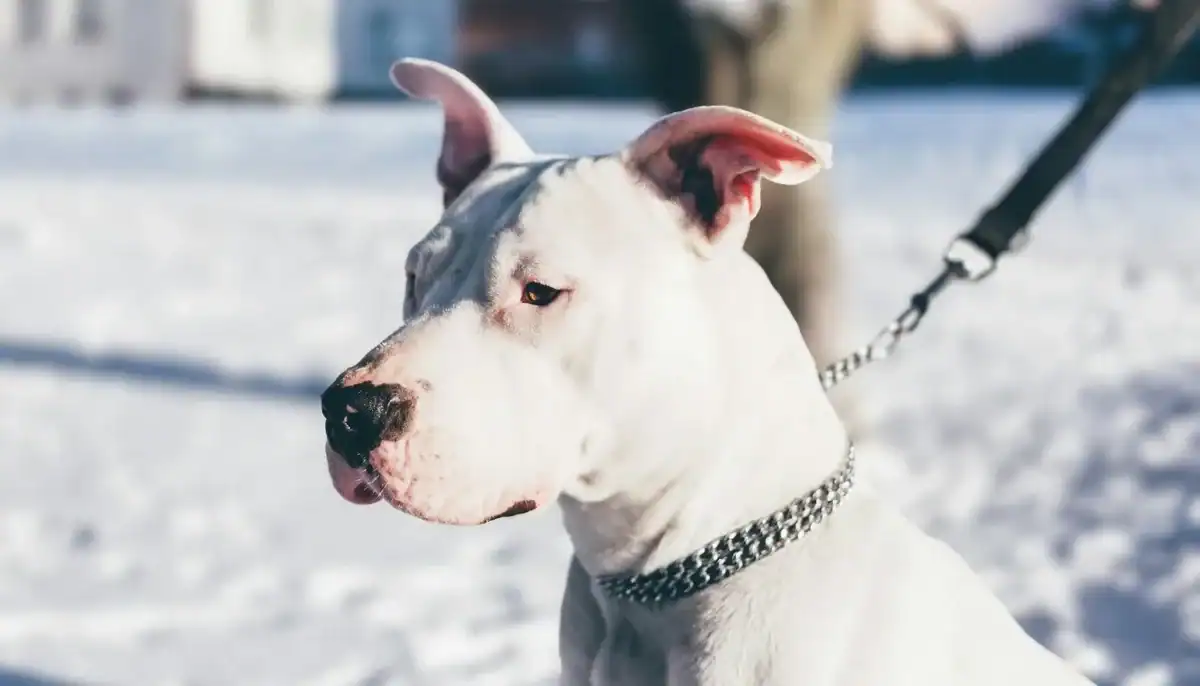
The Dogo Argentino is a large white hunting dog developed in Argentina in the 1920s to take wild boar and puma in packs. It is a working breed purpose-bred for big-game hunting, though a well-raised Dogo can also be a devoted family companion.
Before anything else, check the law where you live. The breed is prohibited, restricted, or subject to import and ownership controls in a number of countries including the United Kingdom, Australia and New Zealand, and some US cities and counties restrict it too.
This guide draws on the AKC breed standard, veterinary literature on congenital deafness in white-coated breeds, and published guidance on breed-specific legislation.
Daily commitments include serious exercise, structured training from week one, secure fencing, and an honest conversation with your insurer. That groundwork gives the dog a far stronger foundation for becoming a stable, manageable companion.
Anyone without experience of powerful working breeds should read the temperament and legal sections before going any further. The calm adult Dogo in photographs is the result of genetics, socialization, training, maturity and management, not simply age or appearance.
Affiliate Disclosure: K9Sphere participates in the Amazon Services LLC Associates Program and other affiliate programs. K9Sphere earns from qualifying purchases made through links in this article at no additional cost to you. Product recommendations are based on independent research and editorial judgment, not paid placement.
Breed Snapshot
📊 Vitals and Lifespan
Height
Males 24 to 26.5 in, females 24 to 25.5 in
Weight
Males 88 to 100 lb, females 88 to 95 lb
Lifespan
9 to 15 years
Breed Group
AKC Working Group
Origin
Argentina
🇦🇷
⭐ Personality Traits
K9Sphere editorial ratings (1 to 5). This is a powerful hunting breed that is affectionate with its own household and demanding of an experienced handler.
History and Origin
This is one of the few breeds whose creation is documented in detail by the man who did it. Everything about the Dogo follows from a single brief, which was to hunt dangerous game in packs across difficult country.
📌 1928. The Breed Standard
Antonio Nores Martinez, a doctor from Cordoba, wrote the first breed standard and set out a deliberate breeding program to create a big game hunter. He started from the Cordoba Fighting Dog and crossed deliberately outward, aiming to keep the courage while removing the dog aggression that made pack hunting impossible.
📌 The Foundation Crosses
Around ten breeds went into the mix, among them the Pointer, Great Dane, Boxer, Bull Terrier, Irish Wolfhound and Spanish Mastiff, contributing traits including scenting ability, size, athleticism, temperament and substance. Published accounts differ on which breed supplied what. The all-white coat was chosen so hunters could tell dog from boar in thick cover.
📌 1964. Recognition in Argentina
The Argentine Kennel Club recognized the breed, and international recognition followed. Martinez did not live to see it. He was killed in 1956, and his brother Agustin carried the program forward.
📌 2020. AKC Recognition
The American Kennel Club admitted the Dogo Argentino to the Working Group. By then the breed had already been banned outright in the United Kingdom for nearly thirty years, which tells you how differently two countries can read the same dog.
Physical Characteristics
The build is heavily muscular over a broad frame, and the impression should be of power that can still move. A Dogo was expected to run with a hunting party for hours and then hold a boar, and the body reflects both halves of that.
🎨 The All-White Coat
Short, smooth, and entirely white by standard. One dark patch on the head is permitted, covering no more than 10 percent of the head, and more than one head patch is a disqualification. That restriction matters more than it sounds, for reasons covered in the health section.
The white coat and heavy build mean the Dogo is often mistaken for a pitbull type, though it is a separate breed with its own origin and written standard.
🏗️ Built to Hold Game
A broad skull, deep chest, and heavy bone. The head is powerful without being extreme, and the standard asks for a dog that looks athletic rather than bulky. Thin skin over that frame tears easily in rough country.
Character and Temperament
With its own people a well-raised Dogo is affectionate, steady, and notably tolerant. The complications sit at the edges, with strange dogs, with small animals, and with anyone who mistakes a calm adult for an easy one.
💛 Devoted at Home
They bond hard to the household and are generally patient with children they have grown up alongside. Owners consistently describe a dog that wants to be in the room with its people rather than off doing its own thing.
🐗 Serious Prey Drive
This is a dog bred to pursue and hold large game. Cats, small dogs, and livestock can trigger that instinct. Training can improve management, but it does not guarantee that the breed’s hunting drive will disappear. Secure fencing and a reliable leash are not optional here.
🐕 Same-Sex Dog Tension
Martinez bred deliberately against dog aggression so the pack could work together, and it shows. Even so, same-sex conflict is reported often enough that careful introductions and honest supervision matter throughout the dog’s life.
🧠 Independent and Slow to Mature
They think for themselves and mature slowly, with adolescence often extending well into the second year. That stretch is where most owners get into difficulty, and it is exactly when consistency matters most.
Screening and Conditions
Veterinary Disclaimer: The information in this article is for educational purposes only and is not a substitute for professional veterinary advice, diagnosis, or treatment. K9Sphere’s authors are experienced dog owners, not licensed veterinarians. Always consult a qualified DVM regarding any health concerns about your pet. Never disregard professional veterinary advice or delay seeking it because of something you have read on this site.
Health Information Sources: Data compiled from:
- American Kennel Club breed page for the standard and general breed guidance
- Dogo Argentino Club of America health programs for the breed’s CHIC testing profile
- Strain 2021, Veterinary Record for congenital deafness prevalence in 811 Dogo Argentinos
- Veterinarian-reviewed breed facts for international restrictions
Always consult your licensed DVM for personalized medical advice.
Congenital deafness is the breed’s most distinctive screening concern. The all-white pigmentation is linked to a higher prevalence of congenital deafness, which is why BAER testing sits in the official health-testing profile alongside two other required tests.
The Dogo Argentino Club of America joined the CHIC program in 2021 with a four-test profile. Three are required, a BAER hearing evaluation, a hip evaluation by OFA or PennHIP, and a cardiac exam by a cardiologist at twelve months or older.
Breeders then choose one elective from an OFA elbow evaluation, autoimmune thyroiditis testing, a CAER eye exam, or CHIC DNA repository participation. Thyroid screening is on that elective list rather than among the required three.
Common Health Concerns
🔴 Congenital Deafness
What to watch for: A puppy that does not startle at sound, sleeps through noise, or fails to orient toward a voice. A 2021 study of 811 Dogo Argentinos found 25.77 percent deaf in one or both ears, made up of 20.35 percent unilaterally deaf and 5.43 percent bilaterally deaf. A unilaterally deaf dog often passes casual observation entirely.
Screening: A BAER test is the only reliable way to know, and it is one of the three required CHIC tests. The same study found dogs without a head patch had a significantly higher deafness rate than patched dogs, so an entirely white puppy is the one to check hardest. Ask for the puppy’s own result rather than a statement about the litter.
🔴 Hip Dysplasia
What to watch for: Stiffness getting up, a bunny-hopping gait, or reluctance on stairs. A dog carrying this much muscle loads its joints hard, and a working Dogo more so.
Screening: Ask for OFA or PennHIP evaluations on both parents. Controlled growth in puppyhood and a lean adult body weight do more across a lifetime than anything bought in a bottle.
🔴 Cardiac Screening
What to watch for: Exercise intolerance, coughing, or fainting. The breed’s CHIC profile includes a cardiac examination, which reflects what the parent club screens for rather than a measured prevalence figure. Many cardiac abnormalities produce no signs an owner would notice until the dog is stressed.
Screening: A cardiac exam by a veterinary cardiologist at twelve months or older is one of the three required CHIC tests for this breed. Ask for that specific certificate, since a general veterinary check is not the same thing.
🟡 Sun Damage and Skin Disease
What to watch for: Pink, flaking, or scabbing skin on the nose, ear tips, and belly. A white coat over unpigmented skin offers little protection, and allergic skin disease is also reported in the breed.
Screening: No breeding test applies. Limit midday sun exposure, ask your vet about a dog-safe sunscreen for exposed areas, and treat recurring skin trouble as a veterinary problem rather than a grooming one.
🟡 Hypothyroidism
What to watch for: Weight gain without a diet change, lethargy, thinning coat, and recurring skin infections, usually appearing in middle age.
Screening: Autoimmune thyroiditis testing is one of the CHIC electives rather than a required test, so not every health-tested dog will have it. Blood testing can help investigate or monitor thyroid disease where clinical signs or your vet’s assessment warrant it, and the condition is manageable for life with daily medication once confirmed.
🟡 Gastric Dilatation-Volvulus
What to watch for: Sudden abdominal swelling, repeated unproductive retching, restlessness, weakness, or collapse. Large deep-chested dogs can develop GDV, in which the stomach distends and sometimes twists.
Screening: No pre-breeding test applies. This is a life-threatening emergency requiring immediate veterinary attention rather than overnight observation, so knowing the signs matters more than any precaution.
🟡 Other Reported Concern: Laryngeal Paralysis
What to watch for: Noisy breathing, a change in the bark, and exercise intolerance, often worse in heat. The airway fails to open properly and the dog cannot move enough air.
Screening: No pre-breeding test. Any large dog with new noisy breathing needs veterinary assessment rather than rest and observation, particularly in warm weather.
Grooming and Coat Care
The coat is the easiest part of owning this breed. A short smooth coat needs a weekly going-over with a rubber curry or hound glove to lift dead hair, and that is most of the job.
They shed more than the short coat suggests, and white hair shows on everything. Our guide to the best brushes for shedding dogs covers tools suited to a short dense coat.
Skin needs more care than the coat does, and it is the one grooming issue owners underestimate. Bathe only when the dog is genuinely dirty, check the belly and ear tips for sun damage, and consider a gentle shampoo for itchy skin if washing leaves the skin irritated. Nails, teeth, and a weekly ear check finish the routine.
Exercise and Living Needs
Plan on substantial daily exercise. Many fit adults benefit from roughly an hour or more of purposeful activity, supplemented with training and mental work, though the right amount varies by age, health and conditioning. This is a hunting dog, and a stroll around the block does not meet the need.
Mental work matters alongside it. Structured training, scent games, and conditioning work give a powerful dog something legitimate to put itself into. An under-stimulated Dogo may redirect that energy into unwanted behavior.
Fencing is the thing to get right before the dog arrives. A tall, solid boundary with a locked gate is the baseline for outdoor security, and it protects the dog and your liability equally.
Apartments are a poor fit. Not because the dog is restless indoors, but because of the size, the strength on a leash in shared spaces, and the difficulty of finding housing that will accept the breed at all.

FurHaven Orthopedic Dog Bed for Large Dogs
A large supportive bed spreads the weight of a heavy frame rather than concentrating it on hips and elbows, which is why it is commonly recommended for big working breeds. It is a comfort measure rather than a treatment for joint disease.
Check price on AmazonNutrition & Diet
Growth is where the costly mistakes happen. A large-breed puppy formula controls calcium and slows the growth rate, which protects a skeleton with a great deal of frame still to build.
Adults need a complete diet with enough protein to hold working muscle, split into two meals rather than one large one, and the ration should move with the workload. Keep the dog lean, since weight is the joint factor an owner controls most directly.
Budget honestly, since feeding a dog this size is a standing monthly cost rather than an occasional one. Separately from diet, owners of older or hard-working dogs sometimes raise joint supplements at a veterinary visit, which is a conversation for your vet rather than a feeding decision.
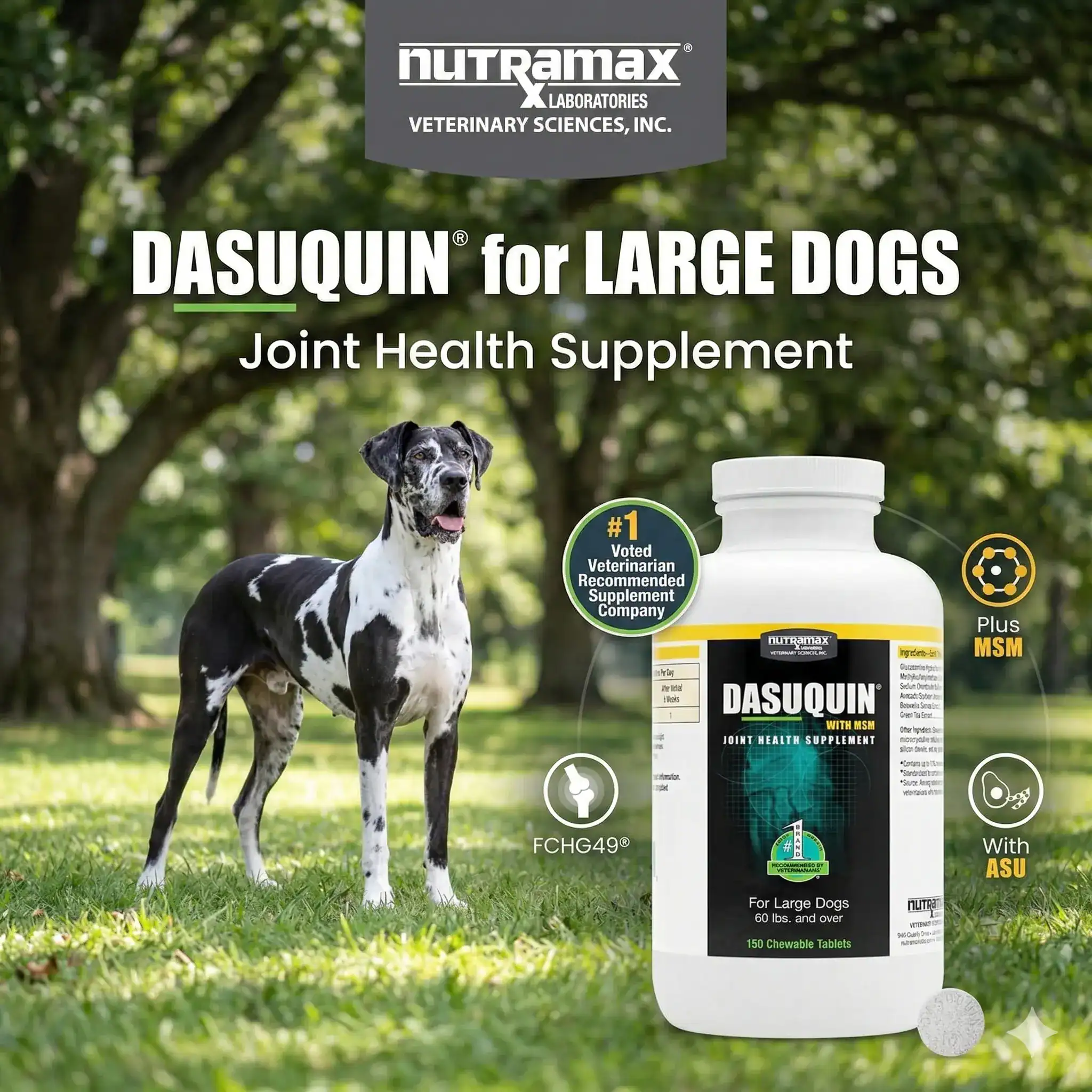
Nutramax Dasuquin with MSM Soft Chews for Large Dogs
A glucosamine and chondroitin supplement commonly used in large breeds carrying joint risk. Evidence of benefit varies and it is not a treatment for joint disease, so discuss it with your veterinarian before starting.
Check price on AmazonTraining
Start in week one and do not stop. This is a breed where the gap between a well-raised adult and a poorly raised one is measured in consequences rather than inconvenience.
Socialization is the priority. Start early, during the puppy’s most important first months, and keep providing appropriate positive experiences with people, places, sounds, and calm adult dogs well beyond sixteen weeks.
Use reward-based methods with clear, consistent rules. Obedience work goes better when the rules never move, and harsh handling on a powerful independent dog produces a worse outcome rather than a more compliant one. A trainer experienced with working breeds is worth lining up before the puppy arrives, and a lot of the groundwork happens before the dog ever arrives.
Its defining original purpose was big-game hunting, although breed standards also describe protective qualities toward family and property. Formal protection or bite work is not needed to meet that purpose, and given the strength and prey drive involved, any such training should only be undertaken with professionals experienced in the breed.
Dogo Argentino vs Cane Corso vs Presa Canario vs Rottweiler
Buyers looking at a Dogo often compare it with other powerful working breeds. The Cane Corso and Presa Canario were used heavily for guarding and livestock work, while the Rottweiler has a different history in droving and guarding.
| Attribute | Dogo Argentino | Cane Corso | Presa Canario | Rottweiler |
|---|---|---|---|---|
| Weight | 88 to 100 lb | 88 to 110 lb | 84 to 110 lb | 80 to 135 lb |
| Original Purpose | Pack hunting big game | Property guarding | Livestock and property guarding | Droving and guarding |
| Historical Working Role | Pack hunting | Estate guarding | Livestock and property guarding | Droving and guarding |
| Tolerance of Strangers | Reserved, often sociable | Aloof | Aloof and watchful | Aloof but confident |
| Coat Work | Weekly, sheds steadily | Weekly | Weekly | Weekly, heavier seasonally |
| Breed-Specific Legal Restrictions | Varies by jurisdiction, check local law | Varies by jurisdiction | Varies by jurisdiction | Varies by jurisdiction |
| Owner Experience | Better suited to experienced owners | Better suited to experienced owners | Better suited to experienced owners | Needs committed training |
| Space and Activity Needs | High, secure fenced property | High, secure yard | High, secure yard | High, secure yard |
The Dogo is not the bigger dog in this group, but its history is the one aimed at prey rather than territory, which changes what you manage day to day. Its other distinguishing feature is legal, and for many buyers that is the one that decides it.
Common Questions about the Dogo Argentino
How much does a Dogo Argentino cost?
Direct Answer: As an approximate, time-sensitive guide (as of 2026), expect roughly USD 1,500 to USD 3,500 from a breeder who BAER tests every puppy.
Context: Prices vary by breeder, location, pedigree, and availability. The purchase price is the smaller number, since food, insurance, and secure fencing all scale with a dog this size.
Management: Get an insurance quote in writing before you commit, since some insurers restrict or exclude the breed.
Is the Dogo Argentino banned where I live?
Direct Answer: Possibly, and the type of restriction differs by country rather than being one single kind of ban.
Context: The UK prohibits the type under the Dangerous Dogs Act 1991. Australia and New Zealand restrict importation. Norway prohibits ownership, breeding and import. Hong Kong and Singapore bar import and breeding while controlling existing dogs. In the USA the restrictions are local rather than federal, set by individual cities and counties.
Management: Check your local ordinance and your insurer in writing before you place a deposit.
Are Dogo Argentinos good family dogs?
Direct Answer: With experienced owners and thorough socialization, they are known for being affectionate and tolerant at home.
Context: The difficulties are outside the house rather than inside it, with strange dogs, small animals, and the practical realities of walking a powerful dog in public.
Management: Supervise all contact with a visiting kid and with other pets, and never leave a large dog unsupervised with a small child.
Why does deafness matter so much in this breed?
Direct Answer: The genes producing an all-white coat are associated with a higher rate of congenital deafness.
Context: Deafness can affect one ear or both, and a dog deaf in one ear usually seems completely normal to an owner. Only a BAER test distinguishes them.
Management: Ask for the individual puppy’s BAER result, not a statement about the litter as a whole.
How much exercise does a Dogo Argentino need?
Direct Answer: Substantial daily activity, often an hour or more for a fit adult, plus separate mental work.
Context: Individual needs vary with age and health. A hunting breed that gets only walks will find its own outlet, usually at the expense of your yard.
Management: Build structured training and scent work into the routine rather than simply walking further.
Are Dogo Argentinos aggressive?
Direct Answer: They were bred against dog aggression so packs could hunt together, but prey drive is high and the breed is powerful.
Context: Behavior depends heavily on breeding, socialization, and handling. The legal restrictions reflect the potential consequences of a bite rather than a measured bite rate.
Management: Socialize continuously, manage introductions deliberately, and never rely on the dog to make the judgment call.
Can a Dogo Argentino live with cats or small dogs?
Direct Answer: It is difficult and depends on the individual dog, even when raised together.
Context: The breed was developed to pursue and hold large game, and that instinct does not train away. Some households manage it successfully and others never do.
Management: Raise them together from puppyhood if you try, and supervise rather than assuming it has resolved.
Are Dogo Argentinos good for first-time owners?
Direct Answer: No. This breed needs a handler who has managed a powerful, independent dog before.
Context: The combination of size, strength, prey drive, and slow maturity is a great deal to learn on, and the legal exposure raises the stakes further.
Management: If the type appeals, get experience with working breeds through fostering or volunteering first.
What health tests should the parents have?
Direct Answer: BAER hearing, hip evaluation, and a cardiologist cardiac exam, which are the three required CHIC tests, plus one elective.
Context: The elective options are elbow, autoimmune thyroiditis, a CAER eye exam, or DNA repository participation. BAER testing of the puppies themselves matters most here.
Management: Ask to see the certificates rather than accepting that the dogs were checked.
What is the Dogo Argentino lifespan?
Direct Answer: Commonly given as 9 to 15 years, a wide range for a breed of this size.
Context: Large dogs generally live shorter lives, and published figures for this breed vary more than usual between sources.
Management: Keep the dog lean, keep annual exams, and add blood work from middle age.
Do Dogo Argentinos shed?
Direct Answer: Yes, steadily year-round, and more than the short coat suggests.
Context: Short white hairs weave into fabric and show on dark furniture and clothing.
Management: A weekly rubber curry lifts most of it before it reaches your sofa.
Will insurance cover a Dogo Argentino?
Direct Answer: Not always. Some home and liability insurers restrict or exclude the breed.
Context: This applies to homeowner and renter liability rather than pet health insurance, and it can also affect rental applications.
Management: Get written confirmation from your insurer and your landlord before you commit to a puppy.
Finding a Puppy
Check the law first and the breeder second. There is no point evaluating a litter offered for sale near you if it is a dog you cannot legally keep, insure, or house where you live.
🏠 Responsible Breeders
A reputable breeder BAER tests every puppy and hands you the individual result, shows hip and cardiac paperwork on both parents, and raises litters in the house. Expect to be questioned closely about your fencing, your experience, and your local ordinance.
🐾 Rescue and Adoption
Choosing to adopt an adult through breed rescue is a realistic route, since rescues take in dogs regularly from owners who underestimated them or hit a legal or insurance problem after the fact. An adult lets you see the temperament and the size you are committing to rather than guessing.
🚩 Red Flags to Watch For
- No BAER result for the individual puppy you are being offered.
- No hip or cardiac documentation for either parent.
- A breeder who dismisses the legal restrictions or tells you enforcement is unlikely.
- Any mention of protection work, bite sports, or guarding as a selling point.
- Puppies marketed as easy family dogs with no discussion of prey drive.
- A seller willing to place a puppy without asking about your fencing or experience.
❓ Questions to Ask the Breeder
- May I see this puppy’s own BAER certificate?
- What are the hip evaluations for both parents?
- May I see the cardiologist cardiac certificate for both parents?
- How are the puppies socialized before they leave?
- Do you place dogs into homes in my state or country?
- What does your health guarantee actually cover?
🔍 Questions a Good Breeder Asks You
- How is your property fenced, and how tall?
- Have you checked your local ordinance and your insurer?
- Have you owned a powerful working breed before?
- Do you have cats, small dogs, or livestock at home?
- What is your plan if the placement does not work out?
A seller who asks nothing at all about your setup is unusual among breeders of this type, and worth a second look before you commit.
Personal Observation
💭 Personal Observation
Moti is one of my older rescues and the easiest dog in my pack to live with. He is content with a slow walk and asks very little of anyone. The single exception is that he does not get along with certain other dogs.
That one trait is the thing that gets planned around. It changes how a walk goes when the wrong dog appears, and it stops there. Nothing else about the household has to bend to it.
The Dogo carries a version of the same trait, since same-sex tension is reported in the breed. The temperament is not the difference. The difference is that this dog was bred to hold a wild boar until the hunters arrived, so the same meeting on the same walk has a much wider range of endings. That gap is the whole argument for experience.
Conclusion
The Dogo Argentino is a remarkable piece of purposeful breeding. Loyal at home, physically extraordinary, and one of the few breeds whose creation is documented step by step by the man who planned it.
The costs are real and mostly not about the dog. Secure fencing, an insurer who will cover you, a landlord who will accept the breed, and two years of consistent work before the calm adult arrives.
Check the law where you live, ask for the puppy’s own BAER certificate and the parents’ cardiac results, and be honest about your experience with powerful dogs. Get those three right and this is a fine dog. Skip any of them and the consequences land on somebody else.
📋 Before bringing one home, run this 4-step pre-buying check
- Legal status. Have you confirmed in writing that the breed is legal to own where you live?
- Insurance and housing. Will your insurer cover you, and will your landlord or HOA accept the breed?
- Containment and handling. Do you have secure fencing and experience managing a powerful dog on a leash?
- Health paperwork. Have you seen this puppy’s own BAER result plus hip and cardiac results for both parents?
If any answer is no, reconsider the breed.
Editorial Disclaimer: This article is for informational and educational purposes only. It does not constitute veterinary advice, medical diagnosis, or treatment recommendations. Always consult a licensed veterinarian before making health-related decisions for your pet.
Legal Notice: The Dogo Argentino is subject to breed-specific legislation in a number of countries and localities, including a prohibition under the Dangerous Dogs Act 1991 in the United Kingdom and import restrictions in Australia and New Zealand. Laws change and enforcement varies by jurisdiction. Nothing in this article is legal advice. Confirm the current position with your local authority and your insurer before acquiring this breed.
Accuracy Notice: While every effort has been made to ensure the information presented here is accurate and current, breed information evolves and individual dogs vary. If you spot a factual error or have updated information from a verified source, please contact us so we can review and update.
Product Disclosure: Product recommendations are based on independent research and editorial judgment. Individual results may vary. K9Sphere participates in the Amazon Services LLC Associates Program and other affiliate programs, and earns from qualifying purchases at no additional cost to you.
Last reviewed: September 2026. Article reviewed for accuracy on the date shown above.


