
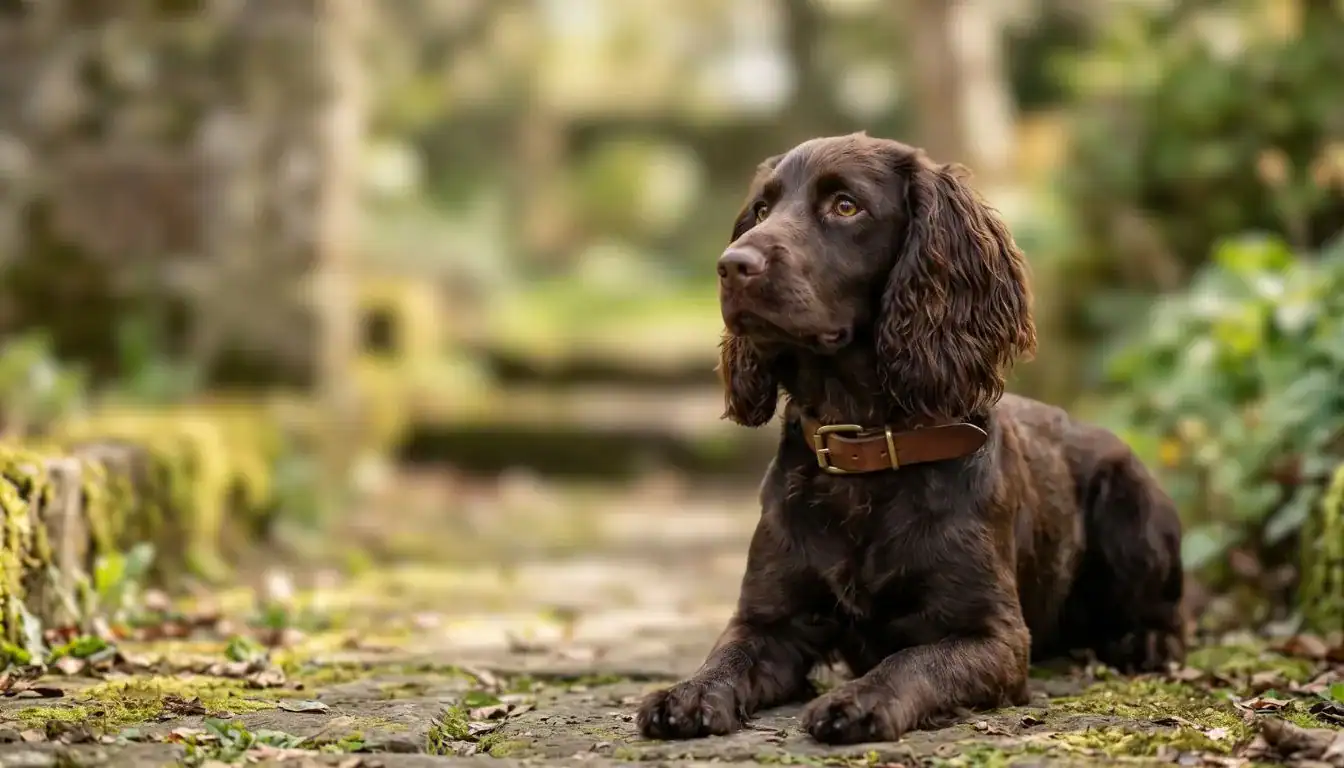
The Boykin Spaniel is a medium-sized American gun dog developed in South Carolina in the early 1900s. It looks like an easygoing family dog, and most buyers underestimate how much work is packed into that frame.
The breed was built to hunt all day in swamp and upland country while staying small enough to ride in a boat. That stamina has not faded, and it turns up in pet homes as readily as in hunting ones.
This guide draws on the AKC breed standard, the national breed club’s published health panel, and OFA screening guidance. Where sources disagree, this guide says so rather than picking the tidier number.
Daily commitments include one to two hours of hard exercise, weekly ear care, brushing a couple of times a week, and real mental work. The brown coat and the friendly face are the easy part.
Households ready for that get a dog that works like a much larger retriever and, once worked, is easy to live with indoors. Anyone wanting a calm apartment companion should read the exercise section before going further.
Affiliate Disclosure: K9Sphere participates in the Amazon Services LLC Associates Program and other affiliate programs. K9Sphere earns from qualifying purchases made through links in this article at no additional cost to you. Product recommendations are based on independent research and editorial judgment, not paid placement.
Breed Snapshot
📊 Vitals and Lifespan
Height
Males 15.5 to 18 in, females 14 to 16.5 in
Weight
Males 30 to 40 lb, females 25 to 35 lb
Lifespan
14 to 16 years, some sources lower
Breed Group
AKC Sporting Group
Origin
United States
🇺🇸
⭐ Personality Traits
Ratings (1 to 5). This is a hunting dog that brings serious field drive to daily life and stays affectionate indoors once it has been properly worked.
History and Origin
Unlike most sporting breeds, the Boykin has a founding story that can be traced to one dog. It was built to flush and retrieve wild turkey and ducks in swamp country. It begins in South Carolina around 1900 and ends with a breed developed for a very specific hunting environment and a versatile set of jobs.
📌 Around 1900. The Foundation Dog
A banker named Alexander White found a small stray spaniel near a church in Spartanburg, South Carolina. He kept the dog, named him Dumpy, and noticed a natural talent for retrieving that went well beyond what a stray had any business showing.
📌 The Breeding Program
White sent Dumpy to his hunting partner, Lemuel Whitaker Boykin. Accounts report crosses with the Chesapeake Bay Retriever, English Springer Spaniel, Cocker Spaniel, and American Water Spaniel. The goal was a dog small enough to ride in a section boat on the Wateree River swamp.
📌 1985. State Dog of South Carolina
South Carolina named the Boykin its official state dog in 1985. The state also marks September 1 as Boykin Spaniel Day, which tells you something about how the breed is regarded at home.
📌 2009. AKC Recognition
The American Kennel Club recognized the Boykin Spaniel in 2009, and the breed began competing in the Sporting Group from January 2010. It remains far better known in the South than elsewhere, and it is not recognized by the FCI or the UK Kennel Club.
Physical Characteristics
The Boykin’s appearance is that of a compact athlete built for endurance in hard country. It carries enough bone and muscle to push through thick brush all day, while staying small enough to sit in a boat or a kayak without tipping it.
🎨 Coat and Color
The standard describes an outer coat of medium length ranging from flat to slightly wavy, over a short dense undercoat, with light feathering on the ears, chest, legs, and belly. Color is solid rich liver, brown, or dark chocolate. The AKC standard permits a small amount of white on the chest or toes. The Boykin Spaniel Society registry is stricter and allows a limited chest marking only, so a puppy with white toes can be AKC registered but turned down by the BSS. Ask which registry a litter is being registered with.
👁️ Eyes and Expression
The eyes run from bright gold to dark amber and stand out against the brown coat. Puppies often start with a bluish-gold eye that darkens as they grow, which surprises first-time owners who expected the adult color from the start.
Character and Temperament
The Boykin is known for its switch. In the field it is intense and locked onto the job. In the house, a properly worked one turns into a soft, devoted dog that attaches to everyone in the family.
✅ What Works
Patient and playful with a respectful kid, strongly bonded to the whole household, and friendly with strangers and other dogs when early socialization is done properly. They are quick learners who genuinely enjoy training, which makes obedience work productive rather than a chore.
⚠️ What Catches People Out
Strong prey drive toward birds and squirrels means recall needs serious work from day one, and the same instinct can apply to a household cat unless the two are raised together carefully. Many struggle with long stretches alone. An under-exercised Boykin gets destructive, and harsh corrections shut this breed down rather than sharpen it.
They bark to announce visitors but are far too friendly to guard anything. That sociability is the breed working as intended rather than a fault, and it is one reason they fit family life so well.
Boykins turn up in rescue mostly because owners underestimated the gap between friendly spaniel and tireless field athlete. If you cannot commit to real daily work, the temperament will not save you.
Screening and Conditions
Veterinary Disclaimer: The information in this article is for educational purposes only and is not a substitute for professional veterinary advice, diagnosis, or treatment. K9Sphere’s authors are experienced dog owners, not licensed veterinarians. Always consult a qualified DVM regarding any health concerns about your pet. Never disregard professional veterinary advice or delay seeking it because of something you have read on this site.
Health Information Sources: Data compiled from:
- American Kennel Club sporting group health testing requirements for the national breed club panel
- Boykin Spaniel Club and Breeders Association of America health education for the club’s own screening list
- American Kennel Club breed page for the standard and general breed guidance
Always consult your licensed DVM for personalized medical advice.
Most of the hereditary issue list for this breed is screenable, and the national breed club’s recommended panel is short and specific. It covers a patella evaluation, a hip evaluation, an eye exam by a board-certified ophthalmologist, and DNA tests for exercise-induced collapse and Collie Eye Anomaly.
The breed club also recommends a cardiac evaluation and DNA testing for degenerative myelopathy, and suggests a full DNA panel. EIC and Collie Eye Anomaly have established recessive tests, so careful pairing can avoid affected puppies.
The degenerative myelopathy test reports a risk variant rather than a certainty. Other genetic tests exist for reported Boykin variants, and the right panel for a given line is a conversation for the breeder and their vet.
Common Inherited Conditions
🔴 Exercise-Induced Collapse
What to watch for: A dog that seems completely normal at rest but loses coordination in the hind legs after several minutes of hard, excited exercise. Episodes can be severe, and this is a condition worth knowing about before you take a young dog out to work.
Screening: A one-time DNA test gives a clear, carrier, or affected result for life. Ask for results on both parents, since two clear parents cannot produce an affected puppy. How a dog with a carrier or affected result should be exercised is a decision for your veterinarian rather than a rule that fits every dog.
🔴 Hip Dysplasia
What to watch for: Stiffness after a hard day, a bunny-hopping gait, or reluctance to jump into a truck. The hip joint forms poorly and arthritis follows, which matters more in a dog expected to work.
Screening: Ask for OFA or PennHIP evaluations on both parents. Body condition is worth discussing at every annual exam, since weight is the part of joint health an owner controls directly.
🟡 Collie Eye Anomaly and Juvenile Cataracts
What to watch for: Collie Eye Anomaly is an inherited malformation at the back of the eye, present from birth and ranging from mild to sight-threatening. Juvenile cataracts show as clouding in a young dog rather than an old one.
Screening: A DNA test covers Collie Eye Anomaly. An annual exam by a board-certified ophthalmologist, with results filed to OFA, covers the cataracts and anything else a DNA test cannot see.
🟡 Pulmonic Stenosis
What to watch for: A congenital narrowing at the pulmonary valve. It ranges from an incidental murmur a vet picks up at a routine exam to exercise intolerance and serious heart disease. Cardiac certification sits in the breed club’s recommended screening, and pulmonic stenosis has been discussed in breed club material as a concern worth watching.
Screening: Ask for a current OFA cardiac certification on both parents, ideally by a board-certified cardiologist. This is a physical evaluation rather than a DNA test, so it needs repeating rather than being settled once.
🟡 Patellar Luxation
What to watch for: A hind leg that skips for a stride or two before returning to normal. The kneecap slips out of its groove, and repeated dislocation wears the joint over time.
Screening: A veterinarian checks this by hand, and the result can be filed with OFA. It is on the breed club’s recommended list, so a serious breeder will have it.
🟡 Ear Infections
What to watch for: Head shaking, scratching, a sour smell, or redness inside the ear. The long feathered drop ears reduce airflow, and a dog that swims as much as this one gets more chances to trap moisture.
Screening: Nothing to test, only routine to keep. Check weekly, dry the ears thoroughly after every swim or bath, and treat a repeat infection as a reason to see a vet rather than to buy another cleaner.
Grooming and Coat Care
Coat care is one of the lighter jobs in this breed. The Boykin sheds moderately year-round with heavier periods at the seasonal changes, and it drops less hair than a Labrador of the same activity level.
Brush two or three times a week to pull dead hair and clear out whatever came home from the field. A curly or wavy coat needs a tool that reaches the undercoat rather than skimming the top, and our guide to the best brushes for shedding dogs covers the options.
Light trimming around the ears, feet, and sanitary areas keeps things practical for a dog that spends time in water and brush. Bathe as needed rather than on a schedule, keep the nails short, and build a dental routine early so the dog accepts having its teeth handled.
Ears are the part that actually needs discipline. Check them weekly, and dry them properly after every swim. This is one of the maintenance tasks most likely to cause problems if you routinely skip it.

Dog Ear Cleaning Finger Wipes with Aloe Vera and Eucalyptus Oil
Finger wipes are commonly used for the weekly ear check on drop-eared dogs that swim a lot. They are part of a routine rather than a treatment, and a dog with a recurring infection needs a veterinarian rather than a cleaner.
Check price on AmazonExercise and Living Needs
The exercise requirement is the part that decides whether this breed fits your household. Expect substantial daily physical and mental exercise. Many healthy adults need somewhere around one to two hours of purposeful activity, and a dog worked in the field may need considerably more. Fetch, swimming, hiking, and field work are what actually empty the tank.
Mental work has to run alongside it. A Boykin that runs for an hour and thinks for none will still invent a project by evening. Puzzle feeders, scent games, and short training sessions cover the rest.
The dark coat absorbs heat quickly, so work the dog in the cooler parts of the day in warm weather and keep water available. Apartment living is possible but challenging, and it depends on whether the owner can reliably supply the outdoor time rather than on the square footage.
Time alone needs building gradually. A dog with this much drive and this much attachment does badly when a full workday is imposed on it without preparation.
Nutrition & Diet
Match the feeding to the actual workload. A Boykin hunting all weekend needs considerably more than the same dog resting through the week, and the portion should move with the season rather than staying fixed.
Keep the dog lean. Extra weight loads hips and knees that already carry inherited risk in this breed. A visible waist and easily felt ribs are the benchmark, and owners of older dogs sometimes discuss hip and joint supplements with their veterinarian.
Puppies need a formula built for steady growth rather than fast growth, since overfeeding a growing sporting dog raises the risk of joint problems later. A senior dog needs fewer calories and often benefits from an orthopedic bed after a hard day.

Nutramax Cosequin for Dogs Joint Health Supplement
A glucosamine and chondroitin supplement commonly used in hard-working and aging dogs. It supplements veterinary care rather than replacing it, and your vet should confirm it suits your dog before you start.
Check price on AmazonTraining
Boykins are bright and want the work, which makes them a pleasure to train. Reward-based methods get results fast, and short upbeat sessions beat long repetitive ones.
Recall is the priority and it deserves more work than anything else. A bird or a squirrel will beat a half-trained recall every time, and this breed was selected to chase exactly those things.
Socialize early and widely with children, other animals, and different places. This is also a sensitive breed, so heavy corrections cost you progress rather than buying it.
Boykin Spaniel vs Labrador Retriever vs Nova Scotia Duck Tolling Retriever vs Chesapeake Bay Retriever
Most people weighing a Boykin are comparing it against bigger retrievers. The Labrador Retriever, the Nova Scotia Duck Tolling Retriever, and the Chesapeake Bay Retriever cover the realistic alternatives, and the Chesapeake is reported among the Boykin’s foundation crosses.
| Attribute | Boykin Spaniel | Labrador Retriever | Nova Scotia Duck Tolling Retriever | Chesapeake Bay Retriever |
|---|---|---|---|---|
| Weight | 25 to 40 lb | 55 to 80 lb | 35 to 50 lb | 55 to 80 lb |
| Original Purpose | Flushing and retrieving in swamp | Retrieving waterfowl | Luring and retrieving ducks | Retrieving in cold rough water |
| Coat | Wavy to curly, solid brown | Short dense double coat | Medium double coat, red | Short wavy oily coat |
| Shedding | Moderate | Heavy, with seasonal peaks | Moderate to heavy | Moderate to heavy |
| Temperament | Friendly, intense in the field | Outgoing and very social | Driven, reserved with strangers | Independent and protective |
| Trainability | Quick and sensitive | Quick and forgiving | Quick, needs a job | Capable but strong-willed |
| Small-Boat Suitability | Excellent, it is the whole point | Poorer, due to size | Variable | Poorer, due to size |
| Common Health Risks | EIC, hip dysplasia, eye disease, patellar luxation | Hip and elbow dysplasia, EIC, obesity | Hip dysplasia, eye disease, autoimmune disease | Hip dysplasia, eye disease, EIC |
| Space and Activity Needs | High, heavy daily outdoor time | High, with secure space | High, needs a job | High, with secure space |
The Boykin’s advantage is simple. It gives you large-retriever drive in a dog that fits a kayak, a small truck, and a normal house. The disadvantage is that the drive does not scale down with the body, so the daily workload is closer to a Labrador’s than the size suggests.
Common Questions about the Boykin Spaniel
How much does a Boykin Spaniel cost?
Direct Answer: As an approximate, time-sensitive guide (as of 2026), expect roughly USD 1,000 to USD 2,500 from a breeder running the full health panel.
Context: Prices vary by breeder, location, pedigree, and availability. Proven field or champion lines run higher, and most good breeders keep a waiting list.
Management: Treat an unusually low price as a signal about skipped hip and DNA testing rather than a bargain.
Are Boykin Spaniels good family dogs?
Direct Answer: Yes, for active families who can meet the exercise load every day.
Context: They are patient with children and bond to everyone in the house. The friendliness is real, but it does not reduce the amount of work the dog needs.
Management: Teach children to handle the dog gently, and get the exercise done before the restlessness starts.
Do Boykin Spaniels shed?
Direct Answer: Yes, moderately year-round with heavier periods at the seasonal changes.
Context: They drop less than a Labrador, but brown hair still finds the furniture. The wavy coat also carries home dirt and debris from the field.
Management: Brush two or three times a week with a tool that reaches the undercoat.
How much exercise does a Boykin Spaniel need?
Direct Answer: Substantial daily exercise, commonly around one to two hours of purposeful activity, plus mental work.
Context: Individual needs vary with age and health, but this is a dog bred to hunt all day. Walking alone rarely satisfies it.
Management: Build fetch, swimming, and short training sessions into the routine rather than adding distance.
Are Boykin Spaniels good for first-time owners?
Direct Answer: Only for an active first-time owner who has priced the exercise honestly.
Context: The temperament is forgiving and the training is easy, which suits a beginner. The workload is what catches people out.
Management: Be honest about your weekly schedule before you join a waiting list.
Can a Boykin Spaniel live in an apartment?
Direct Answer: It is possible but challenging, and it depends entirely on how much outdoor exercise you can reliably provide.
Context: Size is not the constraint. The constraint is finding one to two hours of real outdoor work every day, in all weather.
Management: If you are in an apartment, plan around secure off-leash space and a swimming spot rather than sidewalks.
Do Boykin Spaniels like water?
Direct Answer: Many have a strong natural affinity for water, which follows from their retrieving heritage.
Context: Individual dogs still differ. For a Boykin that does enjoy it, swimming is excellent low-impact exercise and easy on the joints.
Management: Dry the ears thoroughly after every swim, since this is where the swimming habit costs owners money.
What is exercise-induced collapse?
Direct Answer: An inherited condition where hard, excited exercise triggers loss of coordination in the hind legs.
Context: Affected dogs look completely normal at rest, which is why it surprises owners the first time. A DNA test identifies carriers and affected dogs.
Management: Ask for EIC results on both parents, and talk to your vet before starting heavy field work with a young dog.
What health tests should the parents have?
Direct Answer: Hip, eye, patella, and cardiac evaluations, plus DNA tests for EIC, Collie Eye Anomaly, and degenerative myelopathy.
Context: The AKC lists five of these from the national breed club. The Boykin Spaniel Society’s own paperwork adds cardiac certification and degenerative myelopathy, which is why the fuller list is the one to ask for.
Management: Ask to see the certificates rather than accepting that the parents were checked.
What is the Boykin Spaniel lifespan?
Direct Answer: Commonly given as 14 to 16 years, though published figures vary and some sources give ranges as low as 10 to 14.
Context: The breed is young and its published longevity figures vary more than those for long-established breeds.
Management: Keep the dog lean and keep annual exams, which affect the outcome more than any published range.
Are Boykin Spaniels aggressive?
Direct Answer: No. Aggression is not described as characteristic of the breed.
Context: They are sociable by design, which is also why they make poor guard dogs. Any badly socialized or badly under-exercised dog can develop problems regardless of breed.
Management: Socialize early and keep the exercise consistent, since much of what gets read as a temperament problem in this breed traces back to one of those two.
What is the difference between a Boykin and a Springer Spaniel?
Direct Answer: The Boykin is smaller and always solid brown. The English Springer is larger and usually two-tone.
Context: The Boykin was developed for South Carolina swamp work and the Springer for British upland shooting, which shows in size and build.
Management: Both need serious daily exercise, so choose on size, coat color, and what you actually plan to do with the dog.
Finding a Puppy
Most Boykin breeding sits with a small community of breeders, many of them hunters. That is good news for quality and bad news for anyone in a hurry, because few puppies are offered for sale at short notice and waiting lists are normal.
🏠 Responsible Breeders
Look for breeders registered with the Boykin Spaniel Society or the AKC who can show hip, patella, eye, and cardiac clearances plus EIC, Collie Eye Anomaly, and degenerative myelopathy DNA results on both parents. Expect a long application and a waiting list, since good breeders produce few litters.
🐾 Rescue and Adoption
Breed rescues take in Boykins fairly regularly, usually from families who underestimated the exercise demands rather than from dogs with behavior problems. Adopting an adult lets you see the energy level and temperament you are actually taking on.
🚩 Red Flags to Watch For
- No hip, eye, or cardiac clearances available for either parent.
- No EIC or Collie Eye Anomaly DNA results on request.
- Puppies available immediately with no application and no waiting list.
- Any color advertised beyond solid brown, since the standard allows no other.
- A seller describing the breed as low-exercise or apartment-friendly.
- No questions asked about your fencing, schedule, or experience.
❓ Questions to Ask the Breeder
- May I see the EIC, Collie Eye Anomaly, and DM results for both parents?
- What are the hip and patella evaluations?
- When were the parents’ eyes and hearts last examined?
- Are these dogs hunted, and how often?
- Has any dog in this line had ear or joint problems?
- What does your health guarantee actually cover?
🔍 Questions a Good Breeder Asks You
- How many hours a day will the dog be alone?
- What exercise can you provide on a working weekday?
- Is your yard fenced, and how securely?
- Do you plan to hunt the dog or work it in another sport?
- What is your plan if the placement does not work out?
A seller who asks nothing at all about your household is unusual in this breed, and worth a second look before you commit.
Personal Observation
💭 Personal Observation
Rambo, the youngest of the street dogs I rescued, throws himself into any puddle or stream he can find and runs alongside a bicycle with energy left over. Living with a dog like that is the closest I have come to understanding what a water-loving retrieving breed asks of a household.
Moti, one of my seniors, is the opposite. He is content with a slow walk around the neighborhood, and the difference between the two of them is not training. It is what each dog was built for.
Before you fall for the brown coat and the gold eyes, work out honestly which of those two dogs your week actually has room for. The Boykin is firmly the first kind, and no amount of affection on the dog’s part changes that.
Conclusion
The Boykin Spaniel gives you a full-sized retriever’s drive and ability in a dog that fits a small boat and a normal house. For an active household, that combination is hard to beat.
The cost is the daily workload. One to two hours of real exercise, mental work on top, and weekly ear care for the life of the dog. A tired Boykin is a wonderful housemate and an under-exercised one is a problem.
A significant part of the breed’s inherited health burden can be screened for, which gives buyers real information before choosing a puppy. Ask for hip, eye, patella, and cardiac results alongside the EIC, Collie Eye Anomaly, and degenerative myelopathy DNA tests, and read them rather than taking a summary.
📋 Before bringing one home, run this 4-step pre-buying check
- Daily output. Can you provide 1 to 2 hours of hard exercise plus mental work every day, including workdays?
- Space. Do you have regular access to safe outdoor space where the dog can exercise and use its retrieving instincts?
- Time at home. Is someone around enough that the dog is not alone for a full working day?
- Health paperwork. Have you seen hip, eye, patella, and cardiac results plus EIC, Collie Eye Anomaly, and DM DNA tests for both parents?
If any answer is no, reconsider the breed.
Editorial Disclaimer: This article is for informational and educational purposes only. It does not constitute veterinary advice, medical diagnosis, or treatment recommendations. Always consult a licensed veterinarian before making health-related decisions for your pet.
Accuracy Notice: While every effort has been made to ensure the information presented here is accurate and current, breed information evolves and individual dogs vary. If you spot a factual error or have updated information from a verified source, please contact us so we can review and update.
Product Disclosure: Product recommendations are based on independent research and editorial judgment. Individual results may vary. K9Sphere participates in the Amazon Services LLC Associates Program and other affiliate programs, and earns from qualifying purchases at no additional cost to you.
Last reviewed: September 2026. Article reviewed for accuracy on the date shown above.


