

The Aussiedoodle is a cross between an Australian Shepherd and a Poodle. It is not a breed. No registry writes a standard for it, so every litter is a fresh draw from two very different genetic decks.
What attracts buyers is the combination of herding intelligence, a coat that often sheds lightly, and striking merle coloring. What surprises them is the workload sitting behind all three of those traits.
This guide draws on Australian Shepherd and Poodle parent club health protocols, Washington State University pharmacogenetics data, and published veterinary genetics research on the merle mutation.
Daily commitments include hard physical exercise, structured mental work, and grooming that never pauses. Households that supply all three are rewarded with a fast, funny, deeply attached partner that learns almost anything you can teach.
Buyers who want the look without the labor should read the grooming and exercise sections before contacting any breeder. Because no breed club governs this cross, buyer diligence carries weight that a registry would normally share.
Affiliate Disclosure: K9Sphere participates in the Amazon Services LLC Associates Program and other affiliate programs. K9Sphere earns from qualifying purchases made through links in this article at no additional cost to you. Product recommendations are based on independent research and editorial judgment, not paid placement.
Breed Snapshot
📊 Vitals and Lifespan
Height
10 to 23 in (25 to 58 cm) by variety
Weight
10 to 70 lb (4.5 to 32 kg) by variety
Lifespan
10 to 13 years
Breed Group
Not registry recognized (Australian Shepherd to Poodle cross)
Origin
United States
🇺🇸
⭐ Personality Traits
Ratings (1 to 5). Because this is a cross rather than a standardized breed, individual dogs vary more widely than the ratings below suggest.
History and Origin
Both parent breeds have long working histories, but the cross itself is recent. The Australian Shepherd was developed on American ranches despite its name, and it remains one of the most driven stock dogs in the herding group.
The Poodle came out of Germany as a water retriever before France adopted it as a national favorite. Its reputation as an ornamental dog obscures the working build underneath. The American Kennel Club still classes the Standard Poodle as a retrieving breed.
Deliberate Aussie to Poodle crossing followed the designer crossbreed boom that began with the Labradoodle in the late 1980s. Breeders wanted the Poodle coat on a herding frame, and demand grew quickly through the 2000s.
That commercial pull matters to buyers. Popularity arrived faster than any governing structure did, so the quality gap between careful breeders and volume operations is wider here than in most established breeds.
Physical Characteristics
Size follows the Poodle parent, since Australian Shepherds are consistently medium. Toy crosses land near 10 to 15 lb, miniatures roughly 15 to 35 lb, and standards commonly 40 to 70 lb. Ask any breeder for both parents’ adult weights rather than trusting a size label.
Coat texture is the least predictable trait of all. First generation puppies, sold as F1, can be curly, wavy, or close to flat, and littermates often differ. Curl usually tightens between six and twelve months, which catches many owners off guard.
Colors include blue merle, red merle, black, brown, red, and tricolor combinations, with white and copper markings common. Merle is a pattern rather than a color, and it carries genetic consequences covered in the screening section below.
🎨 The Coat Lottery
Curl is set by genes that segregate independently of the parents’ appearance. A litter from two curly parents can still produce a flatter, heavier-shedding puppy. Meet the actual dog before committing.
📏 Reading the Size Label
Terms like toy, petite, and mini are marketing rather than standards, and no two breeders define them the same way. Both parents’ adult weights are the only reliable predictor available.
Character and Temperament
This is a working brain in a companion package. Aussiedoodles are smart in the practical sense. They read their people closely, learn routines fast, and grow restless when a day offers nothing to solve. They rank among the most intelligent dog types a family can own.
They bond hard and stay close. That devotion is the trait owners love most, and it is also the source of the separation distress this cross is prone to. Long solo workdays suit them badly.
A well-exercised Aussiedoodle is calm and easy indoors, and settles readily once playtime and training are done. An under-stimulated one invents its own work, from digging and chewing to barking and rearranging whatever is reachable. The difference is entirely down to what the household provides.
🧠 The Working Brain
Both parent breeds were bred to make decisions alongside a handler. That produces a dog which learns sequences quickly and gets creative the moment a day offers nothing structured to do.
🛡️ Sensitivity to Handling
Harsh corrections backfire badly here. These dogs read tone closely and shut down or grow anxious under pressure, so reward-based training produces far better results than force.
Screening and Conditions
Veterinary Disclaimer: The information in this article is for educational purposes only and is not a substitute for professional veterinary advice, diagnosis, or treatment. K9Sphere’s authors are experienced dog owners, not licensed veterinarians. Always consult a qualified DVM regarding any health concerns about your pet. Never disregard professional veterinary advice or delay seeking it because of something you have read on this site.
Health Information Sources: Data compiled from:
- American Kennel Club herding group health testing requirements for the Australian Shepherd screening panel
- Poodle Club of America health screening guidance for the Poodle side of the cross
- Washington State University Program in Individualized Medicine for MDR1 breed frequency data
Always consult your licensed DVM for personalized medical advice.
Crossbreeding does not cancel inherited disease. A puppy can inherit any condition carried by either parent, so a responsible breeding pair needs the full Australian Shepherd panel and the full Poodle panel, not a token DNA test.
On the Aussie side that means hip and elbow evaluations plus DNA testing for MDR1, hereditary cataracts, progressive retinal atrophy, and Collie Eye Anomaly. On the Poodle side it means hip evaluation, an annual eye exam by a board-certified ACVO ophthalmologist, and a prcd-PRA DNA test.
Ask to see the certificates themselves. Because no parent club oversees this cross, there is no CHIC number to look up and no registry to hold a breeder accountable for skipping steps.
📄 How to Read an OFA Certificate
“OFA cleared” is not a grade, and the difference matters when no parent club is checking for you.
- Preliminary: Taken from 4 months of age. Useful early guidance, but not a certification, because joints are still developing.
- Final: Only issued once the dog is 24 months or older. This is the result a breeding dog should have.
- Passing grades: Excellent, Good, and Fair are all classed as normal hips.
- Failing grades: Borderline, Mild, Moderate, and Severe. A dog graded in this range should not be bred.
Ask which type of evaluation you are being shown and at what age it was taken. A preliminary result presented as a clearance is the detail worth catching.
Common Inherited Conditions
🔴 MDR1 Drug Sensitivity
What to watch for: There are no symptoms until a triggering drug is given. Affected dogs can then suffer tremors, disorientation, blindness, or death from ordinary doses of some common medications, including certain parasite treatments and sedatives.
Screening: Washington State University records the MDR1 variant in roughly 50 percent of Australian Shepherds tested, about 10 percent of herding breed crosses, and about 5 percent of mixed breed dogs. A single cheek swab settles it. Test the puppy and tell your veterinarian the result.
🔴 Double Merle Sensory Defects
What to watch for: A puppy that is mostly white with small color patches, sometimes with unusually small or malformed eyes. Deafness and vision defects range from partial to complete and are permanent.
Screening: The merle pattern comes from an insertion in the SILV gene, and breeding two merle dogs together risks puppies carrying two copies. Ask directly whether both parents are merle. A breeder who pairs merle to merle for color is a breeder to walk away from.
🟡 Hip and Elbow Dysplasia
What to watch for: A bunny-hopping gait, stiffness after exercise, or reluctance to jump. Both parent breeds carry the risk, so the cross inherits it from both sides.
Screening: Ask for OFA or PennHIP evaluations on both parents, and OFA elbow results on the Australian Shepherd parent. Keeping the dog lean protects the joints across its whole life.
🟡 Progressive Retinal Atrophy and Cataracts
What to watch for: Night vision difficulty, bumping into furniture, or a cloudy lens. Both parent breeds carry an inherited eye issue of this kind, and both have DNA tests available.
Screening: The prcd-PRA DNA test covers one common form in both breeds, and the HSF4 test covers Australian Shepherd hereditary cataracts. Neither replaces an annual ACVO eye exam on the breeding parents.
🟡 Autoimmune Thyroiditis
What to watch for: Weight gain without a diet change, lethargy, thinning coat, or recurring skin infections, usually appearing in middle age.
Screening: An OFA thyroid panel is an elective test in both parent breeds. The condition is manageable for life with daily replacement medication once a veterinarian confirms it.
🧪 Medications to Flag to Your Veterinarian
If your dog tests MDR1 mutant, share the result with every veterinarian who treats it. Washington State University groups the documented problem drugs by how they are handled, and the distinction matters.
- Avoid entirely: Loperamide, the antidiarrheal sold as Imodium, causes neurological toxicity at ordinary doses in dogs with the mutation.
- Dose reduction needed: Acepromazine and butorphanol, both common pre-anesthetic agents, along with several chemotherapy drugs. These are not banned, but the dose has to be lowered.
- Dose dependent: Ivermectin and related parasite drugs are safe at heartworm prevention doses and dangerous at the far higher doses used to treat mange.
That last point matters most. Every heartworm preventive labeled for dogs in the United States has been tested in dogs carrying the mutation and found safe at label dose, so an MDR1 result is not a reason to stop heartworm prevention. The full list is published by Washington State University. Never change or withhold a prescribed medication on your own. Take the result to your vet and decide together.
Grooming and Coat Care
This is the commitment most buyers underestimate. A wavy or curly coat holds shed hair inside the curl instead of dropping it, which is why the cross seems clean. That trapped hair is exactly what forms mats.
Line brush to the skin several times a week, ideally daily during the coat change between roughly eight and fourteen months. Surface brushing leaves a tight mat layer against the skin that a groomer can only shave off. A slicker brush and a metal comb are the minimum tools, and our guide to the best brushes for shedding dogs covers the options.
✂️ How to Line Brush
Line brushing is the technique that separates a maintained coat from a matted one. Surface brushing glides over the top and leaves the tangles underneath untouched.
- Lay the dog on its side and start at the lowest point of the body, near the belly or the leg.
- Part the coat with your free hand so you can see a clean line of skin.
- Brush only the hair below that parting, working outward from the skin to the tip.
- Move the parting up about half an inch and repeat, working in rows to the spine.
- Follow every section with a metal comb. If the comb snags or will not reach the skin, that row is not finished.
The comb is the test, not the brush. A slicker can leave a smooth-looking surface over a solid mat layer that only a comb will find.
A professional haircut is needed every six to eight weeks for life. Budget for it before buying, because a coat left too long becomes a welfare problem rather than a cosmetic one. Ask the groomer to leave more length in cold weather, since a short clip strips most of the coat’s insulation.
Understand what happens when maintenance slips. Once matting is tight against the skin, a groomer cannot brush it out humanely and will shave the dog to the skin instead. That is the correct call, not a failure of skill, and it means losing the coat entirely for several months.
Tools matter less than technique, though a slicker brush, a metal comb, and a high-velocity dryer are all worth owning. The dryer forces water out of a dense coat so it dries to the skin, since a coat left damp underneath mats faster and can hold moisture against the skin.
Drop ears trap moisture, so check and dry them weekly, and start a dental routine early, since the smaller varieties inherit the crowded jaws that let plaque build fast. Bathe only when the dog is genuinely dirty, since frequent washing strips the coat, and consider a gentle shampoo for itchy skin if washing leaves the skin irritated.
Exercise and Living Needs
Plan on at least an hour of real exercise daily, and more for a standard-sized dog. A slow leashed walk around the block does not touch the energy reserves this cross inherits from a working stock dog.
Physical output alone is not enough either. A dog that runs for an hour and then thinks for none will still find its own project by evening. Mental work has to run alongside the physical.
Apartments can work for the smaller varieties if the outings are genuine, but a fenced yard suits the standards far better. Smaller does not mean calmer, since the herding brain arrives at full strength in every size.
Nutrition & Diet
Feed a complete diet matched to the dog’s adult size and life stage. Standards grow slowly and benefit from a large-breed puppy formula, while toys and miniatures need small kibble and steadier meal timing.
Split the daily ration into two meals rather than one. Standard-sized dogs inherit the deep chest of the Standard Poodle, a breed carried in the major veterinary studies of bloat, so a single large meal followed by hard exercise is worth avoiding.
Keep the dog lean, because extra weight loads joints that already carry inherited risk from both parent breeds. Owners of larger dogs sometimes discuss hip and joint supplements with their veterinarian as the dog ages.
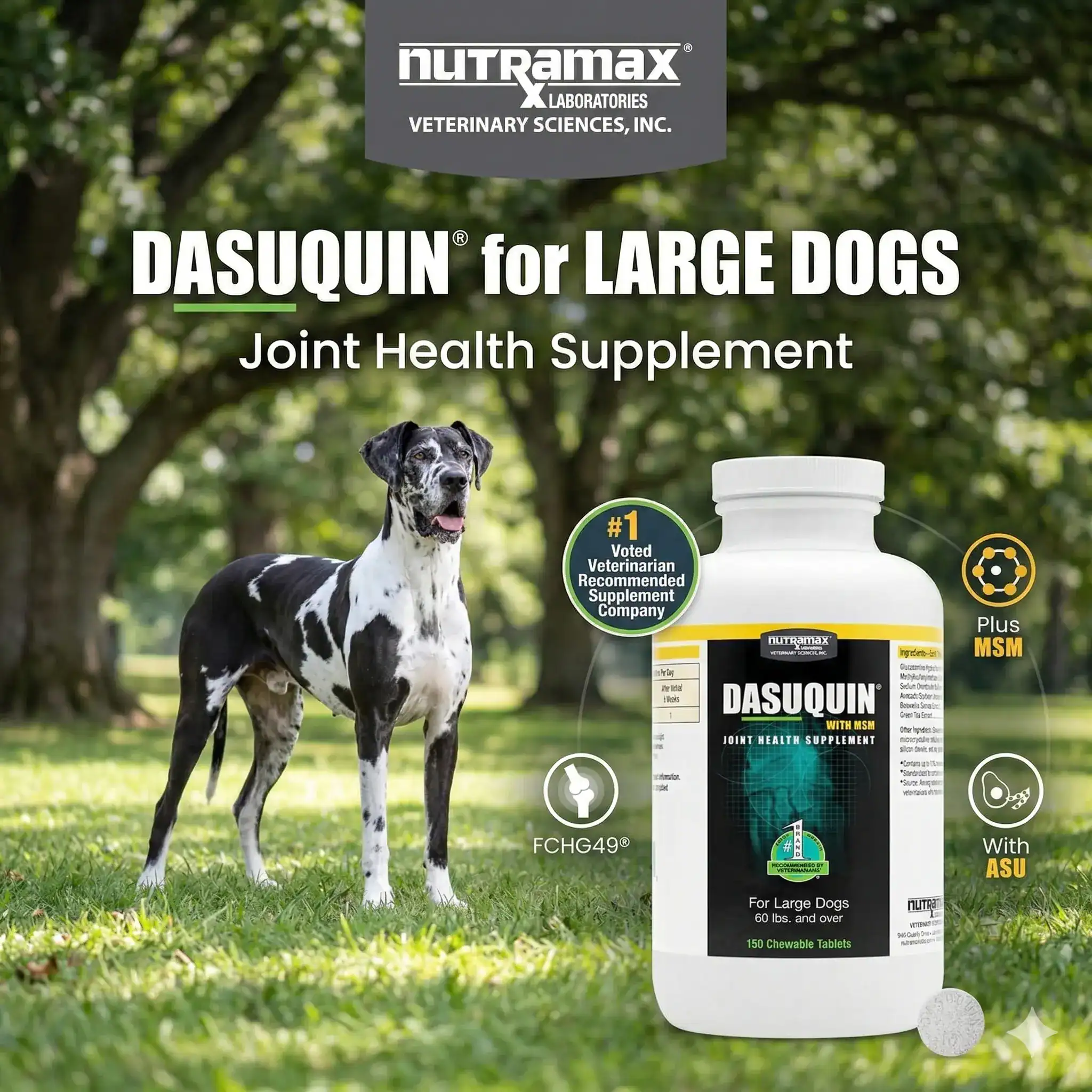
Nutramax Dasuquin with MSM
A joint supplement commonly used in active dogs and in breeds where hip and elbow dysplasia run in the parent lines. It is a supplement to veterinary care, not a replacement for it, and your vet should confirm it suits your dog before you start.
Check price on AmazonTraining
Few dogs learn faster, and few learn unwanted habits faster either. Short daily sessions beat long weekend ones, and positive methods work far better than corrections on a sensitive herding brain.
Prioritize three things early. Build alone-time tolerance in small increments, train a reliable recall, and teach a clean redirection for heel nipping. Puzzle feeders and scent games cover the mental load on days when the weather cuts a walk short.
Giving the Working Brain a Job
Canine sports suit this cross unusually well. The herding side brings speed and body awareness for agility and flyball, while the Poodle’s retrieving background makes many of them keen on dock diving and water work.
Decompression walks do the quieter half of the job. On a long line in open ground, letting the dog choose where to sniff and how long to stay there tires it in a way that a brisk heeled walk does not.
Household tasks fill the gaps between. Teaching a dog to put its toys away, or to fetch named objects one at a time, gives a fast learner something structured to do indoors on days when the weather cuts a session short.
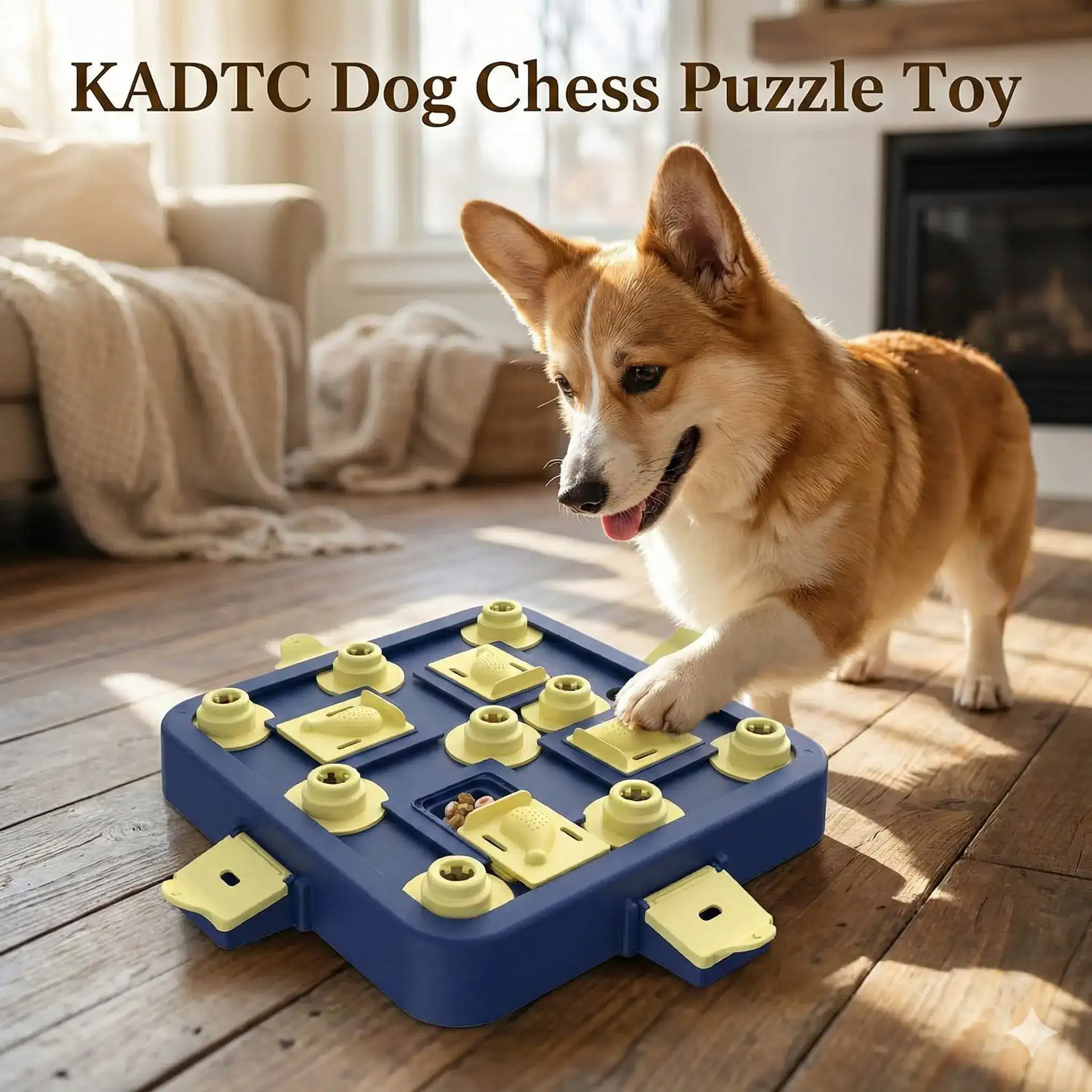
KADTC Dog Chess Puzzle Toy
Sliding-tile puzzles give a fast learner something to solve indoors. They are commonly used to slow down meals and to fill the gap on days when a walk gets cut short, though they supplement daily exercise rather than replacing it.
Check price on AmazonAussiedoodle vs Australian Shepherd vs Goldendoodle vs Border Collie
Buyers weighing this cross usually consider three alternatives. The Australian Shepherd offers the same brain with a predictable shedding coat. The Goldendoodle trades herding drive for a softer retriever temperament. The Border Collie takes the working intensity further still.
| Attribute | Aussiedoodle | Australian Shepherd | Goldendoodle | Border Collie |
|---|---|---|---|---|
| Weight | 10 to 70 lb by variety | 40 to 65 lb | 15 to 90 lb by variety | 30 to 55 lb |
| Original Purpose | Companion cross | Herding livestock | Companion cross | Herding livestock |
| Energy Type | Very high, needs a task | Very high, needs a task | High, more biddable | Extreme, relentless |
| Trainability | Very quick, sensitive | Very quick, sensitive | Quick, forgiving | Exceptional, demanding |
| Grooming | Line brush most days, clip every 6 to 8 weeks | Weekly brush, no clipping | Line brush most days, clip every 6 to 8 weeks | Weekly brush, no clipping |
| Shedding | Usually light, not guaranteed | Heavy, seasonal peaks | Usually light, not guaranteed | Moderate to heavy |
| First-Time Owner? | Active owners only | No | Active owners only | No |
| Common Health Risks | MDR1, hip and elbow dysplasia, eye disease | MDR1, hip dysplasia, eye disease | Hip dysplasia, eye disease | Hip dysplasia, eye disease, epilepsy |
| Living Space | Flexible by size, yard preferred | Home with secure yard | Flexible by size, yard preferred | Home with land and work |
The advantage of the cross is a Poodle coat on a herding dog. The disadvantage is that you cannot predict which parent a given puppy favors.
The honest summary is that the Aussiedoodle asks for Australian Shepherd levels of engagement plus Poodle levels of grooming. If either half of that bill looks unaffordable, the purebred parent may be the better fit. Other Poodle crosses such as the Cavapoo suit calmer homes.
Common Questions about the Aussiedoodle
How much does an Aussiedoodle cost?
Direct Answer: As an approximate, time-sensitive guide (as of 2026), expect roughly USD 1,200 to USD 3,500 from a breeder who health tests both parents.
Context: Prices vary by breeder, location, pedigree, and availability. Miniature and toy sizes and merle coats usually carry a premium over standards.
Management: Treat an unusually low price as a warning about skipped health testing rather than a bargain.
Are Aussiedoodles good family dogs?
Direct Answer: Yes, in active families who can meet the exercise and grooming demands every day.
Context: They are affectionate and closely bonded, but herding instinct means many will chase and nip at running children until taught otherwise.
Management: Redirect heel nipping from the first week and teach children to stop running when the dog circles them.
Do Aussiedoodles shed?
Direct Answer: Most shed lightly, but shedding depends on coat genetics rather than the label on the litter.
Context: Curly and wavy coats hold loose hair inside the curl instead of dropping it. Flatter coats inherited from the Australian Shepherd side shed noticeably more.
Management: Meet the actual puppy and ask what previous litters from the same pairing produced.
Are Aussiedoodles hypoallergenic?
Direct Answer: No dog is hypoallergenic, and no breeder can promise an allergy-friendly puppy.
Context: Allergic reactions come from proteins in dander and saliva, not from hair itself. A low-shedding coat spreads less dander around a home, which helps some people and not others.
Management: Spend time with adult dogs from the same breeder before committing.
How much exercise does an Aussiedoodle need?
Direct Answer: At least one hour of real activity daily, plus separate mental work.
Context: Standards need more than miniatures, but every size inherits working drive. Physical exercise alone leaves the thinking half of the dog unemployed.
Management: Pair walks with training games, scent work, or puzzle feeding so both halves get used.
Are Aussiedoodles good for first-time owners?
Direct Answer: Only for active first-time owners who have researched the grooming and exercise load honestly.
Context: Their intelligence makes training rewarding, but that same intelligence punishes inconsistency. Many surrenders come from homes that expected a low-effort companion.
Management: Book a professional groomer and a training class before the puppy arrives, not after.
Can an Aussiedoodle live in an apartment?
Direct Answer: A miniature or toy can, provided the daily outings are genuine rather than token.
Context: Small size does not reduce drive. A bored miniature in a flat is every bit as inventive as a bored standard in a house.
Management: Commit to multiple outings daily in all weather, and build indoor mental work into the routine.
Do Aussiedoodles have separation anxiety?
Direct Answer: Yes, this cross is strongly prone to separation distress when left alone for long stretches.
Context: Both parent breeds were developed to work closely with a handler, and the cross inherits that need for company from both sides.
Management: Build alone-time tolerance gradually from puppyhood and arrange midday company for full workdays.
What is the Aussiedoodle lifespan?
Direct Answer: Roughly 10 to 13 years, with smaller varieties tending toward the upper end.
Context: Longevity in any cross depends heavily on the health testing behind the parents and on keeping the dog lean throughout life.
Management: Keep annual wellness exams from the start and add senior blood work from about age eight.
Should an Aussiedoodle be tested for MDR1?
Direct Answer: Yes. This is the single most important test for any dog with Australian Shepherd ancestry.
Context: Washington State University records the variant in roughly half of Australian Shepherds tested. Affected dogs can react severely to ordinary doses of some common medications.
Management: A cheek swab settles it. Record the result in the dog’s file and tell every veterinarian who treats it.
Is a merle Aussiedoodle riskier to buy?
Direct Answer: A single merle is fine. A puppy from two merle parents carries real risk of deafness and eye defects.
Context: Merle comes from an insertion in the SILV gene. Two copies strip pigment from tissues where it is needed for normal ear and eye development.
Management: Ask whether both parents are merle, and decline the litter if they are.
Is the Aussiedoodle recognized by the AKC?
Direct Answer: No. It is a cross rather than a breed, so no major registry recognizes it.
Context: There is no breed standard, no parent club, and no CHIC health certification to check. Registration papers from minor doodle registries carry no health meaning.
Management: Judge a breeder on parent health certificates rather than on any registry paperwork offered.
Finding a Puppy
Aussiedoodle puppies are widely advertised across North America, the UK, and Australia, and that volume is the problem. With no parent club and no breed registry behind the cross, the buyer carries the whole burden of verification.
🏠 Reputable Breeders
A serious breeder shows OFA or PennHIP results, eye clearances, and DNA panels for both parents, and explains which tests belong to which parent breed. Expect questions about your working hours and grooming budget.
🐾 Adoption and Rehoming
Doodle crosses appear in shelters and poodle-mix rescues in steady numbers, often surrendered at one to two years when the grooming and energy demands land. Adopting an adult lets you see the coat type and temperament you are actually taking home.
💰 What the First Year Actually Costs
The purchase price is the smaller number. As an approximate, time-sensitive guide (as of 2026), United States owners should plan for the following each year. Figures vary by location, dog size, and local grooming rates.
- Professional grooming: USD 70 to 90 per session every 6 to 8 weeks, which works out to roughly USD 450 to 800 per year.
- Food: USD 600 to 850 per year for a standard-sized adult, less for a miniature or toy.
- Routine veterinary care and parasite prevention: USD 300 to 600 per year.
- Pet insurance: USD 480 to 850 per year for a medium to large crossbreed.
- First-year setup: USD 500 to 700 once, covering crate, bedding, leads, and initial vaccinations.
That lands ongoing costs somewhere near USD 1,800 to 3,100 a year before any emergency. Grooming is the line most buyers never budget for, and it is the one that cannot be skipped.
🚩 Red Flags to Watch For
- Both parents are merle, or the breeder cannot tell you the parents’ merle status.
- No MDR1 result available for the Australian Shepherd parent.
- Health testing described as “vet checked” with no certificates to show.
- The cross marketed as hypoallergenic or as a guaranteed non-shedder.
- Several doodle crosses offered from the same premises year-round.
- Registration papers offered in place of parent health results.
❓ Questions to Ask the Breeder
- May I see the MDR1 result for the Australian Shepherd parent?
- What are both parents’ hip and elbow evaluations?
- Which eye tests were done, and how recently?
- Is either parent merle, and what were the previous litters like?
- What adult weights did earlier puppies from this pairing reach?
- What coat types appeared in the last litter?
🔍 Questions a Good Breeder Asks You
- How many hours a day will the dog be alone?
- Have you budgeted for grooming every six to eight weeks?
- How much daily exercise can you realistically provide?
- Have you owned a high-drive herding type before?
- What is your plan if the placement does not work out?
A seller who asks nothing about your home is running a business, not a breeding program.
Personal Observation
💭 Personal Observation
Rambo, the youngest of the street dogs I rescued, shows me one half of what this cross demands. He is high drive in the literal sense. He needs serious output before he will settle at all, and a short neighborhood walk barely registers with him.
Mun Mun, one of my older rescues, shows the other half. She shadows me from room to room and frets when I leave the house. That is the velcro attachment Aussiedoodle owners describe, and it is not a bonus feature.
Put both traits in one dog and the honest picture appears. This is an animal that needs hard daily exercise and near-constant company in equal measure. Ask yourself which of the two you can supply reliably, because this cross expects both.
Conclusion
The Aussiedoodle rewards households that treat it as a working dog wearing a companion coat. Given real exercise, daily thinking work, and grooming that keeps pace, it becomes one of the most responsive family dogs available.
The risks are concentrated in places buyers rarely look. MDR1 status, the merle status of both parents, and the true coat type of the litter matter more than color or size, and none of them is visible in a photograph.
Weigh the pros and cons before the puppy photos start arriving, because this is not a beginner’s dog in the usual sense. Because no registry stands behind this cross, the questions you ask a breeder are the only quality control in the system. Ask them and you are very likely to bring home a superb dog. Skip them and you are paying purebred money for an unknown.
📋 Before bringing one home, run this 4-step pre-buying check
- Grooming budget. Can you fund a professional clip every 6 to 8 weeks and brush to the skin most days?
- Daily output. Can you provide an hour of hard exercise plus separate mental work every day?
- Time at home. Is someone around most of the day, given how poorly this cross handles isolation?
- Health paperwork. Have you seen MDR1, hip, and eye results for both parents, and confirmed they are not both merle?
If any answer is no, reconsider the breed.
Editorial Disclaimer: This article is for informational and educational purposes only. It does not constitute veterinary advice, medical diagnosis, or treatment recommendations. Always consult a licensed veterinarian before making health-related decisions for your pet.
Accuracy Notice: While every effort has been made to ensure the information presented here is accurate and current, breed information evolves and individual dogs vary. If you spot a factual error or have updated information from a verified source, please contact us so we can review and update.
Product Disclosure: Product recommendations are based on independent research and editorial judgment. Individual results may vary. K9Sphere participates in the Amazon Services LLC Associates Program and other affiliate programs, and earns from qualifying purchases at no additional cost to you.
Last reviewed: September 2026. Article reviewed for accuracy on the date shown above.


