

If you are comparing an Alaskan Husky vs Siberian Husky, the first thing to understand is that you are not comparing two breeds. You are comparing one registered breed against a working type defined entirely by performance.
The Siberian Husky is an AKC-recognized member of the Working Group with a fixed breed standard, a predictable appearance, and a documented history from the Chukchi people of northeastern Asia. The Alaskan Husky is not recognized by any major kennel club. It is a purpose-bred sled dog type developed in Alaskan villages and racing kennels, judged on results rather than looks.
They overlap heavily in weight, energy, and temperament, which is why buyers confuse them. Each is friendly with people, poor as a guard dog, highly vocal, strongly prey-driven, and genuinely uncomfortable in heat. The key differences come down to registry status, how predictable the dog you bring home will be, raw athletic ceiling, and how you actually go about getting one.
This guide compares them across the areas that decide the match, from registry and predictability to temperament, exercise, health, grooming, and cost. Each section ends with a clear round verdict so you can see which one fits your stated use case.
Read it as a decision tool for weighing the real-life trade-offs between these two northern sled dogs. By the final verdict you should know whether you want the predictability of a registered breed or the athletic ceiling of a performance-bred type.
Affiliate Disclosure: K9Sphere is a participant in the Amazon Services LLC Associates Program. As an Amazon Associate, K9Sphere earns from qualifying purchases made through links in this article at no additional cost to you. Product recommendations are based on independent research and editorial judgment, not paid placement.
Quick Answer and Who Each Round Favors
⚡ The 30-Second Answer
Choose the Siberian Husky if you want a registered breed with a predictable size, coat, and temperament, papers for showing or breeding, and a dog you can actually find through normal breeders or rescue. Choose the Alaskan Husky if you want maximum sled-dog performance for mushing, canicross, or bikejoring, and you have access to a racing kennel or sled-dog rescue.
Each is a friendly, vocal, prey-driven, heat-sensitive northern dog needing 90 minutes to two hours of hard daily work. The real decision is predictability versus athletic ceiling.
| Category | Favors |
|---|---|
| Registry and predictability | Siberian Husky |
| Temperament | Roughly even |
| Athletic ceiling | Alaskan Husky |
| Family fit | Roughly even |
| Grooming and shedding | Depends on the line |
| Heat tolerance | Poor for both |
| Health and longevity | Alaskan Husky (slightly) |
| Cost and availability | Siberian Husky |
| First-time owners | Siberian Husky |
Alaskan Husky vs Siberian Husky at a Glance
Whether you search for Alaskan Husky vs Siberian Husky or Siberian Husky vs Alaskan Husky, this comparison table lays out the core differences in registry status, size, purpose, and lifestyle fit. Scan the rows that matter most to you for a quick view of the similarities and differences, then read the detailed sections below.
| Attribute | Alaskan Husky | Siberian Husky |
|---|---|---|
| Registry status | Not recognized by any major club | AKC Working Group (1930) |
| Height (male) | 22–26 in (56–66 cm) | 20–24 in (51–61 cm) |
| Weight | 45–60 lb (20–27 kg) male | 35–60 lb (16–27 kg) |
| Lifespan | 12–15 years | 12–14 years |
| Origin | Alaska, USA | Siberia, Russia |
| Original purpose | Distance and sprint racing | Mid-distance sled work |
| Appearance | Highly variable by line | Predictable, fixed standard |
| Build | Taller, leaner, leggier | Compact, muscular, medium |
| Coat | Varies, dense or short by line | Uniform dense double coat |
| Trainability | Biddable for work | Independent, often stubborn |
| With strangers | Friendly, poor guard dog | Friendly, poor guard dog |
| Main health risks | Athletic injuries, heat stress | Eye conditions, hip dysplasia |
| Where to find one | Racing kennels, sled-dog rescue | Breeders and rescue, widely |
| First-time owner? | Very challenging | Challenging |
📜 A Quick Origin Story
The Siberian Husky was developed by the Chukchi people of northeastern Asia as an endurance sled dog, bred for speed over vast frozen distances rather than heavy hauling. The dogs lived closely with Chukchi families and slept among the children for warmth, which explains the people-loving nature still seen today.
The first Siberians reached Alaska in 1909 for the All-Alaska Sweepstakes, where their smaller size was mocked until their stamina proved decisive. The breed earned lasting fame in the 1925 serum run to Nome, and the AKC recognized it in 1930.
The Alaskan Husky grew out of the indigenous village dogs of the North American Arctic. During the 1896 Klondike Gold Rush, prospectors crossed native dogs with imported hounds and setters for speed and durability under load. The first Iditarod in 1973 cemented modern breeding around racing results.
Genetic research led by Dr. Heather Huson at Cornell mapped which breeds actually shaped the modern Alaskan sled dog. Alaskan Malamute and Siberian Husky ancestry is linked to endurance, Pointer and Saluki ancestry to speed, and Anatolian Shepherd ancestry to work ethic.
Sprint kennels commonly run dogs of 25 percent or greater Pointer ancestry, which is why some Alaskans look almost nothing like a husky. The population is sometimes described as a landrace, though researchers more precisely call it a genetically distinct mixed-breed population selected purely on athletic performance.
Who Should Choose the Alaskan Husky
🐕 The Alaskan Husky is the right pick if:
- You want genuine sled-dog performance for mushing, skijoring, or bikejoring.
- You live in a cool climate and can commit to two hours of daily aerobic work.
- You have access to a racing kennel or a sled-dog rescue network.
- You do not need registry papers, a show career, or a predictable look.
- You understand which line you are getting, since distance and sprint dogs differ sharply.
Who Should Choose the Siberian Husky
🐕 The Siberian Husky is the right pick if:
- You want a predictable size, coat, and temperament backed by a breed standard.
- You want registry papers for showing, sport titles, or responsible breeding.
- You want a dog you can realistically find through breeders or rescue near you.
- You want the classic look, including the facial mask and often-blue eyes.
- You are active enough for daily running but are not aiming at competitive racing.
Registry and Predictability
This is the single biggest difference between them, and it shapes everything else. The Siberian Husky is recognized by the American Kennel Club in the Working Group, with a written breed standard covering height, weight, coat, and temperament. Two Siberian puppies from different litters will still grow into recognisably similar adults.
The Alaskan Husky has no registry status with the AKC, UKC, or FCI, and no breed standard exists. It is a performance crossbreed whose lineage is tracked through racing pedigree and results rather than conformation papers. That is not a flaw, since it is exactly how mushing kennels intend it to work.
The practical consequence is predictability. Buying a Siberian tells you roughly what the adult dog will look like and weigh. Buying an Alaskan tells you far less unless you know the kennel and the line, because coat length, cold tolerance, and build all swing hard between distance and sprint breeding.
Eye colour follows the same pattern. The Siberian Husky is known for striking blue eyes and for heterochromia, where the two eyes differ in colour, alongside the usual brown. Its facial mask is a defining marking of the breed. Alaskan Huskies tend toward brown eyes, since blue is most strongly associated with Siberian ancestry, though blue does appear in lines carrying more Siberian blood.
🎯 Verdict: The Siberian Husky wins clearly on predictability, offering a fixed standard and papers. The Alaskan Husky trades that certainty for performance breeding, which suits mushers but leaves pet buyers guessing without kennel knowledge.
Temperament and Personality
These two are strikingly similar here, which is part of why buyers mix them up. Each is a pack-oriented dog, friendly with people including strangers, poor as a guard dog, highly vocal in the howling and talking register rather than barking, and carrying a prey drive strong enough to make cats and small pets a genuine concern.
The clearest split is in working focus. The Alaskan is generally more biddable when there is a job in front of it, since decades of kennel selection favoured dogs that take direction at speed on the trail. It is still independent at home, but the working switch is easier to find.
The Siberian is widely described as independent and stubborn, a characteristic that leads owners to mistake it for low intelligence when the dog is simply deciding the command is not worth obeying. It bonds deeply and affectionately with family, a legacy of Chukchi households where the dogs slept among the children, but it will happily ignore a recall in favour of something more interesting.
Early socialization helps both types settle around unfamiliar people and dogs.
🎯 Verdict: Call it roughly even, since both are friendly, vocal, prey-driven pack dogs. The Alaskan is more biddable when working, while the Siberian is more openly stubborn. Neither suits an owner expecting retriever-style obedience.
Athletic Ability and Exercise Needs
Both dogs need serious daily work, but the ceiling differs. The Alaskan Husky is the faster and more enduring of the two, and it is the type that actually wins modern competitive races. Its taller, leaner, leggier build with a deep chest and long stride is engineered for sustained output under harness.
The Siberian Husky is a mid-distance specialist rather than a racing machine. It is compact and muscular, efficient over long ground, and famously proved its stamina in the All-Alaska Sweepstakes and the 1925 serum run. It is fully capable of running for hours and remains a superb recreational sledding dog, just not at the level competitive racing kennels demand.
In daily terms the requirement is similar for both, at 90 minutes to two hours of hard aerobic work. Neighborhood walks will not touch it. Harness sports such as canicross, bikejoring, and skijoring channel the hardwired pull instinct far better than obedience drills. Each is also a determined escape artist that will dig under or climb a weak fence, so secure containment matters as much as exercise.
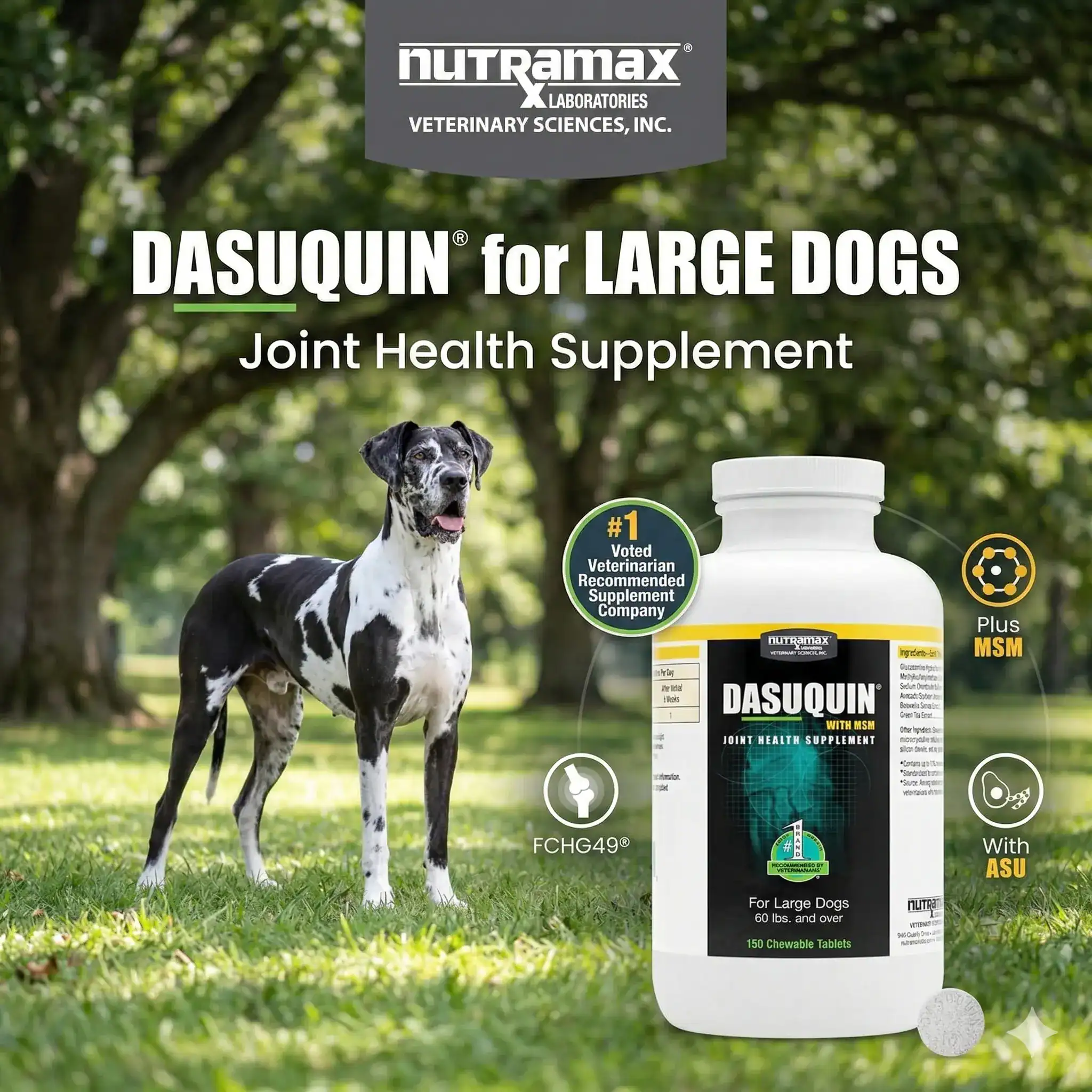
Nutramax Dasuquin with MSM Soft Chews for Dogs
Use for: Both types carry real joint load from sustained pulling work, and hip or elbow issues appear in heavier lines. Glucosamine, chondroitin, and MSM help support cartilage in hard-working adults.
Check price on Amazon🎯 Verdict: The Alaskan Husky takes this round on raw athletic ceiling, being faster and built for competitive racing. Daily needs are similar for both at 90 minutes to two hours, so pick the Alaskan only if you will actually use that extra capacity.
Family Fit
Each can work well in an active family, and each is affectionate with children it lives with. The Siberian is patient and playful, though its bouncy energy can knock over a toddler when it has not been properly exercised first. The Alaskan is equally pack-oriented and generally warm with kids in the household.
The shared warning is prey drive. Neither is a safe default around free-roaming cats, rabbits, or other small pets, and even a dog raised alongside a cat can have instinct override training without warning. Households with small animals should think hard before committing to either.
Vocalisation is the other family consideration. These are howling and talking dogs rather than barkers, which is charming in a detached house and a serious problem in a shared-wall apartment. Supervise young children closely with either dog and exercise before expecting calm indoor behaviour.
🎯 Verdict: Roughly even. Each is affectionate and pack-oriented with its own family, and each carries the same prey-drive and noise cautions. The decision here rests on your home and neighbours rather than the dog.
Grooming and Shedding
The Siberian Husky is the predictable one. It carries a uniform dense double coat that sheds steadily year-round and blows out heavily twice a year, dropping handfuls of undercoat daily for weeks. Brushing several times weekly, and daily during a blowout, is the baseline commitment.
The Alaskan Husky depends entirely on the line. Traditional distance dogs carry the same dense double coat and the same twice-yearly blowouts. Sprint lines with Pointer influence have noticeably shorter, smoother coats with less undercoat, needing only weekly brushing year-round.
For either dog, avoid shaving the coat, since it regulates temperature in both directions and protects the skin. Bathe infrequently at roughly two to three month intervals so the protective oils stay intact, and keep nails trimmed every three to four weeks. An undercoat tool beats a standard bristle brush every time.

FURminator Undercoat Deshedding Tool for Dogs
Use for: Pulling loose undercoat from a dense northern double coat during the heavy twice-yearly blowouts, before it coats every surface in the house.
Check price on Amazon🎯 Verdict: This depends on the line rather than the type. The Siberian is a known heavy shedder, while an Alaskan may shed just as much or noticeably less depending on whether it comes from distance or sprint breeding.
Heat Tolerance and Climate
Neither dog belongs in a hot climate without serious management, and this is the most common reason northern dogs struggle in pet homes. Both were built for sub-zero Arctic work, and coat genetics cannot be conditioned away no matter how long a dog lives in a warm region.
The Siberian is uniformly heavy-coated, so its heat limits are consistent and predictable. Exercise should shift to early morning and late evening whenever temperatures climb, with constant access to cool water and shade.
The Alaskan varies again by line. Distance dogs carry the full Arctic coat and the same constraints, while Pointer-influenced sprint lines have shorter coats and cope somewhat better in mild warmth, though they lose cold-weather protection in exchange. Working sources treat sustained exercise above roughly 60°F as a heat-stress risk, and signs like bright red gums, glassy eyes, or a stumbling gait are a veterinary emergency.
🎯 Verdict: Poor for both, with a small edge to short-coated Alaskan sprint lines in mild warmth. If you live somewhere hot, reliable cooling, shade, and early or late exercise windows are essential for either dog.
Health and Longevity
The two carry different risk profiles. The Siberian Husky lives roughly 12 to 14 years and is generally healthy, with the main inherited concerns being eye conditions such as juvenile cataracts, corneal dystrophy, and progressive retinal atrophy, alongside hip dysplasia. Responsible breeders provide annual ophthalmologist eye clearances and OFA hip results for both parents.
The Alaskan Husky lives roughly 12 to 15 years, and its mixed genetics help it avoid many of the exaggerated structural problems that affect heavily line-bred show dogs. Its vulnerabilities come from the working lifestyle instead, including soft-tissue and carpal injuries, exercise-induced heat stress, and stress-related gastric ulcers during intense racing seasons.
For either dog, the screening question matters more than the label. Ask a Siberian breeder for eye and hip clearances, and ask an Alaskan kennel for working history and soundness records across generations. Keep either lean, protect young joints during growth, and treat heat stress as the emergency it is.
Veterinary Disclaimer: This article is for educational purposes only and is not a substitute for professional veterinary advice, diagnosis, or treatment. K9Sphere’s authors are experienced dog owners, not licensed veterinarians. Always consult a qualified DVM regarding any health concerns about your dog.
Always consult your licensed DVM for personalized medical advice.
Because both types put real load through their joints, a supportive sleeping surface helps recovery between hard sessions. See our guide to the FurHaven orthopedic dog bed for a frame that distributes weight evenly.
Health Information Sources. Data compiled from the following references.
- American Kennel Club Siberian Husky reference
- Siberian Husky Club of America breed health statements and screening requirements
- OFA CHIC Program recommended screening protocols
- Huson et al., BMC Genetics genetic breed composition of the Alaskan sled dog
Always consult your licensed DVM for personalized medical advice.
🎯 Verdict: A slight edge to the Alaskan Husky on longevity and inherited-disease risk, thanks to genetic variability, though its working injuries and heat-stress exposure offset some of that. The Siberian’s risks are better documented and more screenable.
Cost and Availability
Availability is where the gap is widest. Siberian Huskies are everywhere, sold through club-registered breeders and filling rescue groups because so many owners underestimate the exercise demands. Finding one near you is straightforward, and adopting an adolescent lets you skip the destructive phase.
Alaskan Huskies are rarely advertised to the pet market at all. Acquisition runs almost entirely through racing kennels, working-dog networks, and sled-dog rescue adoption, with puppies typically 500 to 2,000 US dollars and retired racing dogs often 200 to 500 through rescue. Kennels usually place dogs that lack the edge for elite competition.
Running costs are high either way, driven by performance nutrition, harness equipment, and active-medicine veterinary care. Coat maintenance and joint support add to the yearly total. Working-dog sources put lifetime Alaskan Husky ownership in the region of 18,000 to 25,000 US dollars across a 12 to 15 year life, and a hard-exercised Siberian sits in similar territory.
🎯 Verdict: The Siberian Husky wins on availability by a wide margin, since you can realistically find one through breeders or rescue. The Alaskan requires access to the mushing world, though a retired racing dog is often the cheapest and best-suited route into pet life.
First-Time Owners
Neither is a sensible first dog, and both fill rescue kennels with adolescents whose owners misjudged the workload. Each needs 90 minutes to two hours of hard daily exercise, six-foot dig-proof fencing, tolerance for constant howling, and acceptance that off-leash freedom is realistically off the table for life.
Between the two, the Siberian is the more forgiving entry point. It is easier to find, better documented, supported by an active breed club, and comes with a predictable adult size and coat so a newcomer knows what they are signing up for.
The Alaskan asks more before you even bring one home. You need to understand the difference between distance and sprint lines, evaluate a racing kennel, and realistically provide a working outlet, since these dogs exist almost entirely outside the pet market for good reason.
🎯 Verdict: The Siberian Husky takes this round. It is the more accessible and better-documented starting point, while the Alaskan Husky suits owners already active in mushing or harness sports.
Head-to-Head Scorecard
Ratings are from 1 to 5 stars and reflect suitability for a typical active home. A high Predictability score means you know what the adult dog will look like and weigh, while a high Availability score means you can realistically find one near you.
Alaskan Husky
Siberian Husky
Reading the scores: Both score maximum on Friendliness to People, which is why neither works as a guard dog. The Alaskan leads on Athletic Ceiling, while the Siberian leads on Predictability and Availability. Low Heat Tolerance on both sides is the shared constraint that decides many placements.
Common Questions about Alaskan Husky vs Siberian Husky
These are the frequently asked questions buyers raise when comparing the two.
What is the difference between an Alaskan Husky and a Siberian Husky?
Direct Answer: The Siberian Husky is an AKC-recognized purebred with a fixed breed standard, while the Alaskan Husky is a working type defined by racing performance rather than appearance.
Context: The Siberian is built for mid-distance sled work and is identified by its facial mask, often-blue eyes, and uniform double coat. The Alaskan is typically taller, leaner, and faster, with widely variable coat and eye colour depending on which breeds were crossed into the line.
Management: Choose a Siberian for predictable appearance and registry papers. Choose an Alaskan for racing performance and working partnership in a cold-climate athletic household.
Is the Alaskan Husky a real breed?
Direct Answer: It is a recognized working-dog type but not a registered purebred.
Context: No major kennel club, including the AKC, UKC, or FCI, lists the Alaskan Husky as a standardized breed. It is still a real and distinctive category, deliberately bred within mushing kennels for over a century and tracked through racing pedigree.
Management: If papers matter for showing or breeding, choose the Siberian Husky. For sled work or athletic partnership, an Alaskan’s working pedigree carries more meaning than a registry stamp.
Which husky is faster?
Direct Answer: The Alaskan Husky, and it is the type that wins modern competitive races.
Context: Alaskan Huskies are generally taller, leaner, and leggier, bred purely for speed and endurance under harness. The Siberian is a capable mid-distance runner but was not selected for competitive racing at the same level.
Management: If you want a racing or serious harness-sport partner, the Alaskan is the stronger choice. For daily running and hiking, either dog will outlast most owners.
Which one is better for a first-time owner?
Direct Answer: The Siberian Husky, though neither is a genuinely easy first dog.
Context: The Siberian is easier to find, better documented, backed by an active breed club, and comes with a predictable adult size and coat. The Alaskan requires understanding kennel lines and usually a working outlet before purchase.
Management: Whichever you choose, commit to 90 minutes to two hours of daily exercise, six-foot dig-proof fencing, and lifelong leash management before bringing one home.
Do Alaskan and Siberian Huskies shed the same amount?
Direct Answer: The Siberian always sheds heavily. The Alaskan depends on its line.
Context: Both traditional distance-bred Alaskans and all Siberians carry a dense double coat that sheds year-round with heavy blowouts twice annually. Sprint-bred Alaskans with Pointer influence have shorter coats and shed noticeably less.
Management: Brush several times weekly, daily during a blowout, using an undercoat tool. Never shave either coat, since it regulates temperature in both directions.
Are either of them good guard dogs?
Direct Answer: No. Neither is a capable guard dog despite the wolf-like look.
Context: Each is a pack-oriented dog that greets strangers as potential friends, and neither carries the territorial suspicion protection work requires. This friendliness is a deliberate product of sled-dog breeding, where teams work closely with handlers.
Management: If home security is the goal, look at traditional guarding breeds instead. Enjoy either husky for companionship and athleticism rather than protection.
Can either husky live in a hot climate?
Direct Answer: Both struggle, and it takes serious daily management to do it fairly.
Context: Each was bred for sub-zero Arctic work, and coat genetics cannot be conditioned away. Working sources treat sustained exercise above roughly 60 degrees Fahrenheit as a heat-stress risk, and heat stress is the most common emergency in warm-climate pet placements.
Management: Restrict hard exercise to early morning and late evening, provide reliable cooling, shade, and constant water, and treat bright red gums or a stumbling gait as a veterinary emergency.
Which husky lives longer?
Direct Answer: The Alaskan Husky, by a small margin.
Context: Alaskan Huskies typically live 12 to 15 years, helped by the genetic variability of mixed working lines, while Siberians average 12 to 14. The gap is modest and individual screening matters more than the type.
Management: Keep either dog lean, screen for the known conditions on each side, and schedule sports-medicine checkups for hard-working adults.
Can either be trusted off leash?
Direct Answer: No. Neither is reliably safe off leash in open areas.
Context: Both carry a strong prey drive and roaming instinct that overrides even well-conditioned recall when a deer, rabbit, or unfamiliar dog appears. This is consistent across both types rather than a training failure.
Management: Use long lines and securely fenced areas with six-foot dig-proof barriers for any free running, and treat recall as a useful backup rather than a guarantee.
Are Alaskan and Siberian Huskies related?
Direct Answer: Yes. Siberian Husky bloodlines are part of what went into the Alaskan Husky.
Context: The Alaskan Husky descends from indigenous Arctic village dogs crossed over generations with imported breeds including hounds and setters, and later Pointers in sprint lines. Siberian stock is among the northern breeds that contributed to the mix.
Management: Treat them as distinct choices despite the shared ancestry, since registry status, predictability, and athletic ceiling all differ meaningfully.
How much does each one cost?
Direct Answer: Purchase prices are broadly similar, but availability differs sharply.
Context: Alaskan Husky puppies from working kennels typically run 500 to 2,000 US dollars, with retired racing dogs often 200 to 500 through sled-dog rescue. Well-bred Siberians sit in a comparable range and are far easier to find, with many available through rescue.
Management: Budget for performance feed, harness equipment, and active-medicine veterinary care with either dog, since lifetime costs run well above an average companion breed.
Do both huskies howl?
Direct Answer: Yes. Each is vocal in the howling and talking register rather than barking.
Context: This is genuine communication rooted in pack behaviour, used to express excitement, frustration, or a response to distant sounds. It is a deep instinct in both types rather than a trainable habit.
Management: Meet exercise and enrichment needs to reduce boredom howling, and be honest with neighbours before choosing either dog for a shared-wall home.
Which husky is better with cats and small pets?
Direct Answer: Neither is a safe default around cats or small animals.
Context: Both carry an exceptionally high prey drive toward fast-moving small animals, and instinct can override training even in a dog raised alongside a cat from puppyhood.
Management: If you already have cats, rabbits, or small pets, seriously consider a different breed. Where a household is already committed, manage separation carefully and never leave them unsupervised together.
How do they compare to the Alaskan Malamute?
Direct Answer: The Malamute is the heavy freight hauler of the three, built for power over distance rather than speed.
Context: Both huskies here are speed and endurance dogs, while the Alaskan Malamute is a larger, heavier-boned breed developed by the Mahlemut people to haul substantial loads at a walking pace. Malamute ancestry also appears in the Alaskan Husky genetic profile, where it is linked to endurance.
Management: Choose a Malamute for strength and a calmer working pace, and either husky for speed and stamina. See our Alaskan Malamute guide for the full breakdown.
The Quick Decision Shortcut
If you want the fast version before the full verdict, use this self-check to decide which northern sled dog fits your household. Each has one big pro and one obvious con, so pick the column that sounds more like you.
🐕 Choose the Alaskan Husky if
- You want genuine racing or harness-sport performance.
- You have access to a racing kennel or sled-dog rescue.
- You live in a cool climate with room for two hours of daily work.
- Registry papers and a predictable look do not matter to you.
🐕 Choose the Siberian Husky if
- You want a predictable size, coat, and temperament.
- You want papers for showing, sport titles, or breeding.
- You want a dog you can realistically find near you.
- You are active but not aiming at competitive racing.
Final Verdict
There is no universal winner here, because one is a registered breed and the other is a performance category, and they are not really competing for the same owner. Both are friendly, vocal, prey-driven northern athletes that need far more work than most households expect.
The underlying decision is simple. The Siberian offers predictability, papers, and a dog you can actually go and find, which is why it suits almost everyone asking this question. The Alaskan offers a higher athletic ceiling and a genuine working partnership, which matters enormously if you are heading into mushing and very little if you are not.
🏆 Bottom line: The Siberian Husky is the predictable, accessible registered breed; the Alaskan Husky is the faster performance type built for the trail. Match the dog to whether you want certainty or a working partner, and be honest about your climate either way.
Personal Observation
💭 From my own experience
My Labrador Bruno reached about 45 kg and lived with me from 2012 to 2021. He was never bred for cold work, yet his coat alone was dense enough that warm months visibly drained him. He needed fans through most of the year and full cooling in peak summer just to rest comfortably.
That taught me the lesson that matters most here. Coat genetics beat conditioning every time, and neither of these dogs carries a coat as light as Bruno’s.
So before the registry question, before the speed question, ask the climate question. If your summers are hot, you are working against this dog’s biology for months a year, and no amount of enthusiasm changes that.
Read More. For the full individual guides, see our Alaskan Husky guide and our Siberian Husky guide. If you are weighing sprint-line genetics, the Eurohound guide explains the Pointer-crossed sprint dog, and both types here benefit from our roundup of the best brushes for shedding dogs.
Editorial Disclaimer: This article is for informational and educational purposes only. It does not constitute veterinary advice, medical diagnosis, or treatment recommendations. Always consult a licensed veterinarian before making health-related decisions for your pet.
Accuracy Notice: While every effort has been made to ensure the information presented here is accurate and current, breed information evolves and individual dogs vary. If you spot a factual error or have updated information from a verified source, please contact us so we can review and update.
Product Disclosure: Product recommendations are based on independent research and editorial judgment. Individual results may vary. K9Sphere participates in the Amazon Services LLC Associates Program and other affiliate programs, and earns from qualifying purchases at no additional cost to you.
Last reviewed: September 2026. Article reviewed for accuracy on the date shown above.


