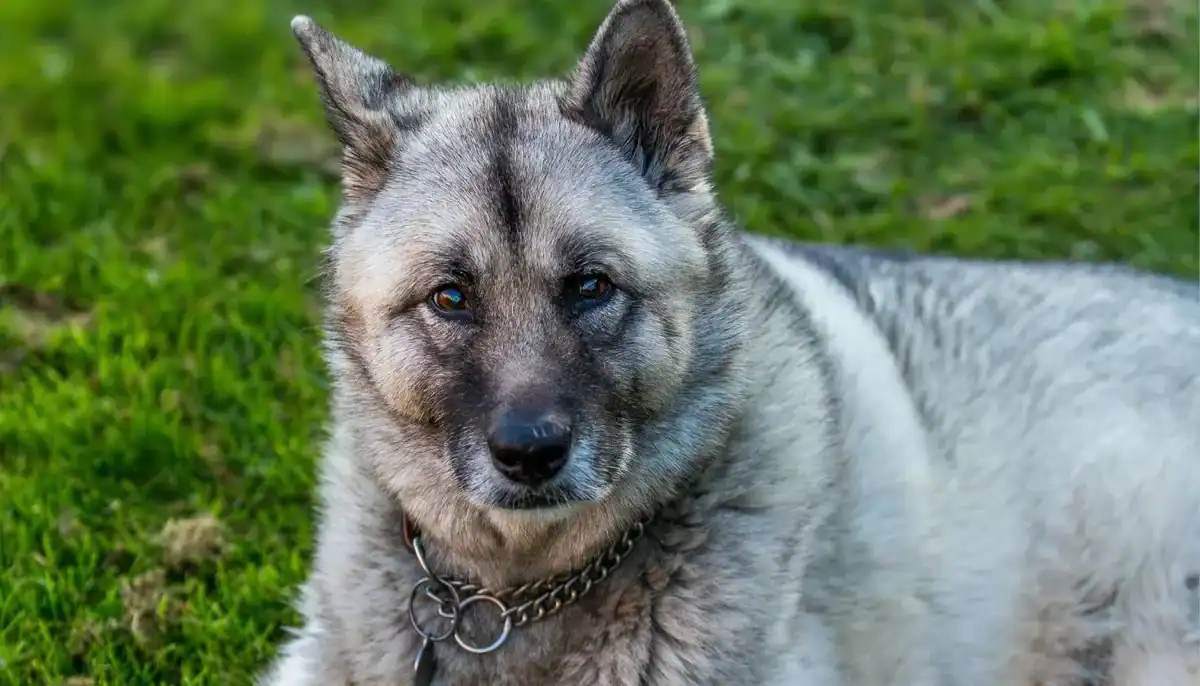
The Norwegian Elkhound is a Scandinavian hunting dog of ancient lineage. Most people see the fluffy silver fur and think companion dog. What they are actually looking at is one of the oldest large-game trackers in the world, bred across Norway’s mountain terrain to chase and hold moose, bear, wolf, and lynx until the hunter arrived.
What makes this Scandinavian dog worth understanding is the combination of a striking silver-gray double layer, a confident and deeply loyal character, and a versatility that stretches from big-game hunting to watchdog duty to loyal companion. Norwegian Elkhounds are alert, bold, and surprisingly affectionate with the people they claim as their own. Properly socialized Elkies develop into steady, trustworthy household members with a sense of humor and a drive to participate in household life.
This guide draws on the American Kennel Club breed profile, the parent club protocols, OFA CHIC screening protocols, peer-reviewed veterinary research on primary glaucoma in the breed published in PubMed, and PetMD clinical references to present an accurate picture of norwegian elkhound dog breed information that what it takes in practice.
Core commitments include at at least 60 minutes of vigorous effort, firm and patient structure from week one, broad socialization with people and other animals during those early weeks, and a willingness to manage an Elkhound whose alerting was built into its core hunting design. Families that invest in this structure are rewarded with a remarkably loyal partner built for both work and household life.
Norwegian Elkhounds reward households that match their requirement for physical work and mental challenge, and consistent leadership. Households without a commitment to consistent sessions outdoors or with very small pets may find the chase instinct and vocal tendencies a real challenge. Know what you’re committing to before bringing one home.
Affiliate Disclosure: K9Sphere is a participant in the Amazon Services LLC Associates Program. As an Amazon Associate, K9Sphere earns from qualifying purchases made through links in this article at no additional cost to you. Product recommendations are based on independent research and editorial judgment, not paid placement.
Breed Snapshot
📊 Vitals and Lifespan
Height
Males: 20.5 in (52 cm)
Females: 19.5 in (49 cm)
Weight
Males: 50–60 lb (23–27 kg)
Females: 40–55 lb (18–25 kg)
Lifespan
12–15 years
Breed Group
Hound Group
Origin
Norway
🇳🇴
⭐ Personality Traits
Ratings (1 to 5). This ancient Scandinavian tracker balances fierce loyalty and deep affection against an independent mind, an intense energy output, and a voice that was literally bred into its job description.
History and Origin
Few dog breeds carry a history as ancient or as well-documented as the Norwegian Elkhound. Before pedigree records existed, this dog worked as a sled dog, hunting companion, and farm guardian across Scandinavia. Skeletal remains matching the breed’s structure have been found alongside stone tools in cave sites in western Norway, with some dating to 4,000 to 5,000 BC. This is an ancient breed in the truest sense, shaped over thousands of years by the demands of Scandinavian tracking dogs and the brutal realities of northern terrain.
📌 4000–5000 BC: Prehistoric Origins
Archaeological evidence places elkhound-type dogs in Scandinavia thousands of years before formal records, well before the Viking Age. Elkhound remains have been found buried with Viking warriors alongside shields and swords, a testament to how deeply the breed was embedded in the Norse way of life. The dogs sailed with Vikings, guarded farms, and tracked large game across mountainous territory. Norwegian folklore includes stories of elkhounds serving as king of Throndjem and hiking snowbound mountains with their people. This is a breed woven into the national identity of Norway centuries before anyone kept pedigree records.
📌 1877: First Dog Shows and Breed Records
The Norwegian Hunters Association held its founding dog show in 1877, marking the start of modern record-keeping for the Norwegian Elkhound. A breed standard was written and a stud book published. The breed remained largely within Scandinavia until the late 19th century, when it began appearing in England. The Norwegian Elkhound is widely regarded as Norway’s national dog, a status it still holds today.
📌 1923 and 1930: International Recognition
The British Kennel Club recognized the Norwegian Elkhound in 1923. The American Kennel Club followed with recognition around 1930, placing the breed in the Hound Group based on its superior ability to trail and hold game. A dedicated parent club was formally established in 1930 to support the breed’s development in the US.
📌 1932: Presidential Recognition
President Herbert Hoover owned a Norwegian Elkhound named Weegie and was so proud of the dog that he included Weegie in the official presidential Christmas card in 1932. This moment of considerable visibility helped raise awareness of the breed among American families. Norway also gifted President Hoover an Elkhound, contributing to the breed’s growing post-World War I popularity in the United States.
Physical Characteristics
The Norwegian Elkhound is a compact, squarely built medium dog designed for endurance over speed. Every structural feature traces back to the demands of tracking moose and large game across rough, cold terrain for hours at a stretch. Strong, well-muscled hindquarters provide the strength required to maintain a fast trot over broken ground. A broad, deep chest houses the lung capacity for sustained effort. The tightly curled tail arched over the back is one of the breed’s most recognizable signatures.
🐺 The Silver-Gray Coat
The layered coat is one of the most practical features. The outer guard hairs are thick, hard, and weather-resistant. The undercoat is dense, woolly, and soft. Together they insulate the dog in cold temperatures and shed dirt with minimal effort. The color is gray overall, with black tips on individual guard hairs creating depth and shading. The muzzle, ears, and tail tip are black. Norwegian Elkhound puppies are actually born black and transition to the signature gray within a few weeks as the fur develops. The color is specific: gray with black-tipped guard hairs and a lighter undercoat. No other color variations are recognized by the AKC standard.
🏗️ Medium, Muscular Build
The body is short and square, with a straight, strong back and a broad wedge-shaped head. Dark brown, oval-shaped irises give the breed a keen, alert expression. Ears stand erect and firm, but mobile enough to flatten back against the head when the dog is relaxed or showing affection. The overall impression is of a solid, capable working dog that carries no excess. Despite the thick fur, the Elkhound is a moderately sized dog, and the squarely built frame gives it agility that belies its robust appearance.
The Name “Elkhound” and What It Actually Means
The name is a direct translation of the Norwegian “Elghund,” where “elg” means “moose” and “hund” means “dog.” This is why the AKC notes the name is somewhat misleading for English speakers who associate “elk” primarily with North American elk rather than European moose. The breed was built specifically to track and bay moose, holding the animal in place by darting in and out and barking constantly until the hunter arrived. This alerting pattern is not a structural problem. It is exactly what the dog was bred to do. Understanding this is the starting point for managing it in a modern household.
Character and Temperament
These dogs occupy interesting character territory. These dogs are deeply devoted to their families, playful with kids they know, and alert enough to serve as reliable watchdogs. They also carry the independent thinking of a dog that was bred to make solo decisions in the field. The combination of loyalty and self-reliance produces an animal that bonds deeply but does not take orders passively.
🛡️ Family Loyalty
Norwegian Elkhounds consider themselves full members of the household and want to be included in everything. They are affectionate with the people they know, patient with older children, and deeply attached to their household. An Elkhound that feels left out usually finds a loud way to tell you. These dogs were bred to work alongside people, not in a kennel, and separation distress is a real concern for households where the dog spends extended hours alone without company or engagement.
🔔 The Elkie Bark
Norwegian Elkhounds are vocal dogs. This is not a quirk or a handler failure. It is the core function the breed was selected for over many centuries. A dog that vocalized while holding big game at bay was a dog that worked. That working instinct transfers directly into modern watchdog patterns, alert calling at passersby, and noise-making during play. People who live in apartments or noise-sensitive neighborhoods should think carefully before choosing the breed. Working on a quiet command can reduce frequency, but the urge to alert will always be there.
🦊 Prey Drive
The hunting genetics that make this dog so capable in the field also make it unreliable around small animals at home. Elkhounds should not be trusted alone with hamsters, pet rats, rabbits, guinea pigs, or other small non-canine pets. Some Elkhounds learn to coexist with household cats, particularly those raised together from the start, but this requires deliberate management rather than assumption. Small animals on the street will trigger the chase response even in a well-trained adult.
🧠 Independent Thinker
An Elkhound will understand “sit” perfectly but may decline if a squirrel is more interesting. That is the everyday reality with an Elkhound. Stanley Coren ranks them 36th out of 138 breeds in working intelligence, well above average. The issue is not capability but willingness to cooperate on someone else’s schedule. Consistent, positive work that makes compliance more rewarding than the dog’s own agenda is the most reliable approach.
Screening and Conditions
Veterinary Disclaimer: The information in this article is for educational purposes only and is not a substitute for professional veterinary advice, diagnosis, or treatment. K9Sphere’s authors are experienced caretakers, not licensed veterinarians. Always consult a qualified DVM regarding any concerns about your pet. Never disregard professional veterinary advice or delay seeking it because of something you have read on this site.
Health Information Sources: Data compiled from:
- American Kennel Club: Breed profile and parent-club guidance
- Norwegian Elkhound Association of America (NEAA): CHIC certification requirements including OFA hip, CERF vision clearance, OFA thyroid, and kidney evaluations
- PubMed peer-reviewed research: A Novel Missense Mutation in ADAMTS10 in Norwegian Elkhound Primary Glaucoma (NCBl/PMC4221187), covering genetics of primary open-angle glaucoma in the breed
- PetMD: Clinical reference
Always consult your licensed DVM for personalized medical advice.
The Norwegian Elkhound is considered a generally robust dog for a purebred of its size, a 2024 UK life expectancy study found a median of 12.9 years for the breed versus 12.7 years for purebreds overall. That said, several specific inherited conditions are well-documented in the breed and require ongoing screening from responsible programs and attentive caretakers throughout life.
Common Inherited Conditions
🔴 Primary Glaucoma
What to watch for: Squinting, watery or redness and cloudiness in the cornea, and visible discomfort or pain around the affected area. Primary open-angle glaucoma in Norwegian Elkhounds is caused by a specific autosomal recessive mutation in the ADAMTS10 gene, confirmed in peer-reviewed research published in PubMed. Elevated intraocular pressure damages the optic nerve and leads to blindness rapidly if not treated.
Screening: CERF (Canine Eye Registry Foundation) eye clearance is a required OFA CHIC test for an Elkhound. Glaucoma is a medical emergency. If you observe sudden squinting, redness, or apparent pain in one or both sockets, do not wait for a scheduled appointment. Go to an emergency clinic immediately. Early treatment preserves more vision than delayed care.
🔴 Fanconi Syndrome and Kidney Disease
What to watch for: Excessive urination and thirst (significantly beyond what is normal for the dog), unexplained weight loss, muscle weakness, and lethargy. Fanconi syndrome is a kidney disorder that allows vital blood nutrients to escape into the urine rather than being reabsorbed. Symptoms typically appear between one and seven years of age. If untreated, the condition can progress to fatal kidney failure. A separate inherited kidney condition, glomerulonephropathy, causes the kidneys to fail early at an early age.
Screening: OFA kidney evaluation is a required CHIC test. Annual urinalysis is strongly recommended from year one onward. Routine urine screening catches problems early before clinical symptoms appear. Prompt treatment when caught early significantly extends quality of life and lifespan.
🟡 Hip Dysplasia
What to watch for: Limping on the rear legs, reluctance to climb stairs or jump, stiffness when rising from rest, and a bunny-hopping gait at speed. This joint condition is common across many working breeds, including Norwegian Elkhounds, and is the result of improper formation of the hip joint leading to progressive arthritis.
Screening: OFA or PennHIP evaluation of both parents is a required CHIC test. Keeping the dog lean throughout its life is the single best management tool. Overweight dogs develop joint arthritis years earlier than those at a lean body weight. Adding a quality hip and joint supplement from early adulthood supports cartilage integrity in a breed that stays in good shape well into senior years.
🟡 Hypothyroidism
What to watch for: Unexplained weight gain without increased food intake, low stamina, dull or thinning fur, recurrent skin and ear infections, and reduced tolerance for cold temperatures. Hypothyroidism is a common hormonal condition in dogs and affects Norwegian Elkhounds with documented frequency. Onset typically occurs in middle-aged adults.
Screening: OFA thyroid evaluation is a required CHIC test. Diagnosis requires a full thyroid panel blood test. Treatment with daily oral synthetic thyroid hormone is quite effective and significantly improves quality of life when started early. Annual blood panels from age five onward catch thyroid dysfunction before secondary complications develop.
🟡 Progressive Retinal Atrophy and Cataracts
What to watch for: Night blindness is typically the earliest indicator of progressive retinal atrophy, often presenting as hesitation in low-light situations the dog previously navigated without concern. Cataracts present as visible cloudiness in the lens. Both conditions are common vision conditions in older Elkhounds.
Screening: CERF clearance covers PRA as part of the required CHIC testing. Regular examinations by a board-certified veterinary ophthalmologist veterinary ophthalmologist are recommended throughout the dog’s life. Surgery to remove cataracts is an option and many dogs adapt well to vision loss when the environment is kept consistent.

Nutramax Dasuquin with MSM Soft Chews for Large Dogs
Use for: Joint support in active working dogs. Combines glucosamine, chondroitin, and MSM to maintain cartilage integrity through adulthood and into the senior stage. Suitable from early adulthood onward in breeds prone to this joint condition.
Check price on AmazonGrooming and Coat Care
The Norwegian Elkhound’s layered fur is one of the most practical features in the field and one of the most demanding in the home. It is weather-resistant and sheds dirt well, but it also sheds actual hair in significant volumes, particularly during the two to three seasonal blowouts per year when the undercoat releases entirely. Outside of these blowout periods, shedding is moderate but ongoing. This is not a low-shed dog. These dogs shed a lot. Plan your furniture choices accordingly.
Weekly work with a slicker tool or metal comb is the standard routine. Work against the direction of hair growth to reach the dense undercoat and pull out loose hair before it ends up on your floors. During the seasonal shed, more frequent sessions become necessary to manage the volume and prevent matting in the undercoat. The right tools make a significant difference during these periods, and our guide to the best deshedding tools for dogs covers slicker brushes and deshedding tools suited to thick layered coats. Bathing every four to six weeks helps loosen the undercoat during a blow. Use a mild shampoo without artificial fragrance. Many many find that a bathe session followed by thorough blow-drying on a low setting dramatically accelerates the shed and reduces the total duration of the blowout period.
Nail trimming every three to four weeks, weekly ear checks for debris and moisture, and teeth cleaning at least three to four times per week round out a care routine that keeps an Elkhound in solid shape. Dental care started early is far easier to maintain than attempting to introduce it in an adult dog. The same applies to every other routine required to maintain an Elkhound properly. This is one area where you cannot skip routines in the opening year without paying for it later in matting and resistance to handling.
Exercise and Living Needs
Bred to pursue large game for hours across mountainous terrain. A 20-minute leash walk meets neither the physical nor the mental demands this dog carries. Plan on at least 60 minutes of vigorous physical work, split across two sessions where possible. This is a working breed that stays in strong condition well into its senior years, and physical demand does not drop off the way it does in some breeds.
The urge to chase and explore means off-leash running outside a securely fenced area is a real safety risk. A squirrel, a rabbit, or any moving animal can trigger the hunting response and pull an Elkhound well outside the range where a recall command reaches them. A securely fenced yard large enough for real running is the best setup. Living without outdoor space is possible for a very well-exercised Elkhound, but the barking tendencies documented in the breed create real challenges in shared-wall living situations.
These dogs thrive in cold weather and were built for it. Hot, humid climates require additional management, shorter outdoor sessions during peak heat, and access to shade and cool water at all points. The thick layered coat retains heat significantly in warm weather. These are not dogs that should be exercised heavily outdoors midday in summer.

Furbo 360° Dog Camera
Use for: Monitoring a vocal, separation-sensitive dog when left alone. Two-way audio lets you address alert noise early before it escalates, while 360-degree coverage tracks movement across the whole space. Useful for dogs that struggle when left without company.
Check price on AmazonNutrition & Diet
These dogs are notoriously motivated by treats. That focus is a genuine asset in teaching but also means the breed gains weight easily without careful portion monitoring. Weight management matters throughout this dog’s life because excess body weight accelerates joint stress and this condition’s progression in a breed already prone to the condition. Keeping the dog lean is one of the most impactful key decisions a caretaker makes.
🐶 Puppy Stage
Feed a quality puppy formula appropriate for a dog this size. Puppies of this breed skip large-breed formula the way giant breeds do, but controlled calcium and phosphorus ratios still matter for sound skeletal development. Three measured meals per day through six months supports stable blood sugar and even growth. Resist the temptation to overfeed a treat-motivated young dog. A lean young dog grows better joints than a heavy one. Set meal schedules and feeding protocol from the start rather than free-feeding, which creates weight issues that become harder to correct in an adult.
🐕 Adult Stage
Adults do best on a quality diet with real animal protein. The strong appetite and tendency toward weight gain mean that bag feeding guidelines are often more than the dog actually requires. Use body condition as the guide: a visible waist from above and easily felt ribs without pressing hard are the targets. Two measured meals per day is strongly preferred over one large meal, which increases bloat risk in any deep-chested breed. Aim for at least 25 percent supports the muscular build. Adding a quality omega-3 supplement such as a Zesty Paws Salmon Oil supports skin and fur quality in dogs prone to sebaceous cysts and fur-related conditions.
🐕🦺 Senior Stage
From around age seven, transition to a senior formula with reduced calories and elevated omega-3 content. This is the life stage when joint arthritis, hypothyroidism, and kidney conditions are most likely to emerge. Annual blood panels including a full thyroid panel and urinalysis catch these conditions before they progress. Portion sizes matter throughout in the senior years. Many dogs slow down as they age but retain the same strong appetite, and slow-creeping weight gain in an older Elkhound accelerates joint deterioration significantly.
Training
Working with these dogs is rewarding for those who understand what they have taken on. This is an intelligent, capable dog that has spent thousands of years making independent decisions in demanding field conditions. It is not wired to default to passive compliance. Those who get the best results share one characteristic: they make compliance more interesting and rewarding than the dog’s own agenda, consistently from day one.
🛑 Start Socialization Immediately
Broad socialization in the opening sixteen weeks of life shapes whether an adult Elkhound greets strangers with curiosity or wariness. These dogs have a natural tendency toward reserve with unfamiliar people, which is not aggression but can become problematic without early exposure. Early socialization classes, regular visitors, varied environments, different surfaces and sounds, and calm introductions to other dogs all must happen before adolescence hits. A well-socialized Elkhound is a confident, stable companion. One that missed this window can become territorial and difficult to manage around guests.
👑 Obedience as a Foundation
Core commands including sit, stay, down, heel, and reliable recall should be established before adolescence, which typically hits between six and eighteen months. Recall practice must be done inside a fenced space. An Elkhound chasing a scent trail will not respond to a recall from outside effective range. Positive reinforcement using treats work exceptionally well given this breed’s strong motivation for treats. Keep sessions short and varied. Repetitive drills bore an intelligent dog quickly and produce mechanical compliance rather than the genuine engagement that makes the relationship work.
🔕 Managing the Bark
Managing this instinct is not about eliminating it. It is about setting a rule for when alerting is appropriate and when to stop. Teaching a “quiet” command paired with reward when the dog stops barking on cue gives the handler a reliable tool. That consistency takes weeks and months, not a single session. Elkies that receive enough physical work and mental engagement through scent work and structured sessions vocalize significantly less than under-stimulated dogs. Tire the body and mind before addressing residual alerting with quiet cues.
🏠 Crate Training and Separation
Crate work from early crate conditioning gives an Elkhound a settled resting space and prevents the destructive tendencies that come from separation anxiety and boredom in an unsupervised dog. Introduce the crate as a positive space using treats and short durations before longer stints. Never use it as punishment. Elkies that are crate-conditioned from the start handle solitude significantly better as adults. Dogs never crate-conditioned and then left alone for long stretches typically develop distress behaviors including excessive barking, chewing, and escape attempts.
Norwegian Elkhound vs Siberian Husky vs Shiba Inu vs Alaskan Malamute
Those looking for a spitz-type dog with distinct character often compare the Norwegian Elkhound to other dogs in the same family when making their choice. Understanding how the Elkhound differs from the Siberian Husky and the Alaskan Malamute helps clarify what what it takes in practice. Each breed in this comparison shares a northern working heritage but differs meaningfully in size, temperament, and management needs.
| Attribute | Norwegian Elkhound | Siberian Husky | Shiba Inu | Alaskan Malamute |
|---|---|---|---|---|
| Weight | 40–60 lb (18–27 kg) | 35–60 lb (16–27 kg) | 17–23 lb (8–10 kg) | 75–100 lb (34–45 kg) |
| Original Purpose | Big-game tracker and bay dog | Long-distance sled dog | Small game hunter, Japan | Heavy freight sled dog |
| Energy Type | High, sustained with bursts | Very high, endurance-focused | Moderate, agile and alert | High, powerful and steady |
| Trainability | Smart but independent | Willful, needs motivation | Stubborn, patience required | Dominant, needs experienced handler |
| Grooming | Weekly brush, heavy seasonal shed | Weekly brush, seasonal blowout | Weekly brush, moderate shed | Weekly brush, heavy seasonal shed |
| Threat Response | Vocal alerter, strong watchdog | Friendly with strangers, poor guard | Vocal alerter, wary of strangers | Confident, not typically aggressive |
| First-Time Owner? | With research and commitment | Challenging for new adopters | Challenging, not recommended | No, experienced handlers only |
| Common Health Risks | Primary primary glaucoma, Fanconi syndrome, joint conditions, hypothyroidism | Hip dysplasia, eye conditions, zinc deficiency, follicular dysplasia | Hip dysplasia, patella luxation, eye conditions, allergies | Hip dysplasia, elbow dysplasia, bloat, hypothyroidism |
| Living Space | House with yard preferred, smaller spaces with heavy physical work | Secure yard essential, escape-risk breed | Flexible, manages smaller spaces | House with large yard required |
Of these four, the most suitable for a new spitz-type buyer who has done real research. It is smaller and more manageable than the Alaskan Malamute, more bonded to its people than the Siberian Husky, and more affectionate and less aloof than the Shiba Inu. The Elkhound’s vocal output is the most challenging ongoing management issue compared to the other three. Husky people deal with escape attempts and howling calls. Shiba Inu adopters deal with a cat-like independent streak. Choose the Norwegian Elkhound when you want a loyal, active, watchful companion that fits a moderately sized household and you are prepared to take the vocal commitment seriously from day one.
Common Questions about the Norwegian Elkhound
What is a Norwegian Elkhound?
Direct Answer: This is an ancient spitz-type hunting dog from Norway from Norway, originally developed as a big-game tracker and bay dog for moose, bear, and other large game. It is the national dog of Norway and has been documented alongside Vikings for thousands of years.
Context: The AKC classifies them in its Hound Group based on their superior trailing and holding ability. They are compact, squarely built, gray-coated dogs with erect ears and a tightly curled tail. The name translates from Norwegian as “moose dog.” The breed functions as hunter, watchdog, sled runner, and loyal companion throughout history. Stanley Coren ranks the Elkhound 36th in working intelligence across 138 breeds tested.
Management: Understanding what this dog was built to do is the right starting point for anyone considering one. The noise factor, the chase instinct, the independence, and the requirement for vigorous physical output per session are all direct products of centuries of intentional selection for hunting large game across difficult terrain.
How much does a Norwegian Elkhound cost?
Direct Answer: Expect to pay USD 1,500 to USD 2,500 from a responsible US program with documented OFA health clearances. Pricing varies by country, with UK, Canada, Australia, and other markets outside the USA differing.
Context: This is a moderately rare breed in the US, with a limited number of preservation programs. Show-quality or champion-line puppies can reach USD 3,000 or above. Adoption through adoption through a shelter typically runs USD 50 to USD 300. Year-one expenses including vaccinations, supplies, nutrition, and pet insurance typically run USD 3,000 to USD 5,000. Annual upkeep averages USD 1,500 per year. Over 12 to 15 years of companionship typically falls in the USD 18,000 to USD 30,000 range including routine care and potential vet interventions.
Management: Secure pet insurance from the day the dog arrives, well before any diagnosis occurs. Budget for nutrition, yearly exams, and urinalysis as fixed annual expenses. Factor in deshedding tools for the heavy seasonal blowout periods.
How much does a Norwegian Elkhound weigh?
Direct Answer: Males typically weigh 50 to 60 pounds (23 to 27 kg). Females range from 40 to 55 pounds (18 to 25 kg). The Norwegian Elkhound should not exceed 60 pounds in most cases.
Context: This is not a large dog by any measure, which often surprises people who see photographs. The squarely built, well-muscled frame and thick fur can make an Elkhound look heavier than it is. Because the breed has a strong appetite means this dog gains weight easily, body condition monitoring matters throughout life. A visible waist from above and easily felt ribs without pressing are the physical benchmarks to maintain.
Management: Weigh the dog monthly or monitor body condition visually. Adjust portions based on the workload rather than relying on bag guidelines, which often overestimate what this breed requires to maintain a lean weight.
How long does a Norwegian Elkhound live?
Direct Answer: The lifespan is 12 to 15 years. A 2024 UK study found a median life expectancy of 12.9 years for the breed, slightly above the purebred average of 12.7 years.
Context: They are generally robust and among the more long-lasting dogs for their size. That works in its favor compared to large and giant breeds, which typically have shorter lifespans. Diet management and weight monitoring, and ongoing screening for the inherited conditions documented in the breed are the most important variables you control as a caretaker.
Management: Yearly wellness exams, urinalysis, and thyroid panels from age five onward catch the conditions most likely to shorten lifespan (kidney disease, hypothyroidism, glaucoma) at a stage where intervention makes a real difference. Weight management and movement support quality of life across the full lifespan.
How much exercise does a Norwegian Elkhound need?
Direct Answer: Plan on at least 60 minutes of vigorous physical work per session. Two sessions of 30 minutes each works better than one extended walk for most households and helps manage energy and vocal output throughout the day.
Context: This working dog was bred to track moose and bear for hours across mountainous terrain. Slow leash walks around the block do not come close to what this dog requires. Running in a securely fenced yard, swimming, hiking on leash, and structured play sessions that involve real physical output are appropriate. Mental stimulation through scent games and structured tasks supplements physical output effectively and reduces excess noise in under-stimulated dogs.
Management: Build the physical commitment into your routine before getting the dog, not after. An under-exercised Elkhound becomes vocal, destructive, and genuinely difficult to manage. The physical demand remains elevated across the senior years compared to other breeds.
How big does a Norwegian Elkhound get?
Direct Answer: Males stand about 20.5 inches. Females reach approximately 19.5 inches. Both carry a compact, heavily muscled frame that looks more substantial than the weight suggests.
Context: This dog sits in a mid-size bracket, which can surprise new buyers who expect something larger given the hunting history and the Viking-era associations. The squarely built body, broad chest, and thick fur create a robust visual impression, but the dog is genuinely well within a manageable size range and fits comfortably without requiring the physical space management that large working breeds demand.
Management: Despite the moderate size, the energy output and vocal output mean that small spaces without adequate outdoor access create a difficult living situation for the dog and the household. A house with a yard handles this breed far better than a small apartment, regardless of the dog’s physical size.
What group is the Norwegian Elkhound in?
Direct Answer: The AKC places this breed in the Hound Group, specifically because of its superior ability to trail and hold game rather than its northern working heritage. In the FCI classification, it belongs to Group 5 (Spitz and Primitive Types).
Context: The Hound Group placement reflects the breed’s primary function as a scent and sight trailer of large game rather than its heritage as a northern working dog, which might suggest a Working Group placement. For conformation dog shows in the US, Norwegian Elkhounds compete within the Hound Group. The parent club is the AKC parent club for the breed.
Management: Understanding the group placement helps set correct expectations. This is not a scenthound that plods along with its nose to the ground, nor a sighthound built purely for speed. It is an all-around hunting dog with a range of instincts, alert senses, and a voice it uses as a primary working tool.
Are Norwegian Elkhounds good with kids?
Direct Answer: Yes, with older children who understand how to interact with dogs. The breed is loyal, affectionate, and tolerant with the kids it knows. Supervision is always required with young children regardless of the individual dog’s character.
Context: These dogs bond strongly with household members of all ages and are patient and playful with kids they are raised with from the start. The concern is the breed’s independent streak, which means that without consistent structure, an Elkhound may try to take on a leadership role in a household where children are not yet setting clear expectations. A well-conditioned Elkhound raised with kids is a genuine family dog. An unprepared one with toddlers creates management challenges.
Management: Teach children how to interact with dogs from the start. Supervise all interactions between young children and the dog. Teach each kid in the household the right way to approach and handle a dog before leaving them together. Ensure the dog has a quiet space it can retreat to when it needs to step away from activity. Never leave any dog unsupervised with a child under twelve.
Are Norwegian Elkhounds hard to train?
Direct Answer: Norwegian Elkhounds are sharp but can be stubborn about compliance. They understand what you are asking. They may simply decide their own agenda is more interesting in the moment.
Context: Harsh corrections do not work with an Elkhound and often produce resentful compliance or withdrawal rather than genuine learning. Positive reinforcement using treats, clear and consistent rules, and short engaging sessions produce significantly better outcomes. The breed’s that treat focus is an asset when used correctly. Those who have not handled an independently-minded dog before may find the initial period of establishing authority more demanding than expected.
Management: Enroll in an a structured class with a positive-reinforcement instructor before or immediately after bringing the dog home. Consistent short practice sessions produces more progress than sporadic extended sessions. Invest in consistent work before the dog hits adolescence and the independent streak intensifies.
Can Norwegian Elkhounds live in apartments?
Direct Answer: Physically possible, but real. The breed’s vocal instinct and elevated energy make smaller-space living a real management challenge that requires a committed outdoor routine and consistent noise management.
Context: Norwegian Elkhounds that receive sufficient physical work and mental engagement can settle calmly at home. The reality is that sufficient physical output for this type of dog requires consistent outdoor work that living without a yard often complicates. Add the breed’s alert-barking nature to a shared-wall building and neighbor relations become an ongoing concern. The alerting instinct cannot be eliminated entirely, only managed.
Management: If yard access is genuinely unavailable, commit to two rigorous sessions throughout the day without exception. Explore off-leash dog parks with secure fencing for runs. Consider a white noise machine indoors to reduce the dog’s reactivity to hallway sounds. A bored, under-exercised Elkhound in a small space is miserable for everyone involved.
Finding a Puppy
This is a moderately rare breed in the US. The limited number of dedicated preservation programs means waitlists are common. Each reputable breeder typically does not have puppies available immediately. That waitlist is a feature, not a drawback. It gives you a chance to do real research and gives the kennel a window to assess whether you are the right household for one of their dogs.
🏠 Responsible Breeders
Seek kennels affiliated with the parent club who can provide complete OFA documentation for both parents: hip evaluation, CERF vision clearance, OFA thyroid, and kidney evaluation results. Reputable programs will interview you thoroughly about your household, experience, living situation, and why you chose an Elkhound. Litters raised inside the household with consistent human handling, noise exposure, and socialization from birth produce significantly better-adjusted adults than kennel-raised litters. Never buy from a program that cannot provide written health clearances or who discourages you from meeting the parents in person.
🐾 Adoption and Rehoming
Elkhound placement networks exist in the US and can place dogs with experienced handlers. Adopting through a shelter lets you assess actual character, energy and vocal frequency before committing rather than guessing based on a pup’s early behavior. Many dogs in dogs came from households that underestimated the schedule and management demands rather than behavioral issues. An adult adoption that has already completed basic socialization and initial structure can be an excellent starting point. Check the parent club’s placement network and regional breed-specific rescues. To adopt through these channels, contact the parent club directly for placement contacts.
🚩 Red Flags When Choosing a Breeder
- No written OFA clearances for hips, thyroid, vision, and kidney function for both parents. A vet check is not a substitute for genetic screening.
- Unwillingness to allow you to meet at least one parent in person before purchase.
- Prices significantly below USD 1,500. Responsible screening and proper litter care require significant investment.
- Marketing “rare colors” or unusual color patterns not recognized in the AKC breed standard. These are not selling points.
- Puppies listed for immediate sale with no questions asked about your household or experience.
- Litters raised in outdoor kennels without household exposure to people, children, and varied sounds during the critical socialization window.
- Parents showing extreme shyness, fearfulness, or unprovoked reactivity. Character and stability are heritable. Poor parental stability predicts difficult adult behavior.
The Norwegian Elkhound Association of America supports buyers through breeder referrals and placement contacts. Before bringing home a Norwegian Elkhound, run this 4-step pre-buying check: (1) Can you commit to 60 or more minutes of vigorous physical work each day, consistent instruction, and ongoing noise management for the next 12 to 15 years? (2) Is your property secured with a fence the dog cannot scale or dig under, or do you have reliable access to securely fenced off-leash areas near you? (3) Have you confirmed your housing and local regulations permit the breed and that your neighbors can realistically tolerate a vocal dog? (4) Have you met at least one adult Elkhound directly and confirmed the energy output, vocal frequency, and shedding volume fit your household’s real everyday life? If any answer is no, reconsider the breed.
Personal Observation
💭 Personal Observation
Chun Chun is one of the most vocal dogs I have ever known. She is not a big dog. But her voice carries, and she uses it freely. Living with an Elkhound would multiply that by a significant margin because the vocal instinct is not just a personality trait here. It is the entire point of the dog’s working design. People do not always think about that when they see the photos. The Elkhound looks like a calm, photogenic companion. The noise in everyday life is a different story. Rusty, my adult male rescue, settled into home life with almost no drama. He chose to sleep outside at night from the beginning, independent by nature. The Elkhound runs on similar independent instincts, but with considerably more energy and considerably more noise. Rambo, my young mixed-breed, showed me what an under-exercised athletic dog does to a home when scheduled runs get skipped. The Elkhound’s physical demand is real and non-negotiable. I have also learned across years of managing a multi-dog household that the dogs you keep together require consistent structure from day one. That is doubly true with a breed whose instinct is to vocalize first and ask questions later. If you have genuine outdoor routines, a securely fenced yard, and a household where noise management is something you commit to consistently rather than hoping the dog grows out of it, the Elkhound pays that investment back in full. It is a deeply loyal companion with a personality that commands respect. Just know what you are signing up for.
Conclusion
The Norwegian Elkhound is an ancient nordic hunting companion that offers a distinctive combination of loyalty, athleticism, and watchful intelligence to households that can meet its demands. Few breeds offer the same depth of history, the same striking silver-gray appearance, or the same fierce loyal devotion in a compact, manageable body.
On the pro side, experienced outdoors-oriented households get a deeply bonded, enduring companion with outstanding watchdog ability and the stamina to match any outdoor commitment. On the con side, every year of that companionship requires committed effort outdoors, consistent guidance, noise management, and ongoing health screening for the specific inherited conditions documented in the breed. The best outcomes come to households ready to invest in all of those areas from day one. For households wanting a quieter, lower-maintenance companion, a Golden Retriever or Labrador Retriever will produce a better match for both the dog and the household.
Editorial Disclaimer: This article is for informational and educational purposes only. It does not constitute veterinary advice, medical diagnosis, or treatment recommendations. Always consult a licensed veterinarian before making decisions about your pet’s care.
Accuracy Notice: While every effort has been made to ensure the information presented here is accurate and current, breed information evolves and individual dogs vary. If you spot a factual error or have updated information from a verified source, please contact us so we can review and update.
Product Disclosure: Product recommendations are based on independent research and editorial judgment. Individual results may vary. As an Amazon Associate, K9Sphere earns from qualifying purchases at no additional cost to you.
Last reviewed: May 2026. Article reviewed for accuracy on the date shown above.