

If you are comparing a Labrador vs Golden Retriever, you are weighing the two most popular retrievers in America. In the American Kennel Club rankings released in March 2026, the Labrador sits at number two and the Golden at number three, behind only the French Bulldog.
They are genuinely similar dogs, which is why this decision paralyses so many buyers. Both are Sporting Group retrievers weighing roughly 55 to 80 pounds, both live 10 to 12 years, both are exceptionally trainable, both shed heavily, both greet strangers warmly, and both make poor guard dogs.
The real differences are narrower than most articles admit, and they are practical rather than dramatic. Coat maintenance, health risk profile, and day-to-day intensity are where these two actually separate. Get those three right and the choice becomes obvious.
This guide compares them across the areas that decide the match, from temperament and food drive to grooming, health, cost, and first-time suitability. Each section ends with a clear round verdict so you can see which one fits your stated use case.
Read it as a decision tool for weighing the real-life trade-offs between these two retrievers. By the final verdict you should know which coat, which health profile, and which energy style suits your household.
Affiliate Disclosure: K9Sphere is a participant in the Amazon Services LLC Associates Program. As an Amazon Associate, K9Sphere earns from qualifying purchases made through links in this article at no additional cost to you. Product recommendations are based on independent research and editorial judgment, not paid placement.
Quick Answer and Who Each Round Favors
⚡ The 30-Second Answer
Choose the Labrador Retriever if you want the lower-maintenance coat, a slightly more robust health outlook, and a boisterous dog you can hose off after a muddy walk. Choose the Golden Retriever if you want a softer, more sensitive companion and you accept longer grooming sessions and a significantly higher cancer burden.
These two are close enough that either will suit most active families. The Labrador is the easier dog to maintain, while the Golden is the gentler dog to live with.
| Category | Favors |
|---|---|
| Temperament | Depends on preference |
| Trainability | Roughly even |
| Exercise and energy | Roughly even |
| Weight management | Golden Retriever |
| Family fit | Roughly even |
| Grooming and coat care | Labrador Retriever |
| Health and longevity | Labrador Retriever |
| Cost of ownership | Labrador Retriever (slightly) |
| First-time owners | Roughly even |
Labrador vs Golden Retriever at a Glance
Whether you search for Labrador vs Golden Retriever or Golden Retriever vs Labrador, this comparison table lays out the core differences in size, coat, health, and lifestyle fit. Scan the rows that matter most to you for a quick view of the similarities and differences, then read the detailed sections below.
| Attribute | Labrador Retriever | Golden Retriever |
|---|---|---|
| Height (male) | 22.5–24.5 in (57–62 cm) | 23–24 in (58–61 cm) |
| Weight (male) | 65–80 lb (29–36 kg) | 65–75 lb (29–34 kg) |
| Lifespan | 10–12 years | 10–12 years |
| Origin | Newfoundland, Canada | Scotland |
| Breed group | Sporting (AKC 1917) | Sporting (AKC 1925) |
| AKC popularity 2026 | Second | Third |
| Coat | Short, dense, water-resistant | Longer, with heavy feathering |
| Colors | Black, yellow, chocolate | Cream to dark reddish-gold |
| Grooming load | Moderate, no trimming needed | High, feathering mats |
| Food drive | Extreme | High |
| Disposition | Boisterous, robust | Softer, more sensitive |
| Main health risks | Obesity, joints, EIC, eyes | Cancer, joints, eyes |
| Guarding instinct | Minimal | Minimal |
| Settles down around | Three to four years | Two to three years |
📜 A Quick Origin Story
These two share a hunting history built around bringing birds back to a gun, though on opposite sides of the Atlantic. Despite the name, the Labrador came from Newfoundland, where St. John’s water dogs hauled nets and retrieved fish alongside cod fishermen in the freezing North Atlantic. English visitors imported them in the 1830s, and British estates refined them into the modern breed.
The Kennel Club in England recognized the Labrador in 1903, and the AKC followed in 1917. The breed then held the top spot in American registrations for 31 consecutive years until the French Bulldog overtook it in 2022.
The Golden Retriever has an unusually well-documented origin. In 1868, Lord Tweedmouth crossed a yellow retriever named Nous with a Tweed Water Spaniel named Belle at his Guisachan estate in the Scottish Highlands, wanting a gun dog that could work rain-soaked terrain and dense cover. Irish Setter and Bloodhound were later added to sharpen scenting. The Kennel Club recognized the breed in 1911 and the AKC in 1925.
Who Should Choose the Labrador Retriever
🐕 The Labrador Retriever is the right pick if:
- You want a short coat you can towel off rather than brush out and trim.
- You prefer the statistically lighter cancer risk of the two retrievers.
- You can enforce strict portion control against an extreme food drive.
- You want a robust, boisterous dog that shrugs off rough play and mud.
- You are prepared for an adolescent phase that can run to three or four years.
Who Should Choose the Golden Retriever
🐕 The Golden Retriever is the right pick if:
- You want a softer, more sensitive dog that reads your mood closely.
- You enjoy grooming and will keep up with feathering, mats, and paw trimming.
- You are prepared, practically and financially, for a serious cancer burden.
- Someone is home most of the day, since this breed struggles with long isolation.
- You want the classic feathered golden coat and are willing to maintain it.
Appearance and Build
Start with the tail, because it is the single most reliable way to tell these two apart. The Labrador carries a thick, round, tapering otter tail that works as a rudder in water and never feathers. The Golden carries a long, plumed tail with heavy feathering along the underside.
Coat length is the second giveaway. The Labrador wears a short, flat, dense coat with no fringe anywhere on the body. The Golden carries a longer coat with pronounced feathering on the forelegs, chest, underbody, and tail, which is exactly what creates its flowing outline.
Head shape is a weaker tell than most guides claim, since every breed standard allows real variation. The Labrador has a broad, powerful skull with fuller jowls, its most quoted characteristic, while the Golden generally shows a straighter, more tapered muzzle.
The complication is that show-bred Goldens are deliberately blockier in the head, so a heavy-headed Golden can easily read as a Labrador at a glance.
Colour confuses novices constantly. A yellow Labrador and a cream Golden can look almost identical in a photograph, and the coat and tail are what separate them rather than the shade. The Labrador comes in black, yellow, and chocolate, while the Golden ranges from pale cream through to a dark reddish gold.
Both breeds also split into distinct lines, which affects appearance more than most buyers expect. English or bench-bred Labradors are stockier and heavier-headed, while American or field-bred Labradors are taller, leaner, and higher-drive. Golden show lines carry blockier heads, heavier bone, and lighter coats, while field lines are leaner, more athletic, and often darker red.
Underneath the coat the frames differ modestly. The Labrador is the denser, more barrel-chested of the two, with webbed toes that reflect its net-hauling origins. The Golden is built on a slightly more slender athletic frame with a deep chest and level topline, moving with a smooth, effortless gait through rough cover.
🎯 Verdict: This round is about identification rather than preference. Judge by tail and coat length rather than head shape or colour, and always ask a breeder which line a puppy comes from, since a field-bred dog of either breed is a noticeably different animal to live with.
Temperament and Personality
Each is famously friendly, affectionate, and loyal to its household, and completely unsuited to guard work, since each is far more likely to greet a stranger with a wagging tail and a toy than to challenge one. The difference is in texture rather than kind.
The Labrador is the more boisterous of the two. It is enthusiastic, physically robust, and slower to mature, with an adolescent phase that many owners find runs until three or four years old. It shrugs off rough play, bounces back from correction, and treats most of life as a reason to celebrate.
The Golden is generally softer and more sensitive. It reads household mood closely, responds poorly to harsh handling, and forms an intense attachment that makes it a genuine Velcro dog. That sensitivity is why many owners describe it as the more emotionally attuned of the two, and also why it struggles more with long stretches alone.
🎯 Verdict: This depends on the personality you want rather than which is better. The Labrador suits a household that wants a robust, exuberant dog, while the Golden suits one that wants a softer, more emotionally attuned companion.
Trainability
This round is close to a dead heat, and each sits near the top of any trainability list. Each combines high intelligence with a strong food motivation and a real eagerness to please, which is why both excel in obedience work, which is exactly why both dominate guide dog, assistance dog, and search and rescue programs worldwide.
The Labrador’s extreme food drive is a genuine training asset. Kibble alone is often reward enough, and the breed responds fast to positive reinforcement. The tradeoff is that its slower maturity means the same dog that learns a command in minutes may struggle to hold it through adolescence.
The Golden learns just as quickly but is softer under pressure. It tends to shut down rather than push back when handling turns harsh, so patience matters more. Its retrieving heritage also brings pronounced mouthiness through roughly the first eighteen months, requiring consistent redirection to a toy.
🎯 Verdict: Call it even. Each is exceptionally trainable through food and positive reinforcement. The Labrador is more forgiving of a clumsy handler, while the Golden rewards a gentler approach.
Exercise and Energy Needs
Neither is a low-energy dog, and both were built to work full days in the field. The Labrador typically needs 60 to 90 minutes of vigorous daily activity, while the Golden generally needs one to two hours. In practice those requirements overlap heavily.
Both love the same activities, which makes exercise genuinely enjoyable rather than a chore. Fetch, swimming, hiking, and structured dog sports all tap the retrieving instinct hardwired into each breed. Prey drive is mild in both, so leash walks past squirrels are far less fraught than with many working breeds. Neither is satisfied by a slow walk around the block.
For both, growth-plate protection matters, so forced running and repetitive jumping should wait until roughly 18 to 24 months. An under-exercised retriever of either type invents its own job, and that job is usually chewing baseboards, digging, or destroying cushions.
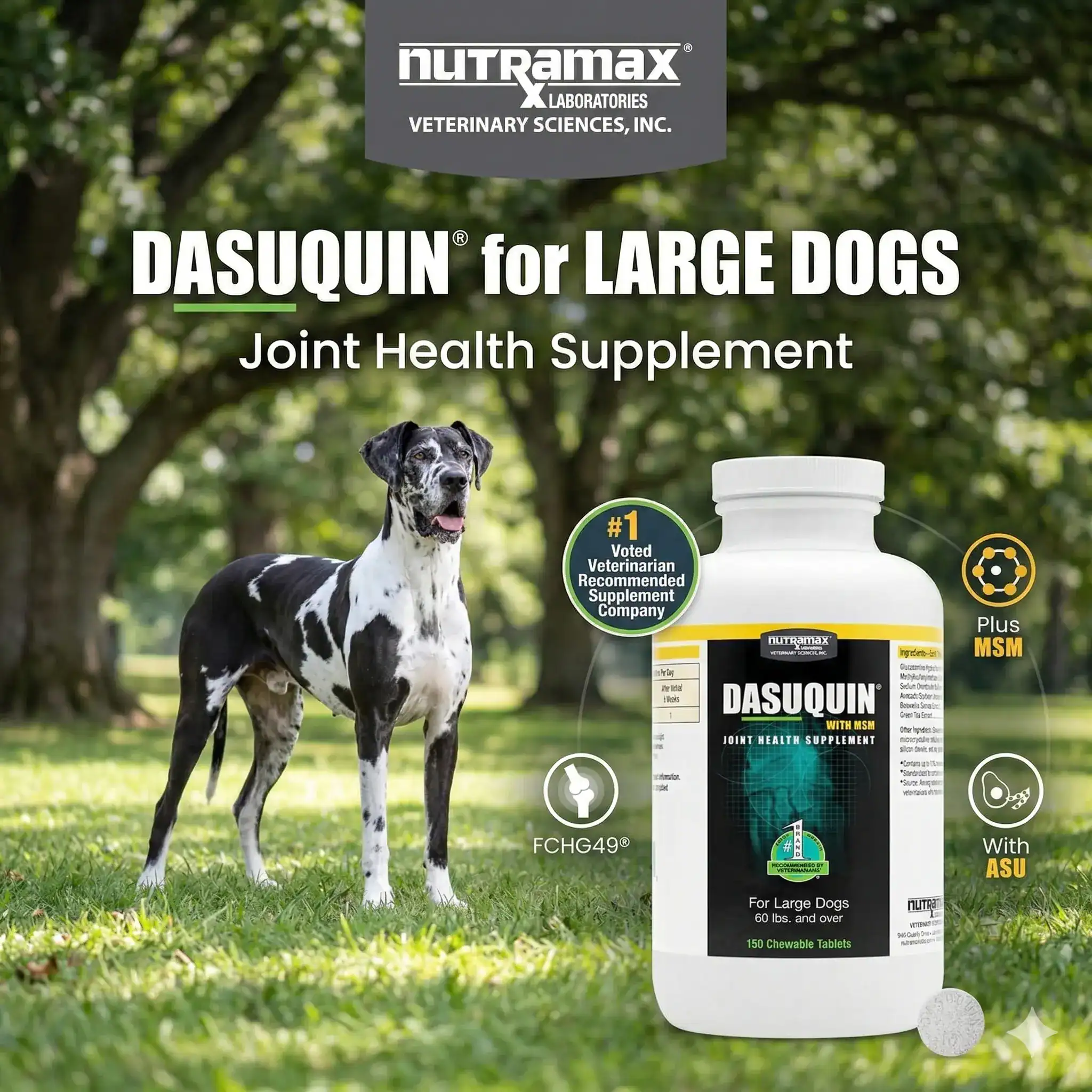
Nutramax Dasuquin with MSM Soft Chews for Dogs
Use for: Hip and elbow dysplasia affect both retrievers, and years of fetch and swimming load the same joints. Glucosamine, chondroitin, and MSM help support cartilage in active sporting dogs.
Check price on Amazon🎯 Verdict: Roughly even, with a slight edge in demand to the Golden. Both need substantial daily aerobic work plus mental enrichment, and both turn destructive without it.
Food Drive and Weight Management
This is the most underrated difference between the two breeds. The Labrador is famous for an extreme food drive, and many individuals simply do not self-regulate. Given the chance, a Lab will eat what is in front of it and then look for more, which makes measured feeding the single most important rule of ownership.
The Golden also has a hearty appetite and gains weight easily, but the drive is generally described as high rather than extreme. Owners of either should be able to feel the ribs without pressing hard, which is harder to judge through the Golden’s longer coat.
The stakes are the same for each dog. Excess weight loads joints that are already vulnerable to dysplasia in both breeds, and it can shorten a dog’s comfortable years. Build the day around measured nutrition rather than free-feeding, count treats within the daily allowance, and split food into two meals a day, which many veterinarians recommend to help manage bloat risk in deep-chested dogs.
🎯 Verdict: The Golden Retriever takes this round narrowly, since the Labrador’s extreme food drive demands more owner discipline. Both gain weight easily, so measured feeding is non-negotiable either way.
Family Fit
These two rank near the top of any list of family dogs, and this round is genuinely close. Each is patient, tolerant, playful, and deeply bonded to every member of the household rather than attaching to one person.
Both generally live well with a resident cat and other pets when raised alongside them, which sets them apart from most high-drive breeds. The shared caution is size and enthusiasm rather than temperament.
A young retriever of either breed is bouncy and lacks body awareness, and a wagging tail at toddler height clears coffee tables. Supervise young children closely with either dog, introduce a new baby gradually, and teach kids not to climb on or pull at them.
The practical split is time alone. The Golden bonds so intensely that extended isolation often produces separation anxiety, and many sources advise against leaving one alone beyond four to six hours. The Labrador handles solitude somewhat better, though neither breed suits a household that is empty all day.
🎯 Verdict: Roughly even, since each is an outstanding family dog. The Labrador copes marginally better with time alone, while the Golden’s sensitivity suits a home where someone is usually present.
Grooming and Coat Care
Here is the clearest practical difference between them. Both shed heavily year-round and blow their undercoat twice a year, so neither is a low-shedding choice and both demand a serious vacuum. The gap is in what the coat needs beyond deshedding.
The Labrador wears a short, dense, water-resistant double coat with no feathering. It sheds a lot, but it never mats, needs no trimming, and dries fast. A muddy Lab can be towelled or hosed and left to dry, which is why owners often describe the coat as wash and wear.
The Golden carries a longer coat with heavy feathering on the legs, chest, underbody, and tail. That feathering mats without regular attention, collects burrs and mud, and needs trimming around the paws.
Neither breed will drool the way the mastiff types do, though both slobber when food is on the counter. Bathe either dog every six to eight weeks so the coat keeps its protective oils, since washing too often strips them and can leave a stronger doggy smell rather than less.
Drop ears on each trap moisture, so weekly ear checks matter, especially since both love water.

FURminator Undercoat Deshedding Tool for Dogs
Use for: Pulling loose undercoat from either retriever before it covers the house, particularly during the heavy twice-yearly blowouts each goes through.
Check price on Amazon🎯 Verdict: The Labrador Retriever wins this round clearly. Both shed just as much, but the Golden adds feathering care, mat prevention, and trimming that the short-coated Labrador simply does not need.
Health and Longevity
Each averages 10 to 12 years, and both share hip and elbow dysplasia plus inherited eye disease including progressive retinal atrophy. Responsible breeders on both sides provide OFA or PennHIP results and annual eye clearances for the parents. That is where the similarity ends.
The Golden Retriever carries a significant cancer burden that defines the breed’s health picture. Research from the Morris Animal Foundation indicates malignancy accounts for a large share of deaths in the breed, with hemangiosarcoma and lymphoma the most common. Golden breeders should also clear parents for heart conditions and pigmentary uveitis.
The Labrador’s distinctive risks are different and generally more manageable. Obesity is the breed’s defining problem, and it drives joint disease and early arthritis. Skin and food allergy is another common issue in the breed, and it often shows up first as recurring ear trouble.
Exercise-induced collapse is an inherited condition identifiable through a simple DNA test, and the floppy ears and love of water make chronic ear infections common. Each is deep-chested and carries bloat risk.
Veterinary Disclaimer: This article is for educational purposes only and is not a substitute for professional veterinary advice, diagnosis, or treatment. K9Sphere’s authors are experienced dog owners, not licensed veterinarians. Always consult a qualified DVM regarding any health concerns about your dog.
Always consult your licensed DVM for personalized medical advice.
Because each carries real dysplasia risk and spend years loading their joints through fetch and swimming, a supportive sleeping surface helps. See our guide to the FurHaven orthopedic dog bed for a frame that distributes weight evenly.
Health Information Sources. Data compiled from the following references.
- American Kennel Club Labrador Retriever reference
- American Kennel Club Golden Retriever reference
- OFA CHIC Program recommended screening protocols
- The Labrador Retriever Club official breed health statements
Always consult your licensed DVM for personalized medical advice.
🎯 Verdict: The Labrador Retriever takes this round. Both share joint and eye risks, but the Golden’s cancer burden is the single heaviest health consideration in this comparison, while the Labrador’s main risk is largely controllable through diet.
Cost and Ownership
Purchase prices overlap almost completely, since each is extremely popular and well supplied by responsible breeders. That popularity is also the risk, because volume operations flood both markets with poorly screened puppies. Breed-specific rescue adoption is a strong alternative for either retriever, and adult dogs arrive past the destructive phase. A bargain price on either breed usually signals skipped health clearances.
Ongoing costs are similar and above average for both, driven by large-breed food, weight-based preventatives, and the strong likelihood of orthopedic care at some stage. Pet insurance is worth serious consideration for either dog, and prices vary by country across the US, UK, Canada, and Australia.
The divergence comes later in life. A Golden’s cancer burden means a realistic chance of significant oncology bills, which is the expense that surprises owners most. A Labrador’s costs skew toward joint management and the downstream effects of weight, both of which respond well to prevention.
🎯 Verdict: A slight edge to the Labrador Retriever. Purchase and routine costs are near identical, but the Golden’s higher likelihood of oncology treatment raises expected lifetime spending.
First-Time Owners
These two are widely and correctly recommended to first-time owners, and this round is close to even. Each is forgiving of handler mistakes, highly motivated by food, and socially straightforward in a way that spares a newcomer the hardest behavioural problems.
Crate training from the first week helps a newcomer manage either breed through adolescence, and neither is a natural apartment dog without committed daily exercise.
The Labrador is the more physically forgiving choice. It tolerates the noise and inconsistency of a busy first-time household, and its coat needs almost no skill to maintain. The challenge is stamina, since the adolescent phase runs long and the food drive requires discipline from day one.
The Golden is the more emotionally forgiving choice but asks more in other ways. Its sensitivity rewards a gentle beginner, while the grooming routine, the mouthy first eighteen months, and the need for company through the day all demand real commitment. Neither breed suits a household that is out all day.
🎯 Verdict: Roughly even, and each is a genuinely good first breed. Pick the Labrador if your constraint is time and grooming skill, and the Golden if your constraint is patience with a boisterous adolescent.
Head-to-Head Scorecard
Ratings are from 1 to 5 stars and reflect suitability for a typical active family home. A high Coat Maintenance Ease score means less grooming work for the owner, and a high Weight Control Ease score means the dog is less likely to overeat given the chance.
Labrador Retriever
Golden Retriever
Reading the scores: Both score maximum on Trainability and Family Suitability, which is why this decision is so hard. The Labrador leads on Coat Maintenance Ease and Health Outlook, while the Golden scores better on Weight Control Ease. Neither tolerates long days alone particularly well.
Common Questions about Labrador vs Golden Retriever
These are the frequently asked questions buyers raise when comparing the two retrievers.
What is the main difference between a Labrador and a Golden Retriever?
Direct Answer: Coat and health profile. The Labrador has a short, low-maintenance coat and lighter cancer risk, while the Golden has long feathering and a significant cancer burden.
Context: The two are remarkably similar in size, lifespan, trainability, friendliness, and exercise needs. Both are Sporting Group retrievers that shed heavily and make poor guard dogs, so the practical separators are grooming workload and medical risk.
Management: Decide based on how much grooming you will realistically do and which health profile you are better prepared to manage financially and emotionally.
Which breed is better for families with children?
Direct Answer: Each is excellent, and this is close to a tie.
Context: Each is patient, tolerant, and bonded to the whole household rather than one person. The caution is identical too, since a bouncy young retriever of either breed can knock over a small child without meaning to.
Management: Supervise young children closely with either dog, teach respectful handling, and exercise the dog before expecting calm indoor behaviour.
Which one sheds more?
Direct Answer: They shed comparably, but the Golden takes more work.
Context: Both carry double coats that shed year-round with heavy blowouts twice annually. The difference is that the Golden’s feathering mats and needs trimming, while the Labrador’s short coat sheds just as much but never tangles.
Management: Brush both several times weekly and daily during blowouts using an undercoat tool. Add feather and paw trimming for a Golden.
Which breed is healthier?
Direct Answer: The Labrador, on balance, though both share real risks.
Context: Each is prone to hip and elbow dysplasia and inherited eye disease, and both average 10 to 12 years. The Golden carries a significantly higher cancer burden, while the Labrador’s defining risk is obesity, which owners can largely control.
Management: Buy only from breeders providing OFA hip, elbow, and eye clearances, keep either dog lean, and budget for proactive veterinary care and insurance.
Which is easier to train?
Direct Answer: Neither has a real advantage, since both rank among the most trainable breeds.
Context: Each is intelligent, food-motivated, and eager to please, which is why both dominate guide dog and assistance programs. The Labrador is more forgiving of clumsy handling, while the Golden responds better to a gentle approach.
Management: Use positive reinforcement and start socialization early with either breed, and redirect a Golden’s mouthiness onto toys through the first eighteen months.
Which breed is calmer?
Direct Answer: The Golden Retriever, generally, though the gap is modest.
Context: The Labrador is the more boisterous of the two and often does not fully settle until three or four years old. The Golden typically matures somewhat sooner and carries a softer, more sensitive disposition.
Management: Expect a long adolescence with either breed and provide structured daily exercise, which does more for indoor calm than any training technique.
Are Labradors or Goldens better guard dogs?
Direct Answer: Neither. Each is a poor guard dog by design.
Context: Each breed was selected for a cooperative, trusting nature that suits retrieving work. A dog of either breed may bark when someone approaches but is far more likely to greet a stranger with a wagging tail.
Management: If you want property protection, look at dedicated guardian breeds and enjoy either retriever purely as a companion.
Which breed lives longer?
Direct Answer: Their average lifespans are the same at 10 to 12 years.
Context: Neither breed has a documented longevity advantage in typical ranges. In practice, individual outcomes hinge on breeder screening, body condition, and the Golden’s higher likelihood of developing cancer.
Management: Keep either dog lean, screen for the known conditions on each side, and schedule veterinary monitoring more frequently after age seven.
How much exercise does each one need?
Direct Answer: Both need substantial daily activity, roughly 60 minutes to two hours.
Context: The Labrador typically needs 60 to 90 minutes of vigorous work and the Golden one to two hours, so the requirements overlap heavily. Both love fetch, swimming, and hiking, which taps their shared retrieving instinct.
Management: Protect young joints by delaying forced running and repetitive jumping until roughly 18 to 24 months, and add puzzle work on days when outdoor time is short.
Can either breed be left alone during the workday?
Direct Answer: Neither suits a household that is empty all day, and the Golden struggles most.
Context: The Golden bonds so intensely that many sources advise against leaving one alone beyond four to six hours, since extended isolation commonly produces separation anxiety. The Labrador copes somewhat better but still dislikes long solitude.
Management: Arrange a midday walker or daycare if you work long hours, and build up alone-time gradually from puppyhood with either breed.
Which breed is more expensive to own?
Direct Answer: The Golden Retriever, once lifetime veterinary costs are counted.
Context: Purchase prices and routine costs are near identical for two very popular breeds. The difference is the Golden’s higher likelihood of oncology treatment, which is the expense that surprises owners most.
Management: Budget for insurance with either breed, and treat a bargain-priced puppy of either type as a warning sign about skipped health screening.
Are Labradors and Golden Retrievers related?
Direct Answer: They are separate breeds, though both descend from the retriever lines developed in nineteenth-century Britain.
Context: The Labrador traces to St. John’s water dogs from Newfoundland, refined on British estates. The Golden was created in Scotland from a yellow retriever crossed with a Tweed Water Spaniel, with Irish Setter and Bloodhound added later.
Management: Treat them as distinct choices despite the shared retrieving heritage, since coat and health profiles differ meaningfully. A deliberate cross of the two is known as a Goldador, though a mix inherits traits unpredictably from both sides.
Which retriever is right for a first-time owner?
Direct Answer: Each is a genuinely good first breed, so choose based on your own constraints.
Context: The Labrador is more physically forgiving and needs almost no grooming skill, but has a longer adolescence and a stronger food drive. The Golden is gentler and more sensitive, but adds grooming work and needs more company through the day.
Management: Be honest about your available time, grooming willingness, and household schedule, then match the breed to the constraint that is hardest for you to change.
How can you tell a Labrador from a Golden Retriever?
Direct Answer: Look at the tail and coat length. The Labrador has a thick, smooth otter tail and a short flat coat, while the Golden has a long feathered tail and fringing on its legs and chest.
Context: Head shape is less reliable than most guides suggest, since show-bred Goldens are deliberately blockier and can read as Labradors at a glance. Colour is unreliable too, because a yellow Labrador and a cream Golden look nearly identical in photographs.
Management: If you are identifying a dog in person, check the tail first, then run a hand down the back of the front legs to feel for feathering.
The Quick Decision Shortcut
If you want the fast version before the full verdict, use this self-check to decide which retriever fits your household. Each has one big pro and one obvious con, so pick the column that sounds more like you.
🐕 Choose the Labrador if
- You want the lower-maintenance coat with no trimming or matting.
- You prefer the lighter cancer risk of the two.
- You can hold the line on measured feeding for life.
- You want a robust dog that shrugs off mud and rough play.
🐕 Choose the Golden if
- You want a softer, more emotionally sensitive companion.
- You genuinely enjoy grooming and will keep up with feathering.
- Someone is home for most of the day.
- You are prepared for the breed’s serious cancer burden.
Final Verdict
There is no universal winner here, because these two breeds are close enough that either will suit most active families. Each is a trainable, devoted, heavy-shedding sporting dog of nearly identical size and lifespan, and both rank in the top three of American registrations for good reason.
The underlying decision is simple. The Labrador is the easier dog to maintain, with a wash-and-wear coat and a health risk you can largely control through the food bowl.
The Golden is the gentler dog to live with, and its softer nature comes paired with real grooming work and a cancer burden you cannot train or feed your way out of. Match the breed to the constraint you find hardest to change.
🏆 Bottom line: The Labrador Retriever is the lower-maintenance, more robust retriever; the Golden Retriever is the softer, more sensitive one with a heavier health burden. Each is an outstanding family dog, so choose on coat commitment and medical risk rather than temperament.
Personal Observation
💭 From my own experience
I lived with a Labrador, Bruno, for nearly ten years, and he reached about 45 kg. The two things that defined those years were exactly the two things this comparison turns on. His coat asked almost nothing of me beyond brushing and the odd hose-down, and his appetite asked everything.
He would have eaten twice his ration every single day if I had let him, and holding that line was the daily work of owning him. That is the Labrador tradeoff in one sentence. The grooming is easy and the feeding is not.
In his senior years I watched his kidney values climb, and it taught me to monitor a big dog’s organ health far earlier than most owners think to. Whichever retriever you choose, start that habit young. Each hides problems behind a wagging tail.
Read More. For the full individual guides, see our Labrador Retriever guide and our Golden Retriever guide. If you are also weighing a protective breed, our German Shepherd vs Golden Retriever comparison covers that decision, and both retrievers here benefit from our roundup of the best brushes for shedding dogs.
Editorial Disclaimer: This article is for informational and educational purposes only. It does not constitute veterinary advice, medical diagnosis, or treatment recommendations. Always consult a licensed veterinarian before making health-related decisions for your pet.
Accuracy Notice: While every effort has been made to ensure the information presented here is accurate and current, breed information evolves and individual dogs vary. If you spot a factual error or have updated information from a verified source, please contact us so we can review and update.
Product Disclosure: Product recommendations are based on independent research and editorial judgment. Individual results may vary. K9Sphere participates in the Amazon Services LLC Associates Program and other affiliate programs, and earns from qualifying purchases at no additional cost to you.
Last reviewed: September 2026. Article reviewed for accuracy on the date shown above.


