
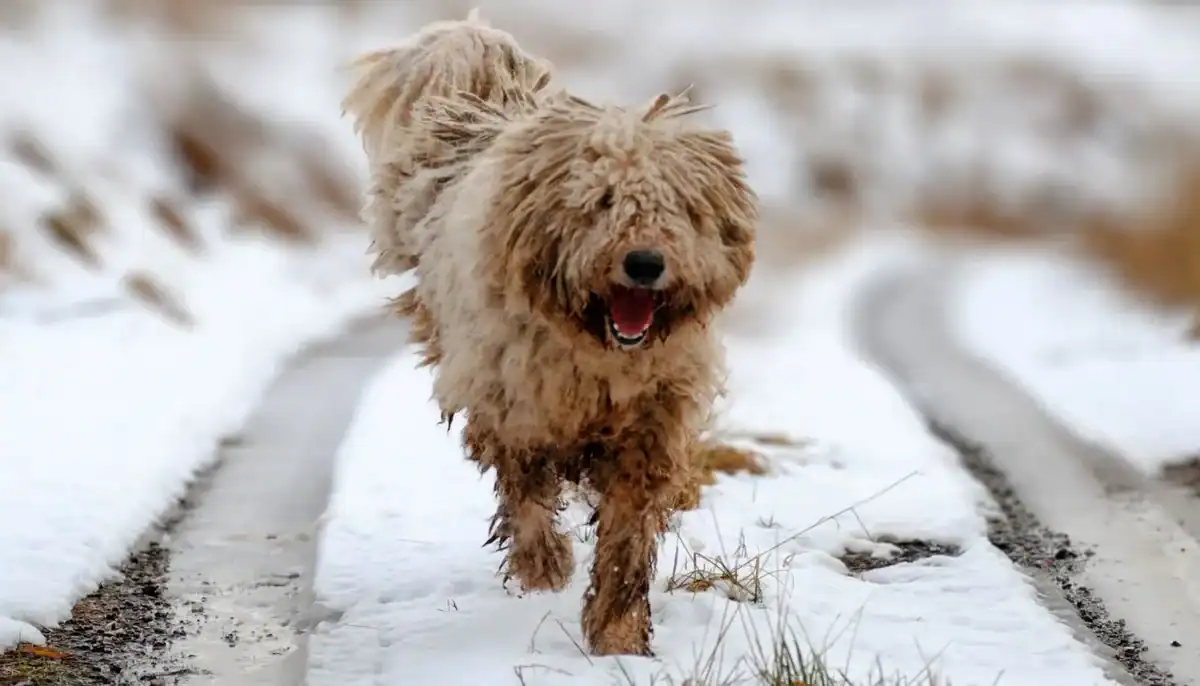
The Komondor is a Hungarian working flock-guarding dog developed centuries ago to protect sheep from wolves and bears across open plains. The Komondor is a large breed capable of independent action, with a commanding physical presence and a deep instinct for protection.
What makes this dog so recognizable is the heavy corded white coat that acts as natural armor against predators and harsh weather alike. Beneath those cords beats an independent heart capable of making split-second threat decisions without human direction. It was built for a very specific job and keeps that intensity today.
This guide draws on the American Kennel Club breed standard, the Komondor Club of America health protocols, OFA joint testing requirements, and veterinary references to outline what owning this giant actually takes.
Daily commitments include structured obedience routines, careful grooming practices to keep the dreadlock masses clean, and providing a securely fenced space for patrol. Households that invest in consistent leadership are rewarded with a deeply devoted and watchful companion.
For handlers ready to manage a powerful flock protector, the Komondor offers intense loyalty and around a decade of companionship. Know what you are committing to, because a breed shaped to fight off predators needs confident handling and significant early socialization to thrive in a modern home.
Affiliate Disclosure: K9Sphere participates in the Amazon Services LLC Associates Program and other affiliate programs. K9Sphere earns from qualifying purchases made through links in this article at no additional cost to you. Product recommendations are based on independent research and editorial judgment, not paid placement.
Breed Snapshot
📊 Vitals and Lifespan
Height
Males: 27.5+ in (70+ cm)
Females: 25.5+ in (65+ cm)
Weight
Males: 100+ lb (45+ kg)
Females: 80+ lb (36+ kg)
Lifespan
10 to 12 years
Breed Group
Working (AKC); FCI Group 1
Origin
Hungary
🇭🇺
⭐ Personality Traits
Ratings (1 to 5). This breed is fiercely loyal to its own household but needs intense coat care and confident leadership. A low trainability score reflects an independent, decision-making mind rather than low intelligence, and a low friendliness score reflects its guarding nature, not a flaw.
History and Origin
The history of the Komondor traces back to the nomadic Cuman people who settled in Hungary during the 12th and 13th centuries. These herders brought big guardian dogs with them to protect their flocks from regional predators. The plural of Komondor is Komondors, though many historical texts use the Hungarian Komondorok.
📌 1544: First Written Record
The name appears in Hungarian literature in 1544 for the earliest recorded time. The dog developed largely in isolation on the plains. Shepherds wanted a dog that could blend in with sheep visually while having the size and courage to drive off wolves, and the corded coat served both purposes well.
📌 1920s: The First Breed Standard
Following World War I, Hungarian breeders began standardizing the breed. The first written standard was created in 1921. This effort helped preserve the bloodline, as agricultural changes and later wars threatened to wipe out the working population.
📌 1937: American Kennel Club Recognition
The AKC recognized the Komondor in 1937, classifying it within the Working Group. Despite this formal recognition, it remains relatively rare in the USA today. Many still work actively on farms rather than living strictly as suburban companion pets.
Physical Characteristics
The Komondor is one of the largest working breeds. A fully grown male stands over 27.5 inches tall and often weighs well over 100 pounds. The build is muscular and powerful, suited to standing up to a wolf in defense of the flock.
🎨 The Corded White Coat
The coat of the Komondor is its defining feature, a corded white jacket unlike anything else in the dog world. A puppy is born with a soft, wavy coat that begins to clump and form cords between nine and ten months of age. This dense armor shields against predator bites and insulates against extreme weather. The white color let shepherds tell their dog apart from wolves at night.
🏗️ Muscular Build
Beneath the dreadlocks is a heavily boned, deep-chested frame. The head is large, and the dark brown eyes are often hidden behind the facial cords. The tail hangs low with a slight upward curve at the tip. Despite their bulk, these dogs are surprisingly agile and can accelerate rapidly when a threat appears.
Character and Temperament
The Komondor temperament is defined by its working heritage. A dog bred to guard a flock alone on a mountainside must be capable of independent thought. They do not wait for commands to act if they perceive a threat to their territory.
🛡️ Fierce Guardian
They are deeply affectionate with their own people but deeply suspicious of strangers. A Komondor will quietly observe visitors and place itself between the household and the unfamiliar person. They are an exceptional guardian, but this protective instinct calls for a handler who can confidently direct the behavior.
🔥 Independent Thinker
This is not a dog that lives to please. They assess situations and make their own decisions. Without consistent rules and guidance, a Komondor may begin making household decisions on its own. Obedience training is essential to establish clear boundaries early in life.
💪 Low Separation Anxiety
Because they are bred to watch over livestock for hours, separation anxiety is uncommon. They are content to patrol a yard or watch the property boundaries. They prefer to sleep in a spot where they can observe entry points to the home.
🧠 Not for Apartments
An apartment is a poor fit. They are intensely territorial and will bark loudly at any perceived intrusion, including hallway foot traffic. They want plenty of securely fenced space to fulfill their patrol instincts safely.
Screening and Conditions
Veterinary Disclaimer: The information in this article is for educational purposes only and is not a substitute for professional veterinary advice, diagnosis, or treatment. K9Sphere’s authors are experienced dog owners, not licensed veterinarians. Always consult a qualified DVM regarding any health concerns about your pet. Never disregard professional veterinary advice or delay seeking it because of something you have read on this site.
Health and Breed Information Sources:
- American Kennel Club for the official breed standard and Working Group classification
- Komondor Club of America for parent-club health protocols and breeder code of ethics
- Orthopedic Foundation for Animals (OFA) for CHIC hip and eye testing recommendations
Always consult your licensed DVM for personalized medical advice.
The Komondor is generally robust, but its sheer size brings specific orthopedic and gastric risks. Responsible breeders screen for these conditions before producing a litter.
Common Inherited Conditions
🔴 Gastric Dilatation-Volvulus (Bloat)
What to watch for: A swollen abdomen, pacing, unproductive retching, and excessive drooling. This condition happens when the stomach fills with gas and twists on itself, cutting off blood flow. It is a life-threatening emergency that progresses rapidly without surgical intervention.
Screening: Preventive care involves feeding two smaller meals daily instead of one large bowl. Avoid heavy exercise for an hour before and after feeding. Some owners opt for a prophylactic gastropexy during a routine spay or neuter to pin the stomach and reduce the risk of twisting.
🔴 Hip Dysplasia
What to watch for: Stiffness rising from rest, reluctance to jump or climb stairs, or a bunny-hopping gait. This genetic malformation causes the joint to grind rather than glide smoothly.
Screening: OFA or PennHIP joint evaluation of both parents is strongly recommended. Adding a supplement with glucosamine and chondroitin early in adulthood can support long-term joint health.
🟡 Eye Conditions (Entropion and Cataracts)
What to watch for: Excessive tearing, squinting, or a cloudy appearance in the eye. Entropion causes the eyelid to roll inward, allowing lashes to scratch the cornea. Cataracts obscure vision progressively.
Screening: Annual eye examinations for breeding stock help catch these conditions. Entropion usually requires surgical correction to protect the eye surface from chronic scarring.

Nutramax Dasuquin with MSM Soft Chews for Large Dogs
Use for: Joint support in heavy working breeds prone to joint malformation. Combines glucosamine, chondroitin, and MSM to support cartilage in heavy dogs carrying significant weight. Consult your veterinarian before starting any supplement.
Check price on AmazonGrooming and Coat Care
You do not brush this dog. The coat naturally forms heavy cords that must be separated by hand, which takes a lot of time and begins when the puppy is around nine months old. The soft undercoat intertwines with the coarse outer hair to form dreadlocks.
If you do not split these cords to the skin regularly, the coat turns into a solid, painful mat. A wash is a major undertaking, since the dreadlocks act like a mop and soak up water and dirt. After bathing with a mild shampoo, drying takes hours, and many people use strong blow dryers or specialized cage dryers.
If they are left damp near the skin, mildew and skin infections develop quickly. These dogs do not shed conventionally; instead, they drop whole cords occasionally. Between baths, you pick debris, twigs, and leaves out by hand.
For those who cannot maintain the dreadlocks, the hair can be clipped short a few times a year. Clipping removes the signature look but creates a far more manageable hygiene routine for a pet.
Exercise and Living Needs
This is not a high-energy running companion, but they do require daily activity. A couple of brisk walks combined with time patrolling a securely fenced yard satisfy their physical needs. They are sprinters rather than marathon runners, built to burst into action when a predator approaches.
A tall, solid fence is strongly recommended. This breed views passing pedestrians, delivery drivers, and neighborhood pets as potential threats to its territory. Without a secure barrier, a defensive incident becomes more likely. An electronic boundary is generally ineffective against an animal with this pain tolerance and drive.
They can live outdoors in cold weather thanks to their heavy insulation, but they prefer to be near their people. A working guardian stays with the sheep, while a companion dog wants to monitor its human household. A supportive orthopedic bed gives this heavy breed a healthier place to rest between patrols.

FurHaven Orthopedic Dog Bed (Jumbo)
Use for: Heavy-duty joint relief for very large dogs. The medical-grade foam supports the weight of a 100-pound adult and helps protect aging joints and prevent elbow calluses.
Check price on AmazonNutrition & Diet
How you feed your Komondor affects their skeletal health directly. Overfeeding a pup causes rapid bone growth that stresses developing joints and raises the risk of joint problems. Keep young dogs lean and use a high-quality big-breed formula that regulates calcium levels carefully.
Adults do best on a meat-first diet rich in protein to maintain their muscular build. Because they are prone to gastric torsion, divide their daily food intake into two measured meals. Avoid feeding from an elevated bowl unless your vet directs otherwise, as some studies suggest elevated feeding may raise that risk in deep-chested dogs.
Training
Training should begin the day the puppy arrives. A first time owner will struggle with this dog’s independent nature. You cannot force a Komondor into submission. They respond to firm, fair, and consistent leadership. If they respect you, they comply. If they sense inconsistency, they tend to ignore commands.
Early socialization is the most critical task for any handler. Introduce the young dog to many strangers, varied environments, and other animals before they reach sixteen weeks of age. A poorly socialized adult can become a serious management problem, as their default reaction to anything unfamiliar is suspicion.
Basic obedience commands give you control when the dog reaches 100 pounds. Crate training provides a secure den and simplifies vet visits or travel. Keep training sessions brief, as repetition bores them quickly.
Komondor vs Puli vs Great Pyrenees vs Kuvasz
Anyone looking for a flock guardian often weighs several breeds. Understanding the differences between the Komondor, the Great Pyrenees, the Kuvasz, and the Puli helps clarify which one fits your background and property setup.
| Attribute | Komondor | Puli | Great Pyrenees | Kuvasz |
|---|---|---|---|---|
| Weight | 80 to 100+ lb | 25 to 35 lb | 85 to 100+ lb | 70 to 115 lb |
| Original Purpose | Flock guarding | Sheep herding | Flock guarding | Flock guarding |
| Energy Type | Low-moderate, burst speed | High, agile | Low, patrolling | Moderate, patrolling |
| Trainability | Independent, stubborn | Smart, eager worker | Independent thinker | Independent, sensitive |
| Grooming | Cords need splitting, high effort | Cords need splitting, high effort | Heavy shedding, weekly brush | Heavy shedding, weekly brush |
| Threat Response | Confronts and defends | Vocal alert, quick response | Barking, physical blocking | Barking, confronts threats |
| First-Time Owner? | No | With dedication | No | No |
| Common Health Risks | Hip dysplasia, bloat, entropion | Hip dysplasia, PRA, deafness | Hip dysplasia, bloat, patellar luxation | Hip dysplasia, bloat, PRA |
| Living Space | Large fenced yard or farm | Fenced yard | Large fenced yard or farm | Large fenced yard or farm |
The Puli shares the corded coat but is a small herding dog rather than a giant guardian. The Great Pyrenees offers a slightly softer temperament for family life compared to the fierce drive of these Hungarian dogs. Choose the Komondor only if you have the physical space, the coat-care dedication, and the assertive leadership required to manage a serious property protector.
Common Questions about the Komondor
Are Komondors good with children?
Direct Answer: They are highly protective of children in their own family, but they are not generally safe around visiting children without strict supervision.
Context: This breed may read roughhousing or shouting among children as an attack on “their” child and step in to stop the perceived threat, which creates a risky situation for neighborhood kids.
Management: Never leave this dog unsupervised with visiting children. Socialize the dog extensively from an early age to tolerate normal child behavior.
How much does a Komondor cost?
Direct Answer: Expect to pay about USD 1,500 to 3,000 for a puppy from a reputable US breeder. Pricing varies by country, with UK, Canada, and Australia rates differing.
Context: The initial purchase price is a fraction of the lifetime expense. High food volume, specialized grooming tools, giant-breed veterinary care, and robust fencing can cost thousands of dollars annually.
Management: Budget for large-breed food and pet insurance from day one. An unexpected bloat surgery can run well past USD 5,000.
Is the Komondor dog breed dangerous?
Direct Answer: They are powerful protectors capable of confronting predators and intruders, which is exactly what they were bred for. In the hands of an inexperienced owner, that capability can become a serious management challenge.
Context: They are not inherently malicious toward their family, but their instinct is to confront threats. A poorly socialized dog that cannot tell a mail carrier from an intruder is far more likely to make a mistake.
Management: Commit to daily obedience work and secure perimeter fencing. This is a serious working animal, not a casual pet.
What is the lifespan of a Komondor?
Direct Answer: They generally live between 10 and 12 years.
Context: For a giant breed, this is a relatively strong lifespan. Their longevity depends heavily on keeping them lean to protect their joints and managing the risk of gastric torsion.
Management: Provide preventive joint care, feed two smaller meals daily to lower gastric torsion risk, and maintain a healthy weight throughout adulthood.
Do Komondors shed?
Direct Answer: They do not shed like most dogs, but they do drop whole cords occasionally and carry dirt inside the house.
Context: The undercoat sheds into the outer coat, locking together to form the cords. While you will not find loose hair on your sofa, the cords trap leaves, mud, and debris.
Management: If you use dog shampoo for itchy skin or regular bathing products, rinse thoroughly. Soap residue left in the cords can cause skin irritation.
Can you adopt a Komondor?
Direct Answer: Yes, adult dogs occasionally turn up in breed-specific rescue networks when owners underestimate the coat or behavioral demands.
Context: Adopting an adult lets you see the dog’s fully formed temperament. A Komondor rescue will often place these dogs with experienced LGD handlers or farm properties.
Management: Contact the Komondor Club of America rescue network. Expect a rigorous screening process regarding your fencing and large-dog experience.
How hard is it to groom a Komondor?
Direct Answer: It is exceptionally labor-intensive and requires hours of manual work.
Context: Each cord must be separated by hand to the skin to prevent solid matting. Drying the dog after a bath takes the better part of a day. Neglected coats often require a full shave-down by a professional.
Management: Establish a routine of separating a few cords every evening while relaxing with the dog. Keeping up with the work prevents it from becoming overwhelming.
Is the Komondor a good guard dog?
Direct Answer: Yes, they are elite guardians built to work without human supervision.
Context: They are territorial, brave, and physically powerful. They do not need to be taught the job; the drive is hardwired into their genetics.
Management: The challenge is not teaching them to guard, but teaching them what is NOT a threat. Socialization is the control valve for their guarding drive.
What is the difference between a Komondor and a Puli?
Direct Answer: Size and specific working role are the primary differences.
Context: The Komondor is a giant flock guardian built to confront predators. The Puli is a much smaller, agile herding dog built to move the sheep. Both wear a corded coat and originate from Hungary.
Management: If you love the corded look but live in a smaller space or lack giant-breed experience, the Puli is a more practical option.
Are Komondor puppies easy to train?
Direct Answer: No, they are known for being stubborn and they test boundaries continuously.
Context: They learn commands quickly but often choose to ignore them if they see no practical reason to comply. They mature slowly, keeping puppy behaviors while growing into a massive body.
Management: Keep training sessions short, use positive reinforcement, and establish yourself as a calm, unwavering leader. Consistency is more effective than repetition.
Finding a Puppy
Because the Komondor breed is rare, finding puppies takes patience. A reputable breeder screens buyers carefully to make sure the dog does not end up somewhere unsuitable such as an apartment.
🏠 Responsible Breeders
Start your search with the Komondor Club of America. A good breeder provides OFA hip and eye certifications for both parents. They will ask detailed questions about your fencing, your experience with protective dogs, and your willingness to manage the corded coat, since experienced Komondor owners know how much work it is.
🐾 Rescue and Adoption
If you want to bypass the puppy cord-forming phase, adopting an adult is an excellent option, since the temperament is already established. You can assess whether the dog’s protective drive matches your household’s capability before making a commitment.
🚩 Red Flags to Watch For
- Red Flag 1: Breeders offering puppies for sale without OFA health certificates.
- Red Flag 2: Breeders who push the dogs as “great for any family.”
- Red Flag 3: Parents exhibiting fear aggression or extreme shyness.
- Red Flag 4: Breeders who cannot explain the grooming process in detail.
Personal Observation
💭 Personal Observation
The single most useful thing I have learned from years with territorial dogs is how differently they handle a perceived threat when nobody has given them clear rules. My young male Rambo will plant himself between a visitor and the rest of the household and hold that position until he is sure the situation is safe.
With Rambo I can redirect that behavior the moment it starts, because we built that habit early. Scale his instinct up to a hundred-pound flock guardian bred to act alone, and you can see why an inexperienced handler gets overwhelmed.
A guardian that makes its own decisions is not being difficult; it is doing exactly what its job once required. My senior rescue Rusty shows that same self-directed streak, preferring to settle outside and watch the yard rather than wait for instructions. A breed like the Komondor takes that independence much further, which is why these dogs reward calm, consistent leadership and frustrate anyone hoping for instant obedience.
Coat care is the other reality people underestimate. My rescues have wash-and-go coats that dry in an hour, so a corded coat that needs hand-separating and most of a day to dry is a genuinely different level of commitment. If you are not prepared for both the behavioral and the grooming side, this is not the breed to start with.
Conclusion
The Komondor is an uncompromising working dog that demands respect and a specific lifestyle. It is one of the most effective flock guardians in the world, combining a unique natural armor with fearless intensity.
The clear pro is acquiring a devoted protector that needs little encouragement to guard your property. The con is managing a huge, headstrong dog wrapped in a coat that requires hours of manual maintenance.
If you want a powerful protector with far lighter grooming and a more trainable streak, look at alternatives like the Cane Corso or the Rottweiler, though both still need secure fencing of their own. If you have the space and the leadership capability, this dreadlocked guardian is hard to match in its devotion.
📋 Before bringing one home, run this 4-step pre-buying check
- Secure containment. Do you have a tall, solid fence to safely contain a territorial dog?
- Grooming reality. Are you willing to spend hours separating cords by hand to prevent painful matting?
- Handler experience. Have you successfully trained independent, strong-willed dogs before?
- Living space fit. Can you accept that this dog will bark at perceived threats and is a poor fit for apartment life?
If any answer is no, reconsider the breed.
Editorial Disclaimer: This article is for informational and educational purposes only. It does not constitute veterinary advice, medical diagnosis, or treatment recommendations. Always consult a licensed veterinarian before making health-related decisions for your pet.
Accuracy Notice: While every effort has been made to ensure the information presented here is accurate and current, breed information evolves and individual dogs vary. If you spot a factual error or have updated information from a verified source, please contact us so we can review and update.
Product Disclosure: Product recommendations are based on independent research and editorial judgment. Individual results may vary. K9Sphere participates in the Amazon Services LLC Associates Program and other affiliate programs, and earns from qualifying purchases at no additional cost to you.
Last reviewed: June 2026. Article reviewed for accuracy on the date shown above.


