
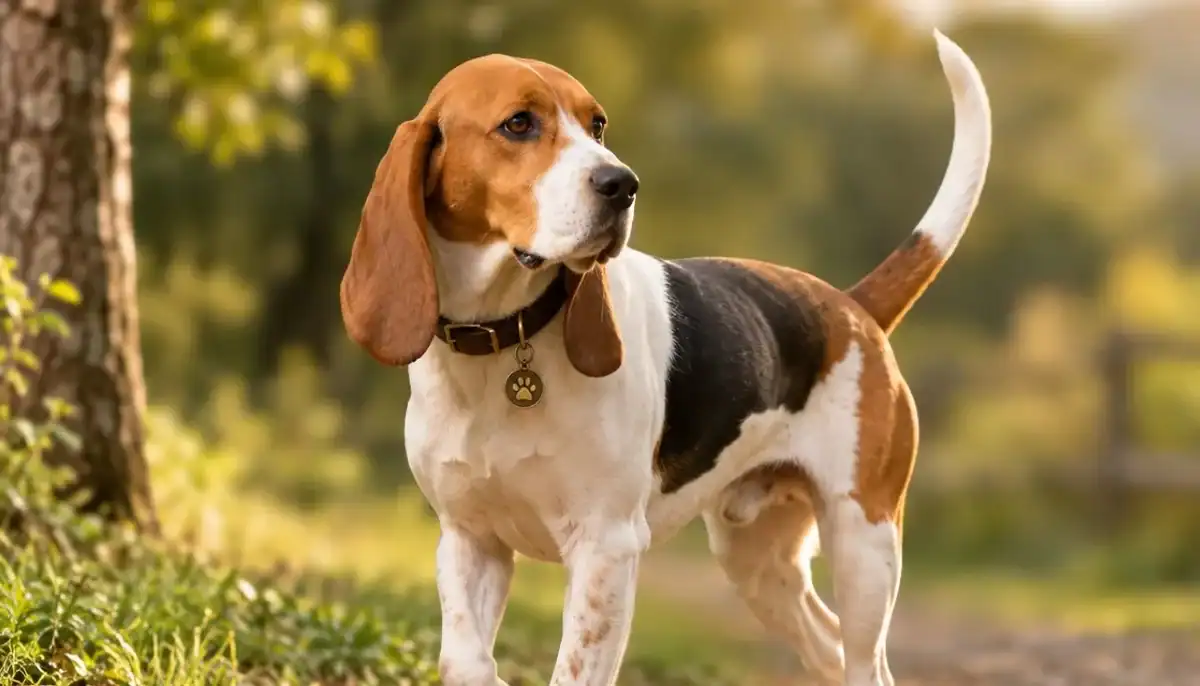
The Artois Hound, known in France as the Chien d’Artois, is a medium-sized scent hound bred in northern France to hunt hare in small packs. It is among the rarest working hounds in Europe.
What sets the breed apart is not temperament or looks but scarcity. The French LOF recorded 57 Chien d’Artois registrations in 2025 and 51 in 2024. Those are annual registration counts rather than a population total, and the dogs behind them are overwhelmingly working hunting hounds.
This guide draws on the FCI breed standard and nomenclature records, published French kennel club registration statistics, and peer-reviewed veterinary research on ear disease in drop-eared breeds. Where breed-specific data does not exist, this guide says so rather than filling the gap.
Daily commitments include an hour or more of hard exercise, secure fencing, and tolerance for a voice built to carry across open country. In return you get a steady, affectionate dog that settles completely once the work is done.
Anyone outside France should read the Finding a Puppy section first. Availability, not suitability, is the real obstacle with this breed, and it is worth understanding before you fall for the dog.
Affiliate Disclosure: K9Sphere participates in the Amazon Services LLC Associates Program and other affiliate programs. K9Sphere earns from qualifying purchases made through links in this article at no additional cost to you. Product recommendations are based on independent research and editorial judgment, not paid placement.
Breed Snapshot
📊 Vitals and Lifespan
Height
21 to 23 in (53 to 58 cm)
Weight
62 to 66 lb (28 to 30 kg)
Lifespan
12 to 14 years (commonly cited, no breed survey)
Breed Group
FCI Group 6, Scent Hounds, Medium-sized Hounds
Origin
France
🇫🇷
⭐ Personality Traits
Ratings (1 to 5). The population is small and almost entirely made up of working hunting dogs, so descriptions of pet behavior rest on a thin evidence base.
History and Origin
The breed takes its name from the Artois region of northern France and was formerly called the Picard. Its story is one of long decline followed by a deliberate rescue, which explains why it sits among the world’s rare dog breeds today.
📌 Late 1500s to Early 1600s
The breed enjoyed high favor in the hunts of Henry IV and Louis XIII, prized above all for hare. Early writers on French hunting recorded their astonishment at dogs holding a trail an hour old in dry conditions.
📌 The 1800s to the First World War
An 1890 hunting manual praised the breed while noting how hard a pure one had become to find. The FCI records that M. Levoir of Picardy attempted to re-establish the old Artois type from the late 1800s into the early 1900s without really succeeding, and that another Picard breeder, M. Mallard, dominated the breeding of the line until the First World War.
📌 Mid 1900s
Two world wars, rural depopulation, and changing hunting practice pushed the breed to the edge. By mid-century only a handful of pure dogs remained. The FCI accepted the breed on a definitive basis on 18 October 1963.
📌 The 1970s Revival
M. Audrechy of Buigny les Gamaches and Mme Pilat located the surviving specimens and rebuilt the breed around them. French registrations today run in the dozens per year, a small number but a steady one.
Physical Characteristics
The FCI breed standard describes a dog built for sustained work rather than speed. The frame is muscular and not overly long, and the overall appearance is of strength held in reserve rather than raw scenting ability on display.
🎨 Coat and Color
The coat is short, thick, and flat. The standard calls for a tricolor pattern in dark fawn over black and white, usually with large patches. Head marking is generally fawn. Weather resistance comes from coat density rather than length.
🏗️ The Scent Hound Build
The head is broad with a rounded skull and dark brown eyes set well apart. The ears sit at eye level, broad and nearly flat, long enough to reach the start of the nose. The tail is strong and carried in a sickle curve.
Character and Temperament
Almost everything recorded about this breed’s character comes from the hunting field rather than the living room. The picture below reflects that, and it is worth reading with the small population in mind.
🐾 Built for the Trail
The standard credits the breed with outmaneuvering the tricks of a hare and holding a line at moderate but sustained speed. That persistence does not switch off when the dog leaves the field.
🐕 Pack Mentality
Six to eight dogs make a traditional Artois pack, worked on hare and at times on roe deer or wild boar, and the breed generally lives easily alongside other dogs as a result. The same trait shows up across working pack hounds such as the American English Coonhound.
🧠 Independent Thinker
A scenthound was bred to solve problems far from the handler, and that independence is instinct rather than defiance. What reads as stubbornness in an obedience class is the same trait that makes the dog useful half a mile into a hedgerow.
🔊 The Voice
The standard praises a high-pitched tongue audible from a long way off. This is a hound that will bay rather than bark in the ordinary sense, which is a working asset and a serious constraint on where the dog can live.
Screening and Conditions
Veterinary Disclaimer: The information in this article is for educational purposes only and is not a substitute for professional veterinary advice, diagnosis, or treatment. K9Sphere’s authors are experienced dog owners, not licensed veterinarians. Always consult a qualified DVM regarding any health concerns about your pet. Never disregard professional veterinary advice or delay seeking it because of something you have read on this site.
Health Information Sources: Data compiled from:
- Fédération Cynologique Internationale nomenclature record for breed status, group, and recognition date
- Royal Veterinary College VetCompass study of canine otitis externa for ear disease risk by ear carriage
- Societe Centrale Canine LOF 2025 registration statistics for current French registration numbers
Always consult your licensed DVM for personalized medical advice.
Be careful with anything you read about Artois Hound health, including this section. We could find no published breed health survey and no registry screening statistics for the Artois Hound, and annual registrations are too few to support meaningful breed-level data.
What follows is therefore split into two kinds of information. The first is structural risk that follows from the dog’s build and is well supported across breeds. The second is the honest gap where breed-specific evidence should be.
Potential Health Concerns and Evidence Gaps
🔴 A Small Gene Pool and Missing Health Data
What to watch for: Nothing visible in an individual dog. The breed’s reconstruction from a very small surviving population raises legitimate questions about genetic diversity, though no published genetic study of the breed exists to measure it either way.
Screening: Ask the breeder for a coefficient of inbreeding on the proposed pairing and for the results of any testing they have done. A breeder working with a reconstructed breed should know these numbers without being prompted.
🟡 Otitis Externa and Ear Infections
What to watch for: Head shaking, scratching at the ear, discharge, or a sour smell. This is the single ear issue most likely to recur across a hound’s life. A Royal Veterinary College study of 22,333 dogs in UK primary care found that pendulous ear carriage carried roughly 1.8 times the odds of otitis externa compared with erect ears. That study covered dogs generally and included no Artois Hounds, so it describes the risk attached to this ear shape rather than to this breed.
Screening: Nothing to test for, only routine to keep. Dry the ears after every wet outing and inspect weekly, and raise the frequency in a hot humid climate, since warmth and moisture are both listed predisposing factors. Note that ear carriage is a predisposing factor rather than a cause, and most drop-eared dogs never develop a problem.
🟡 Hip Dysplasia
What to watch for: A bunny-hopping gait, stiffness after a long day, or reluctance to jump into a vehicle. This is a general medium-breed risk rather than a documented Artois problem, since no breed data exists either way.
Screening: Ask whether the parents have been hip scored under any scheme, whether OFA, PennHIP, BVA, or the French system. Keeping the dog lean does more for its joints across a lifetime than any supplement.
🟡 Weight Gain Outside the Hunting Season
What to watch for: A waistline that disappears over winter. Dogs bred for long working days carry an appetite matched to that output, and the appetite does not shrink when the season ends.
Screening: Weigh monthly and adjust portions to the season rather than the bag. Body condition scoring with your vet at each annual visit catches drift early.
Grooming and Coat Care
Coat care is the easiest part of owning this breed. The short flat coat sheds moderately year-round and needs a rubber curry or hound glove once a week to lift dead hair and spread skin oils.
Bathe only when the dog has rolled in something, since frequent washing strips the coat’s weather resistance. A curry mitt is usually all you need, though our guide to the best brushes for shedding dogs covers the alternatives.
The ears take more attention than the coat. Lift and dry them after every outing in wet grass, and check weekly for wax, debris, or smell. Trim nails every few weeks so the running gait stays correct.
Teeth are the quiet omission in most hound routines. Daily brushing is the standard, and a water additive is a common fallback for dogs that will not tolerate a brush.

Oxyfresh Premium Pet Dental Care Water Additive
A tasteless additive commonly used by owners whose dogs refuse a toothbrush. It is a supplement to brushing and veterinary dental care rather than a replacement for either, and your vet is the right person to ask about your dog’s teeth.
Check price on AmazonExercise and Living Needs
Plan on substantial daily exercise paired with scent work rather than a fixed quota. For most healthy adults that tends to mean somewhere around 60 to 90 minutes of purposeful activity, varying with age, health, and how hard the dog is worked.
Mental stimulation does more than distance alone. Tracking work, hidden food trails, and a long hike over varied ground use the part of the dog that actually tires it, which is the nose rather than the legs.
Off-leash freedom in open ground is not realistic. Once a line is picked up, recall competes with several centuries of selective breeding and loses. Secure fencing is not a preference here, it is the baseline requirement.
Apartments are a poor fit, mostly because of the voice rather than the space. A hound that bays at every interesting smell will find you neighbors quickly.
Nutrition & Diet
Feed a complete diet matched to the dog’s real workload. A hound running several days a week needs more calories than the same dog resting through the off season, and your vet is the right person to advise on how to supply them.
Measure portions rather than estimating, and split the daily feeding into two meals. Drop the calories back when activity drops, since carrying extra weight is the fastest way to shorten a working dog’s career. Some owners of older dogs discuss hip and joint supplements with their veterinarian.

Nutramax Dasuquin with MSM
A joint supplement commonly used in hard-working and aging dogs. It supplements veterinary care rather than replacing it, and a vet should confirm it suits your dog before you start.
Check price on AmazonTraining
Expect slower obedience progress than a biddable gundog would give you. Like many scenthounds this one is strongly motivated by scent rather than by handler approval, and treating a slow sit as defiance sours the relationship fast.
Keep sessions short and pay well. High-value food holds attention where praise alone will not. Recall deserves the most work and the least trust, since a good hound can rarely be relied on once a scent is live.
Fit a harness early. A tracking hound leans hard into a collar, and the same advice applies to other driven scent breeds such as the Plott Hound.
Artois Hound vs Beagle vs Basset Hound vs Bloodhound
Most people weighing an Artois Hound are really choosing among the hound breeds that are actually obtainable. The Beagle, the Basset Hound, and the Bloodhound cover the realistic alternatives.
| Attribute | Artois Hound | Beagle | Basset Hound | Bloodhound |
|---|---|---|---|---|
| Weight | 62 to 66 lb | 20 to 30 lb | 40 to 65 lb | 80 to 110 lb |
| Original Purpose | Pack hunting hare | Pack hunting rabbit | Trailing small game | Trailing by scent |
| Availability | Very rare, mainly France | Widely available | Widely available | Uncommon but obtainable |
| Energy Type | Sustained athletic | High and busy | Steady and slow | High endurance |
| Trainability | Independent | Willful | Stubborn | Independent |
| Grooming | Weekly curry | Weekly brush | Weekly brush plus skin folds | Weekly brush plus wrinkles |
| Voice | Loud carrying bay | Loud bay and howl | Deep loud bay | Deep loud bay |
| Health Data Available | Almost none | Extensive | Extensive | Good |
| Living Space | House with secure yard | House with secure yard | Flexible, low jumping risk | House with large secure yard |
The row that should decide it is health data. The advantage of an established breed is decades of screening records, and the disadvantage of this one is that it has almost none. Choosing this breed means accepting that trade in exchange for something genuinely rare.
Common Questions about the Artois Hound
How much does an Artois Hound cost?
Direct Answer: As an approximate, time-sensitive guide (as of 2026), no reliable published price range exists for this breed.
Context: Prices vary by breeder, location, pedigree, and availability. With registrations in the dozens each year and almost no open advertising, any figure quoted anywhere is best treated as an estimate.
Management: Ask kennels directly, and budget transport and export paperwork alongside whatever price you are quoted.
Are Artois Hounds good family dogs?
Direct Answer: Reports from working homes describe steady friendliness and open affection toward their own household.
Context: Nearly all of these dogs live as hunting hounds rather than family pets, so evidence about behavior around a child at home is thin compared with an established breed.
Management: Meet adult dogs from the kennel you are buying from and judge those individuals rather than the breed description.
Do Artois Hounds shed?
Direct Answer: Yes, moderately and year-round, dropping short stiff hairs that weave into fabric.
Context: The coat is short and dense, so there is no seasonal blowout, just a steady background level that never quite stops.
Management: A weekly rubber curry pulls out most of it before it reaches your sofa.
How much exercise does an Artois Hound need?
Direct Answer: Substantial daily activity with scent work, commonly put at around 60 to 90 minutes for a healthy adult.
Context: Distance alone does not satisfy a tracking hound. The nose is what tires this dog, and a walk that never lets it work is only half an outing.
Management: Build tracking games and long-line sniffing into the routine instead of adding more pavement.
Are Artois Hounds good for first-time owners?
Direct Answer: No. This is not a beginner’s dog, and availability makes the question mostly academic anyway.
Context: An independent hound with a loud voice, an unreliable recall, and no established pet-owner community to ask for advice is a demanding first dog.
Management: If the type appeals, start with a Beagle or Basset Hound and learn how a scent hound thinks first.
Can an Artois Hound live in an apartment?
Direct Answer: It is a poor fit, and the voice is the reason more than the square footage.
Context: The breed standard describes a high-pitched tongue that carries a long way. In a building with shared walls that becomes a daily problem.
Management: A house with a securely fenced yard and tolerant neighbors is the realistic minimum.
Are Artois Hounds aggressive?
Direct Answer: No published source describes aggression toward people as a characteristic of the breed.
Context: Prey drive toward small animals is a different matter and is strong here. First-time hound owners often confuse the two. Bear in mind the evidence base is small, since almost all these dogs live in working packs.
Management: Early socialization still matters, since prey drive toward small animals is a separate matter from aggression toward people.
What is the Artois Hound lifespan?
Direct Answer: Commonly cited as 12 to 14 years, though no breed health survey exists to confirm it.
Context: Figures for very rare breeds are usually inherited from earlier breed profiles rather than measured, so treat the range as an estimate.
Management: Annual veterinary checks and a lean body weight influence life expectancy more than any published breed figure.
What health tests should the parents have?
Direct Answer: There is no official panel, so ask for hip scoring and a coefficient of inbreeding at minimum.
Context: Because no parent club runs a scheme, testing is entirely at the individual breeder’s discretion. That makes what they volunteer highly informative.
Management: Ask what they have tested and why. A breeder who has thought about it will have a clear answer.
Can an Artois Hound be trusted off leash?
Direct Answer: Not in unfenced ground. A live scent will beat your recall almost every time.
Context: The breed was selected for exactly this, following a line independently and at distance from the handler.
Management: Use a long line in open country and save off-leash freedom for securely fenced space.
Is the Artois Hound recognized by the AKC?
Direct Answer: No. The FCI and the United Kennel Club recognize the breed, but the American Kennel Club does not.
Context: The FCI accepted it on a definitive basis in 1963 and places it in Group 6 among medium-sized scent hounds.
Management: Expect FCI or UKC paperwork rather than AKC registration if you import a dog.
Why is the Artois Hound so rare?
Direct Answer: It nearly went extinct in the mid-1900s and was rebuilt in the 1970s from a handful of surviving dogs.
Context: Crossbreeding through the 1800s, then two world wars and rural depopulation, left almost nothing of the original line to work from.
Management: With annual French registrations in the dozens, expect long waits and significant logistical barriers to buying from abroad.
Finding a Puppy
This is the section that decides whether the rest of the article matters. With 57 registrations recorded in France in 2025, very few dogs are offered for sale abroad, and buyers outside the country should expect long waits and real logistical barriers.
🏠 Working Kennels
Nearly all breeding sits with French hunting kennels that produce dogs for the field. They will want to know how the dog will be worked, and a purely companion home may simply be declined. Expect the conversation in French.
🐾 Rehoming and Rescue
No breed-specific rescue network exists at any scale. Adult dogs occasionally come up through French hunting circles or general hound rescue in Europe, usually when a hunter retires or reduces a pack.
🚩 Red Flags to Watch For
- Puppies advertised as readily available outside France.
- No FCI or UKC pedigree paperwork offered for the parents.
- The breeder cannot tell you how closely related the pairing is.
- Health testing described only as “vet checked” with nothing to show.
- A seller marketing the breed as an easy family pet.
- Any listing that sells on rarity rather than on the dogs.
❓ Questions to Ask the Breeder
- What is the coefficient of inbreeding for this pairing?
- Have the parents been hip scored, and under which scheme?
- How are the parents worked, and how often?
- What paperwork comes with the puppy?
- Have you placed dogs into companion homes before?
- What does export from France actually involve?
🔍 Questions a Good Breeder Asks You
- Will this dog be worked, and at what?
- How is your land fenced?
- Have you owned a scent hound before?
- How will your neighbors handle a hound’s voice?
- What happens to the dog if your circumstances change?
A kennel that asks nothing at all about your setup is unusual in this breed, and worth a second look before you commit.
Personal Observation
💭 Personal Observation
Chun Chun, a rescued street dog who was with me for years and died in 2026, taught me what a genuinely loud dog costs a household. She announced every change she noticed, and no amount of training moved her off it. A hound bred to be heard across a valley is that trait made deliberate.
Rambo, the youngest of my rescues, shows me the other half. He needs serious physical output before he will settle, and a short walk leaves him worse than before it.
A working hound asks for both allowances at once, the noise and the mileage. Be honest about whether your street and your schedule can absorb them before the rarity does your thinking for you.
Conclusion
The Artois Hound is a serious working dog that survived its own near-extinction. For a hunter with land, a pack, and the patience to wait for a puppy, it is a rewarding and historically remarkable animal.
For almost everyone else the obstacles are practical rather than temperamental. The voice, the recall, the fencing, and above all the near-total absence of health data are the things that decide whether this breed fits a home.
Rarity is a reason to admire a breed, not a reason to buy one. If the working life suits you, few hounds are better company. If it does not, an obtainable scent hound will give you the same character with far more information behind it.
📋 Before bringing one home, run this 4-step pre-buying check
- Voice tolerance. Can your household and your neighbors live with a hound bred to be heard from a distance?
- Containment. Is your ground fenced well enough to hold a dog that will follow a scent regardless of recall?
- Daily output. Can you provide substantial daily activity plus scent work, on the order of an hour or more?
- Health unknowns. Are you willing to take on a breed with no health survey, no screening scheme, and a small gene pool?
If any answer is no, reconsider the breed.
Editorial Disclaimer: This article is for informational and educational purposes only. It does not constitute veterinary advice, medical diagnosis, or treatment recommendations. Always consult a licensed veterinarian before making health-related decisions for your pet.
Accuracy Notice: While every effort has been made to ensure the information presented here is accurate and current, breed information evolves and individual dogs vary. If you spot a factual error or have updated information from a verified source, please contact us so we can review and update.
Product Disclosure: Product recommendations are based on independent research and editorial judgment. Individual results may vary. K9Sphere participates in the Amazon Services LLC Associates Program and other affiliate programs, and earns from qualifying purchases at no additional cost to you.
Last reviewed: September 2026. Article reviewed for accuracy on the date shown above.


