
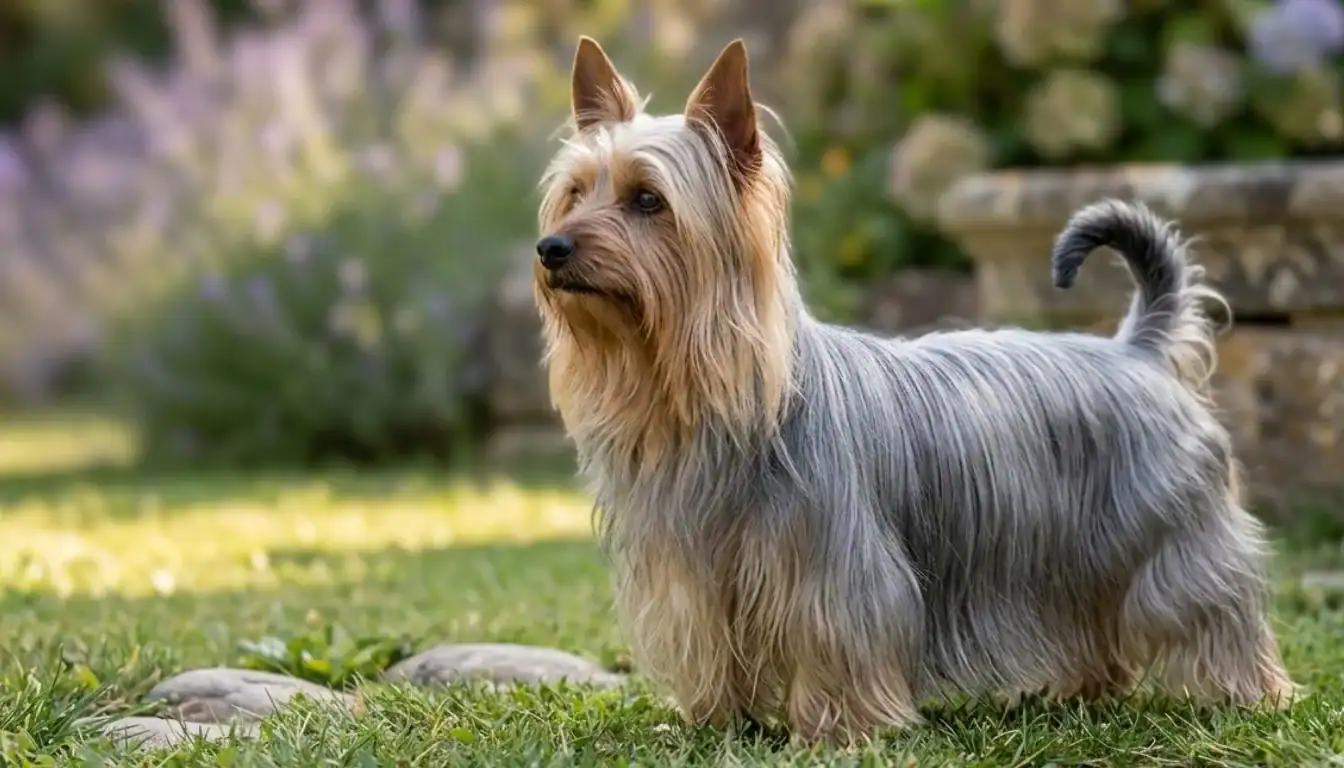
The Silky Terrier is a small Australian toy dog developed in late 19th century Sydney to hunt rodents and serve as a lively companion. Crossing imported Yorkshire Terriers with native Australian Terriers produced a breed with the elegance of a lap pet and the working drive of a true earthdog.
Most prospective owners see only the elegant, floor-length hair and assume they are delicate lap dogs. The reality is a 9-to-11-pound frame packed with intense terrier drive, sharp alert barking, and a prey drive that demands secure containment around backyard wildlife and cats.
This guide draws on AKC and Silky Terrier Club of America references, OFA orthopedic screening protocols, and AVMA oral and respiratory medicine to lay out exactly what living with this dog demands from day one.
Daily commitments include 30 to 60 minutes of focused exercise, daily brushing if the hair is kept long, professional grooming every four to six weeks, and consistent boundary-setting to prevent vocal patrolling from becoming a neighborhood nuisance. Households that ignore the structure side typically end up with a noisy or restless animal within months.
For families ready to commit to grooming and training, the Silky offers 13 to 15 years of devoted companionship, sharp alertness, and travel-ready portability. For households expecting a quiet lap pet, a different lap breed will suit far better.
Affiliate Disclosure: K9Sphere is a participant in the Amazon Services LLC Associates Program. As an Amazon Associate, K9Sphere earns from qualifying purchases made through links in this article at no extra cost to you.
Breed Snapshot
📊 Vitals and Lifespan
Height
Males: 9-10 inches (23-25 cm)
Females: 8-9 inches (20-23 cm)
Weight
Males: 9-11 lb (4-5 kg)
Females: 8-10 lb (3.5-4.5 kg)
Lifespan
13-15 years
Breed Group
Toy Group
Origin
Australia
🇦🇺
⭐ Personality Traits
Ratings (1 to 5). This alert little companion balances real working drive with deep household attachment, balanced against intensive grooming demands and sharp alert barking.
History and Origin
The origins of this compact Sydney companion trace back to the expanding agricultural settlements of late 19th century Sydney. Early settlers needed a dog capable of keeping rodents and minor pests away from homes and outbuildings without consuming the food rations of a larger working dog.
📌 1890s: The Foundation Crosses
Sydney breeders crossed imported Yorkshire Terriers with the native Australian Terrier. The goal was a dog that retained robust hunting instincts while developing the finer, longer, more elegant hair characteristic of the modern dog.
📌 1906: First Formal Standards
The first official Silky Terrier breed standard was drafted in Sydney. Shortly after, a separate standard was created in Victoria, leading to decades of debate over the ideal weight and ear shape before the two regions finally compromised on a single national standard in 1926.
📌 1955: Name Standardization
The official name became “Australian Silky Terrier.” American servicemen stationed in Australia during World War II had already been bringing dogs back to the USA, where enthusiasts shortened the name to simply “Silky Terrier” to distinguish the dogs clearly from the parent lines.
📌 1959: AKC Recognition
The American Kennel Club officially recognized the Silky Terrier in 1959 and placed the breed in the Toy Group. Despite the toy classification, breeders maintained the fiery spirit of the original earthdogs, and modern Silkies retain measurable working ability against rodents.
Physical Characteristics
These dogs are built low to the ground with a structure slightly longer than it is tall. This proportion supports a quick, light-footed gait built for rapid pursuit through tight spaces.
🎨 The Flowing Coat
The most defining feature is a single layer of fine, glossy hair that parts neatly down the spine. Unlike double-coated working breeds, this hair behaves more like human hair than fur. It requires meticulous maintenance to prevent painful tangles and breakage close to the skin.
🏗️ Sturdy Construction
Despite the delicate appearance, the build carries strong, well-angulated hindquarters that support short bursts of speed. V-shaped ears stand erect on a wedge-shaped head, giving these dogs an expression of constant vigilance.
The Coat Color Question
Standard Silky colors are blue and tan, with the tan covering the muzzle, cheeks, ears, legs, and underside. Puppies are born black and tan, with the blue developing as they mature, typically completing the color change between 12 and 18 months. Variations include silver and tan, gray and tan, and rare lighter shades. The AKC standard specifically rejects pure black, white-and-tan, and chocolate as disqualifying colors.
Character and Drive
These dogs are intensely curious and highly reactive to their environment. Every sound, movement, or unfamiliar visitor triggers an immediate response, which makes them excellent watchdogs but a poor fit for households that value quiet.
🔊 Vocal Early Warning
They take watchdog duties seriously. A passing car, a delivery person, or a neighborhood cat through the window will result in sharp, persistent barking until the handler acknowledges the perceived threat. This is genuine alert behavior, not random noise, and it responds to structured “quiet” command training.
🛡️ Intense Prey Drive
Generations of ratter genetics remain active in modern lines. They will readily chase squirrels, mice, and even neighborhood cats if given the opportunity. Off-leash work in unfenced areas is genuinely dangerous because their pursuit instinct overrides recall when prey appears.
👨👩👧 Velcro Attachment
Silkies bond deeply with their primary household and prefer to stay in the same room continuously. This intense devotion means they commonly develop separation-related vocalization or destructive chewing if left alone for extended periods without conditioning from puppyhood. Separation anxiety is well-documented in the breed.
🧠 Willful Intelligence
They learn quickly but test boundaries persistently. If they sense hesitation or inconsistency from their handler, they may become aggressive about resource guarding, refuse commands, and attempt to dictate their own routine. Consistent, calm leadership from day one prevents this dynamic from setting in.
Screening and Conditions
Veterinary Disclaimer: The information provided in this article is for educational purposes only and is not intended as a substitute for professional veterinary advice, diagnosis, or treatment. Always consult a licensed veterinarian for any health concerns about your pet.
Health Information Sources: Data compiled from:
- OFA (Orthopedic Foundation for Animals): Required orthopedic and genetic testing protocols for the Silky
- American Kennel Club: Breed health monograph and parent-club guidance
- AVMA: Clinical research on small-dog oral and respiratory medicine
Always consult your licensed DVM for personalized medical advice.
Although generally long-lived at 13 to 15 years, the Silky Terrier’s compact frame and inherited genetics carry a defined set of vulnerabilities. Strict parental health screening through OFA-approved tests is the primary defense against the inherited conditions documented in the breed.
Common Inherited Conditions
🔴 Tracheal Collapse
What to watch for: The cartilage rings supporting the windpipe weaken and flatten progressively. Symptoms include a harsh, dry “honking” cough, especially during excitement, exercise, or pulling against a neck collar.
Management: Neck collars are strongly contraindicated for affected dogs. Use a well-fitted Y-shaped or H-shaped harness for all leash work to eliminate pressure on the throat.
🔴 Legg-Calvé-Perthes Disease
What to watch for: Decreased blood supply to the femoral head causes the bone to deteriorate, leading to progressive pain and lameness in one rear leg. Onset typically occurs between four and ten months of age. Affected puppies often appear suddenly reluctant to bear weight, jump, or use stairs.
Screening: OFA hip evaluation is recommended before breeding. Surgical correction (femoral head ostectomy) is frequently required and produces good outcomes when performed early.
🟡 Patellar Luxation
What to watch for: The kneecap slips out of its groove, causing the dog to suddenly hop or skip on one hind leg before the joint pops back into place. Repeated dislocation accelerates cartilage wear and leads to early-onset arthritis.
Screening: OFA patella evaluation of both parents is mandatory before breeding. Adding a quality hip and joint supplement supports cartilage maintenance, especially as the dog ages.
🟡 Severe Dental Disease
What to watch for: Tightly packed jaws crowd teeth together, trapping plaque and bacteria along the gum line. Without daily intervention, this leads to rapid periodontal disease, tooth loss, jaw bone erosion, and systemic infections that affect the heart and kidneys.
Management: Daily toothbrushing with enzymatic dog toothpaste is non-negotiable for Silkies. Most veterinarians recommend professional scaling under anesthesia annually starting at age two or three.
🟡 Allergic Skin Disease and Coat Issues
What to watch for: Silkies are prone to environmental and food allergies that present as itchy patches, recurring ear infections, and dull or breaking coat. Unlike double-coated breeds, allergic reactions visibly damage the silky hair texture quickly.
Management: Adding marine omega-3 fatty acids to the diet helps maintain barrier function and hair sheen. A quality option is Zesty Paws Salmon Oil, which provides EPA and DHA at therapeutic ratios for petite breeds.

Oxyfresh Premium Pet Dental Care Solution Pet Water Additive
Use for: Daily oral care for breeds prone to periodontal disease. Helps reduce plaque buildup and targets bacteria in tightly packed jaws between professional veterinary cleanings.
Check price on AmazonGrooming and Coat Care
Silkies shed very little, but low shedding does not mean low effort. The hair behaves like human hair: it grows continuously, tangles rapidly if neglected, and forms tight mats close to the body within days when brushing is skipped. Many owners opt for a shorter “puppy clip” haircut style to reduce the daily burden, especially during peak shedding-season substitutes.
Daily brushing is essential when the fur is kept long, using a pin brush followed by a fine-toothed metal comb. Combs must reach down to the body rather than smoothing just the top layer, since hidden mats develop close to the body where they cause sores when undetected. Regular brushing with an appropriate grooming tool distributes natural oils through the fur and supports the signature glossy sheen.
Bathing every two to three weeks keeps the hair silky and free of debris, paired with high-quality conditioner to prevent dryness and breakage. Trimming the hair around the eyes, paw pads, and sanitary areas between professional grooming appointments (typically every four to six weeks) prevents discomfort and hygiene issues. Nail trimming every three to four weeks and weekly ear checks complete the basic routine.
Exercise and Living Needs
Do not let the lap-pet classification fool you. These dogs possess the stamina of larger working breeds and require dedicated daily exercise to burn off nervous energy. Without proper outlets, they convert excess drive into destructive chewing, persistent barking, and obsessive patrolling.
A short walk around the block is rarely enough. Plan on 30 to 60 minutes of focused work daily, split between two brisk walks and indoor games that engage their problem-solving instincts. Because of their intense prey drive, off-leash time should only happen in securely fenced areas where they cannot pursue wildlife into traffic or onto neighboring property.
The Silky Terrier’s compact footprint suits flats physically, but their vocal nature creates friction with neighbors when not actively managed. Shared-housing households must commit to consistent “quiet” command training and provide ample mental stimulation indoors to reduce the hyper-vigilance that drives most barking complaints.

Furbo 360 Dog Camera
Use for: Monitoring velcro-type companions prone to separation barking when left alone. Two-way audio and treat-toss features help interrupt distress vocalization in shared-housing settings during work hours.
Check price on AmazonNutrition & Diet
Precise portion control is critical for these dogs. Even a few ounces of excess body fat places significant strain on the joints and can exacerbate conditions like tracheal collapse and patellar luxation. The visible waist and easily-felt ribs are the working benchmarks for a healthy adult.
🐶 Puppy Stage
Feed a high-quality small-breed puppy formula that matches their rapid metabolism and tiny jaw size. These kibbles are engineered into smaller pieces to prevent choking and encourage chewing. Three to four measured meals daily through six months of age helps prevent hypoglycemia, which young pups are particularly prone to.
🐕 Adult Stage
Adults thrive on a high-quality small-breed formula fed in two measured meals per day. The recommended daily amount is typically half a cup to three quarters of a cup, divided into two meals, but exact portion size should be calibrated to the individual dog’s energy and body condition. Limit high-calorie treats and substitute pieces of plain vegetables or training kibble. Dry kibble helps scrape early plaque off teeth, which complements daily brushing.
🐕🦺 Senior Stage
From age 8 to 9 onward, the risk of knee arthritis, gum disease, and Cushing’s-related weight gain rises. Transition to a senior small-breed formula with joint-support ingredients and reduced calories. This is also the optimal stage to integrate a quality joint supplement to support cartilage function. Annual veterinary blood panels become important for catching diabetes, hypothyroidism, and liver issues early.
Training
These dogs are highly intelligent and eager to engage, but they bore quickly with repetition. Drilling the same command for ten minutes will cause them to disengage, walk away, or actively resist. Short, varied sessions produce dramatically better results than long structured drills.
🛑 Socialization Priorities
Expose puppies to larger dogs, varied surfaces, household appliances, and diverse human visitors before sixteen weeks of age. A poorly socialized Silky becomes excessively fearful of unfamiliar situations and may resort to defensive snapping when overwhelmed in adulthood. Group classes that include controlled exposure to bigger dogs are particularly valuable.
👑 Leadership Through Trust
Silkies respond terribly to harsh corrections, which fracture their confidence and damage the trust relationship. Use positive reinforcement with high-value treats during obedience sessions, keep each session under ten minutes, and always end on a successful command. Their willingness to engage drops sharply when sessions feel like punishment.
🎯 The “Quiet” Command
Teaching a reliable “quiet” command is the single most important training task for the Silky. Reward generously the moment they stop barking when asked. Mental fatigue from learning new tricks and varied commands exhausts these dogs far faster than physical running, which is why puzzle toys and scent games make excellent supplements to walks.
Silky Terrier vs Yorkshire Terrier vs Australian Terrier vs Toy Poodle
Understanding how this breed compares to its parents and to other popular companion breeds clarifies what ownership actually entails. Many families look at the French Bulldog for a calmer alternative or the Border Collie for high engagement, but this energetic ratter occupies a unique middle ground that does not match either profile.
| Attribute | Silky Terrier | Yorkshire Terrier | Australian Terrier | Toy Poodle |
|---|---|---|---|---|
| Weight | 8-11 lb (3.5-5 kg) | 4-7 lb (2-3 kg) | 15-20 lb (7-9 kg) | 4-6 lb (2-3 kg) |
| Original Purpose | Rodent hunting | Mill ratting | Harsh-terrain pest control | Companion / circus performer |
| Energy Type | Sustained, alert | Moderate, playful | Sustained, rugged | Bursts, focused |
| Trainability | Smart but stubborn | Eager to please | Independent thinker | Highly trainable |
| Grooming | Daily if long | Daily if long | Weekly brushing | Professional clip every 4-6 weeks |
| Threat Response | Sharp alert barking | Sharp alert barking | Vocal warning | Alert barking |
| First-Time Owner? | With dedication | Yes | With dedication | Yes |
| Common Health Risks | Patellar luxation, tracheal collapse, Legg-Calvé-Perthes, dental disease | See breed-specific guide | See breed-specific guide | See breed-specific guide |
| Living Space | Flexible (vocal) | Flexible | Yard preferred | Flexible |
The Silky sits between the delicate lap-pet nature of the Yorkie and the rugged build of its other parent, sharing the parent genetics of both. The Toy Poodle offers a smaller, more trainable companion with similar grooming demands but without the working ratter drive. Choose the Silky Terrier when you want a compact companion with real working spirit and elegant appearance. Choose the Yorkshire Terrier for a more compact lap-dog build, the rugged outdoor parent, or a smaller cross with higher trainability and comparable grooming.
Common Questions about the Silky Terrier
Are Silky Terriers good family dogs?
Direct Answer: Yes for families with respectful older children and adults willing to commit to grooming and training, but a poor fit for households with very young toddlers.
Context: Their petite size makes them vulnerable to injury from clumsy handling, and they will nip if cornered or hurt unexpectedly. With older children who understand gentle handling, they form strong bonds and make devoted household companions for 13 to 15 years.
Management: Teach children to interact gently, never disturb the dog while resting or eating, and ensure the dog has a quiet retreat space (crate or covered bed) where they cannot be reached.
Are Silky Terriers hypoallergenic?
Direct Answer: They are considered low-shedding and are tolerated better than many breeds by allergy sufferers, but no dog is completely hypoallergenic.
Context: The single-layer hair does not blow seasonally the way double coats do, and loose hairs tend to stay caught in the fur until brushed out rather than scattering through the home. However, dander and saliva proteins still trigger reactions in sensitive individuals.
Management: Meet adult Silky Terriers before committing if anyone in the household has dog allergies. HEPA air filters and weekly bathing reduce airborne dander significantly.
What is the difference between a Silky Terrier and a Yorkie?
Direct Answer: Silky Terriers are slightly larger and heavier (8-11 lb versus 4-7 lb), carry more working drive, and were developed in Australia rather than England.
Context: While they share a similar texture and blue-and-tan coloring with Yorkies (the Silky has the Yorkshire Terrier among its parents), the Silky was bred to retain functional ratting ability against rural pests. The Yorkie was refined more heavily in England as a pure companion. The Silky has a flatter back skull, longer body proportions, and noticeably more athletic build.
Management: Choose the Silky Terrier if you want a slightly more robust walking partner with working drive. Choose the Yorkie if extreme miniature size and toy focus are your primary goals.
How much does a Silky Terrier cost?
Direct Answer: Expect to pay USD 900 to USD 2,000 for a puppy from a reputable breeder in the US, with championship-line dogs occasionally reaching USD 3,000 or more. Pricing varies by country; UK, Canada, and Australia rates differ.
Context: Adoption from specialty networks typically costs USD 200 to USD 500 and includes initial vet checks. Long-term ownership runs higher than the average companion breed because of frequent professional grooming (USD 60 to USD 100 every four to six weeks) and routine teeth cleanings under anesthesia (USD 400 to USD 1,000 annually). Total lifetime ownership across 13 to 15 years typically falls between USD 20,000 and USD 30,000.
Management: Secure pet insurance early to offset potential kneecap surgery and Legg-Calvé-Perthes correction costs, and budget for grooming as a fixed monthly expense rather than an occasional one.
What are the common health issues in Silky Terriers?
Direct Answer: The most documented conditions are tracheal collapse, Legg-Calvé-Perthes disease, kneecap dislocation, severe periodontal disease, and allergic skin disease.
Context: Their tightly packed jaws trap bacteria, while their compact frame predisposes them to orthopedic and respiratory issues common to toy breeds. Diabetes mellitus, epilepsy, and hypothyroidism also appear at rates higher than the canine average.
Management: Schedule annual veterinary exams with blood panels, brush teeth daily, walk on a harness rather than a neck collar, and only purchase from breeders who provide OFA certifications for both parents.
How much exercise do Silky Terriers need?
Direct Answer: Plan on 30 to 60 minutes of focused exercise daily, depending on the individual dog’s energy level.
Context: They are far more athletic than the toy classification suggests and require sustained engagement to prevent destructive boredom behaviors. Ideal routine is two brisk walks paired with indoor puzzle games or scent work.
Management: Combine outdoor walks with mental enrichment indoors. Puzzle feeders, scent games, and short training sessions tire them out faster than physical activity alone.
Do Silky Terriers bark a lot?
Direct Answer: Yes, they are notably vocal and bark sharply at perceived threats, unfamiliar visitors, and passing wildlife.
Context: Alert barking is hardwired into the watchdog heritage and cannot be eliminated entirely. However, structured “quiet” command training, mental stimulation, and reduced exposure to triggers (closed blinds, sound masking) keep barking at manageable levels.
Management: Begin “quiet” command training the day they arrive and work hard at it for several weeks. Reward silence heavily, never reward continued barking with attention, and identify the specific triggers (windows, doorbell, mail) so you can manage them proactively.
Can Silky Terriers live in an apartment?
Direct Answer: Physically yes, but the vocal nature creates real challenges in shared-wall housing.
Context: Their compact footprint takes up minimal space, but their default response to hallway footsteps, neighboring dogs, and elevator sounds is sharp piercing barking. This frequently leads to noise complaints from neighbors.
Management: Prioritize “quiet” command training from day one, provide ample mental stimulation to reduce hyper-vigilance, and consider sound-dampening curtains or white noise machines during work hours.
Are Silky Terriers good with children?
Direct Answer: Best suited to families with kids aged eight or older, where each kid can handle a delicate dog gently and respect a small dog’s space.
Context: Their fragile size means rough handling, accidental drops, or being squeezed during hugs can cause serious injury and provoke defensive nipping. They are not suitable household additions for very young toddlers who cannot regulate their physical interactions.
Management: Always supervise interactions, teach children specific gentle-handling rules, never allow the dog to be carried by young children, and provide a safe retreat space the dog can access without being followed.
What is the temperament of a Silky Terrier like?
Direct Answer: Devoted, alert, intelligent, vocal, and notably stubborn outside of consistent training contexts.
Context: They form intense bonds with their primary humans and show classic “big dog in a tiny body” confidence. They are friendly with familiar people but suspicious of strangers, and they retain real prey drive toward backyard wildlife and cats.
Management: Channel their energy through structured training, daily exercise, and mentally engaging puzzles. Always use secure containment for off-leash work given their hardwired prey drive.
Finding a Puppy
Silky Terriers are bred predominantly through dedicated kennels and the Silky Terrier Club of America’s network of registered breeders. If you adopt one through specialty networks, you bypass the chaotic young-adult phase that overwhelms many new owners. This route is also common because many Silkies enter the adoption system when families become overwhelmed by the daily grooming demands or the sharp alert barking.
🏠 Responsible Breeders
Seek breeders who prioritize OFA orthopedic screening on both parents, including patella and hip evaluations. They should interview you extensively about your grooming plans, daily schedule, and prior experience with toy breeds. Litters should be raised inside the home with consistent human handling from birth, never in outdoor kennel runs.
🐾 Rescue and Adoption
Adopting an adult Silky through specialty networks near you lets you bypass the chaotic young-adult phase and accurately assess personality before committing. Many adoption candidates come into the system through divorce, handler illness, or grooming overwhelm rather than behavioral problems, and they often settle quickly into well-prepared homes.
🚩 Red Flags to Watch For
- Inability to provide official OFA patella and hip screening documents for both parents.
- Marketing pups as “teacup” or “micro” sized, which guarantees severe physical defects and shortened lifespan.
- Sale rates significantly below the regional USD 900 to USD 2,000 average, frequently a sign of unscreened parents or commercial operations.
- Parents exhibiting extreme fear, unprovoked snapping, or persistent honking cough during your visit.
- Litters raised in outdoor kennel runs without exposure to household sounds and human traffic.
- Refusal to allow you to see the environment where the litter was raised or to meet the mother.
Before bringing home a Silky Terrier puppy, run this 4-step pre-buying check: (1) Can you commit to 30 to 60 minutes of focused exercise plus daily brushing for the next 13 to 15 years? (2) Is your budget prepared for professional grooming every four to six weeks plus annual teeth cleanings under anesthesia? (3) Are you prepared to manage sharp alert barking through consistent training in a shared-wall living situation? (4) Have you met adult individuals to confirm their high prey drive and vocal habits match your lifestyle? If any answer is no, reconsider the breed.
Personal Observation
💭 Personal Observation
My rescue Chun Chun, who weighs roughly 17 kg (38 lb), taught us something that applies directly to anyone considering a Silky in a shared-living environment: an alert dog’s vocal patrolling requires active management from day one, not passive tolerance. She greets every passing sound at the gate, every unfamiliar footstep on the road, and every visitor approaching the door with sharp persistent barking. Once that pattern sets in, redirecting it is far harder than preventing it. The Silky faces the same instinctive watchdog drive packed into a 10-pound frame, amplified by tenacious ratter genetics that reward vigilance with hunting opportunities. If you live in an apartment with shared walls or close neighbors, you must teach a “quiet” command from the first week, reward silence heavily, and proactively reduce trigger exposure through closed blinds and white noise. Without that structure, the natural early-warning system quickly becomes a serious neighborhood nuisance and a real risk to housing stability in lease environments with noise complaint policies.
Conclusion
The Silky Terrier is a sophisticated, spirited companion that bridges the gap between delicate lap dogs and rugged earthdog workers. They offer profound family loyalty, sharp alertness, and 13 to 15 years of devoted companionship for handlers willing to meet their structural needs.
On the pro side, this breed offers fierce loyalty and 13+ years of devoted partnership. On the con side, that same spirit comes with strict daily commitments. They demand a handler willing to commit serious effort to grooming, boundary setting, “quiet” command training, and mental stimulation. For households ready to provide that structure alongside affection, the reward is an endlessly entertaining and fiercely devoted small partner. For households expecting a quiet, low-maintenance companion, a Cavalier King Charles Spaniel or Bichon Frise will lead to a happier outcome for everyone involved.


